This guide contains affiliate links. We may earn a small commission if you purchase through our links, at no extra cost to you.
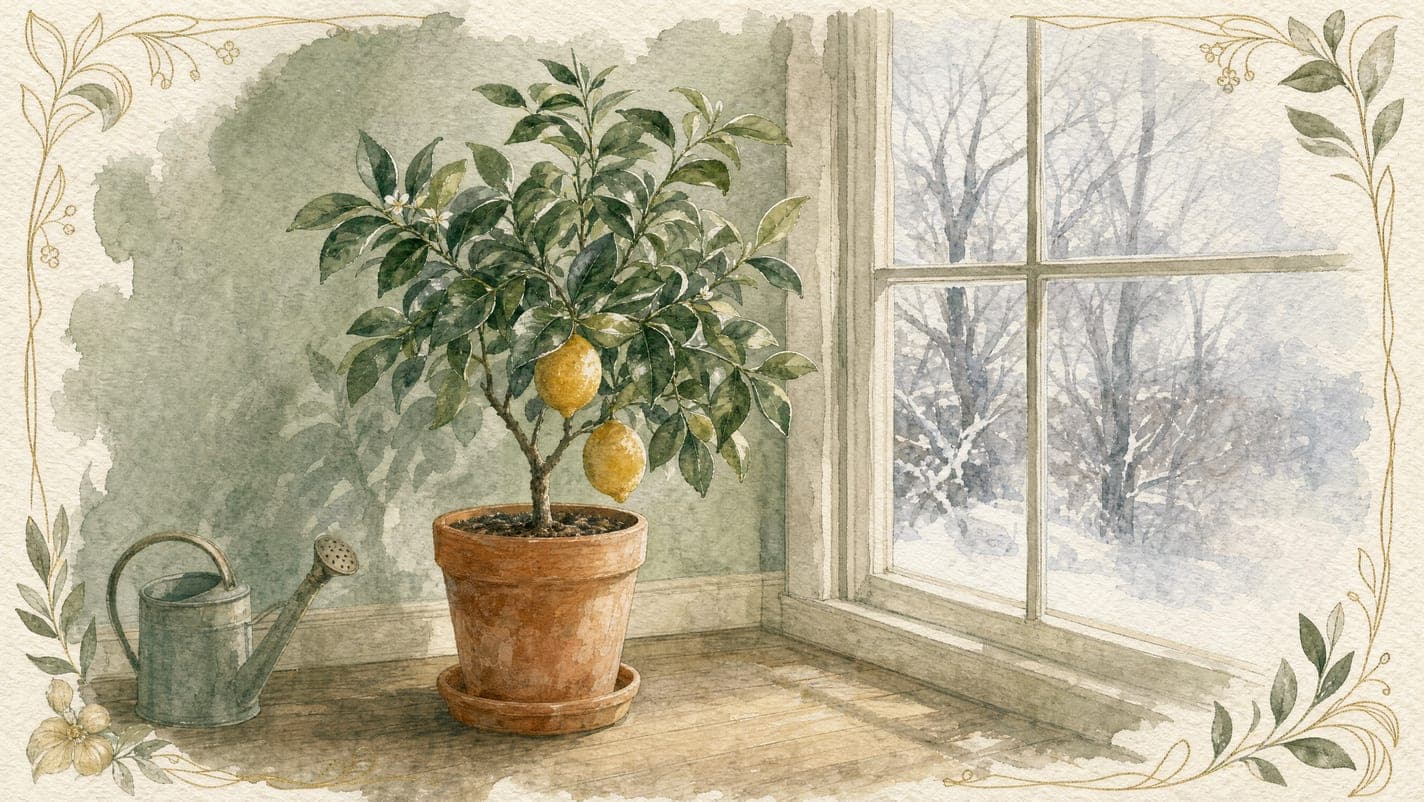
To overwinter a citrus tree indoors, give it three things: the brightest window in the house, a cool room rather than a warm one, and much less water than it drank in August. Clemson Cooperative Extension's container citrus fact sheet puts the winter target at a room with southern exposure and lots of natural light, with the temperature maintained "between 55 °F and 65 °F."
The cool part is what people get wrong. It is a citrus, so surely it wants warmth — a 70°F living room feels like kindness. It is not. A warm tree tries to grow; a cool tree waits, and a waiting tree drinks a fraction of what it drank in August. This is the potted-tree chapter of our Indoor Move guide.
When to Bring It In — and When Not to Rush
Citrus can stay out after the tropicals come in, but how much later depends on what you own. Mississippi State University Extension's container citrus publication ranks the common types from most to least cold hardy, running from kumquat, calamondin and satsuma at the top, through the oranges, mandarin, grapefruit and tangerine, down to lemon and lime at the bottom. It warns that "Lemon and lime trees are easily killed or severely damaged by freezing temperatures from the mid- to high-20s." Mandarins sit ahead of lemons and limes there; our profile of the dwarf seedless mandarin Kishu mikan covers one of them — a mandarin specifically, not a stand-in for citrus generally.
Published triggers differ, so there is no universal number. Mississippi State recommends covering or moving container citrus into protected areas when the forecast is 28°F or below; Clemson warns that temperatures below 25 °F, especially for extended periods, can cause significant damage; the Chicago Botanic Garden describes most dwarf citrus as "hardy to 30 degrees."
All three of those figures are already about citrus in containers rather than in the ground, and a root ball in a pot has less margin than one in open ground. UMass Extension's fact sheet on overwintering container-grown ornamentals says "Roots are much less cold-hardy than shoots" and that "unlike field grown plants, the roots of container-grown plants are not buffered from cold temperatures by the soil." Keep a cushion above whichever number you use, and count back from your frost date with our temperature thresholds guide.
Rushing costs you too, because light is what you cannot replace indoors. The Chicago Botanic Garden splits the difference: "In early September, move your plants from the sunny patio to a shaded outdoor spot for several weeks."
Why Citrus Wants a Cool Room, Not a Warm One
Indoors the light supply collapses; keeping the tree cool is the most direct way to make its demand fall with it.
Published ranges overlap but do not agree. Clemson says maintain "between 55 °F and 65 °F"; Iowa State University Extension gives "Plants prefer 65-85°F during the day and 55-65°F at night" and adds that "Warm temperatures are essential"; the University of Wisconsin-Madison says "Citrus grow best between 55 °F and 85 °F." So warmth is not forbidden, and the cool-end case is about growth rather than survival. Wisconsin makes it historically: the European orangeries that wintered potted citrus kept them "cool so they don't grow too much during the winter." There is a floor as well, because Iowa State says temperatures below 50°F can cause leaf loss and freezing temperatures or lower are lethal.
Warmth creates a supply-and-demand mismatch. The University of Missouri Extension's houseplant publication describes chronic low light plainly: "Plants kept continuously in poor light will have spindly shoots, few flowers, yellow foliage, poor flower color and, often, little or no growth" — and notes those effects "cannot be cured by extra fertilizer, water or repotting." A warm tree makes exactly that growth, and the pale shoots are first to yellow and drop in January.
Rooms that qualify: a barely-heated spare bedroom with a south window, an enclosed porch that stays comfortably above that 50°F floor, a bright basement window, a stairwell landing. The Chicago Botanic Garden's advice for a lemon tree is to place it "in a cool area free of drafts that receives direct sunlight" — cool but not drafty, which rules out the spot beside a door to the street, and off heat registers, which give you warm, dry and dim at once.
A monstera wants the opposite; see bringing tropical plants indoors for winter. Citrus wants the room you would not choose for yourself — and so do rosemary and bay, so overwintering herbs indoors describes the same shelf.
Light, Honestly
Citrus is the most light-hungry plant in this series. Iowa State says "A west- or south-facing window that receives at least 6 to 8 hours of direct light is often required," and Clemson lists at least 8 hours for optimum growth.
In December, in most of the country, a south window does not deliver that. Still enough to hold a tree in good condition — not enough to make one fruit. The University of Wisconsin-Madison's indoor citrus article draws the line there: "Supplemental light will be needed for fruit production if the plants do not receive at least 6 hours of direct light daily."
Supplemental light earns its keep if your best window faces east or north, or if you want flowers. For a small tree on a table, the GooingTop clamp grow light is the cheap version, about $20.99 as of October 2026. GooingTop's listing describes a 6000K gooseneck fixture with 10 red plus 74 white LEDs, a timer offering 4, 8 or 12 hour cycles, and about 10 watts of draw. Those are the manufacturer's figures, not our measurements; a 10-watt lamp on a four-foot tree supplements a window rather than replacing one. Our grow lights guide covers sizing.
Watering: This Is What Actually Kills Overwintered Citrus
Less light, cool air and almost no growth mean water use falls off a cliff. Running a July watering schedule in January is a common way to lose one. The Chicago Botanic Garden's winter rule is to water "only when the soil is dry to the touch," and Iowa State gives both failure modes in one breath: "Too much water and the roots rot. Too little water and the plant starts dropping leaves."
Check, do not schedule.
- Lift or tilt the pot. A watered root ball is much heavier than a dry one — your most reliable signal on a big container.
- Go deeper than the surface. Clemson's instruction is to check the top 2 to 3 inches of soil for moisture before irrigating. The top inch dries in a day.
- Empty the saucer. Missouri Extension's rule: "Discard water that remains beneath the pot one hour after watering."
Large pots are the specific trap. A 14- or 16-inch container stays wet at depth long after the surface feels dry, and a barely-transpiring tree is not drawing it down. The cooler the room and bigger the pot, the longer the interval — two or three weeks is plausible in midwinter.
Early root trouble reads like thirst: limp foliage that does not recover after watering, yellowing inside the canopy, soil staying dark for days. Wisconsin notes that "Cupped or yellowed leaves can be a symptom of excessive watering." Stop watering, do not fertilize, and read our root health guide before repotting anything.
Humidity, Briefly
Clemson pairs its light figure with 30% to 60% humidity for optimum growth, and Missouri Extension names the obstacle: "Air in most modern homes is extremely dry during the winter. A furnace or room humidifier can help plant growth." Missouri also credits watertight trays of constantly moist sand or gravel, and says 40 to 60 percent relative humidity is best for most plants but difficult to attain indoors. Its only word on misting is that misting the leaves daily "can help a plant overcome the stress of low humidity" — a humidifier or a gravel tray is what it reaches for first. See our humidity guide.
Citrus Leaf Drop Indoors: Normal Versus Not
Some leaf loss in the first weeks after the move is a response to the light drop, not a verdict on your care. Wisconsin puts it generally: "drastic environmental changes can also cause leaves, flowers and young fruit to drop." Do not react by watering more. The full differential belongs to our guide on why plants drop leaves after coming inside. Citrus has three tells of its own:
- Sudden, heavy drop across the whole tree points at a watering extreme or cold exposure rather than acclimation. Iowa State pairs root rot with too much water and leaf drop with too little, and says below 50°F can cause leaf loss.
- Flower and fruit drop have separate causes, covered below — the Chicago Botanic Garden's short version is that "Overly dry air will cause them to drop their flowers."
- A cold draft, from a door or a pane the leaves touch, is common and fixable. Cool room, yes; cold blast, no.
Scale on Indoor Citrus — Plus Mealybug and Spider Mite
Dry winter air makes indoor citrus an ideal host. Wisconsin names the regional suspects: "The most common pests on citrus trees in the Midwest are brown soft scale and two-spotted spider mite," with aphids, mealybugs and whiteflies occasional.
Scale reads as bumps, not insects. Minnesota Extension describes adults under waxy shell-like coverings, "Round, oval or oyster shell-shaped, 1/16 to 1/8 inch in diameter," on stems and leaf undersides, especially along the mid-veins. They do not move, and stickiness arrives first: Clemson's citrus insect fact sheet notes that "when a scale infestation is heavy, black sooty mold can grow on the clear, sweet, sticky honeydew (the sugary waste product resulting from scale feeding on plant sap)."
Mealybug is the white cottony one — Minnesota: "White, powdery, waxy secretions cover their bodies," found along leaf-underside veins and where leaves join stems. Spider mite shows damage first: Clemson describes "light-colored, scratched, or bleached areas, known as stippling," with heavy infestations adding webbing at the ends of upright branches. Minnesota explains the seasonality — "Spider mites thrive in dry, warm conditions" — which describes a citrus beside a radiator.
Inspect on the patio in September, because a six-foot tree cannot go in the shower in February. The Chicago Botanic Garden: "Check your plants thoroughly for insects before bringing them indoors." Work undersides, axils, midribs and trunk — our pre-move debugging routine has the rest.
Horticultural oil, and how to use it
Colorado State University Extension's horticultural oils fact sheet explains the mechanism: "Most importantly, they block the air holes (spiracles) through which insects breathe, causing them to die from asphyxiation." So coverage is everything — Clemson says to spray until the oil runs off the upper and lower leaf surfaces, twigs, branches and trunk, and Wisconsin notes that "multiple applications are usually required to achieve control."
The restrictions below belong to horticultural oil specifically — insecticidal soap has its own, different ones (Minnesota warns not to mix homemade soap products, as this can burn plants), and our pest treatment comparison sets the options side by side.
- Clemson says oil sprays can control scales when temperatures are between 45 and 85 °F; Colorado State says not to apply when temperatures are excessively high (above 100 degrees F) or low (below freezing). The windows differ; your label governs.
- "Do not spray in direct sunlight or if rainfall is expected within 24 hours," and "Do not spray citrus that are in bloom." (Both Clemson, for oil.) Indoor citrus often flowers in winter, so the second one bites.
- "If citrus fruit are present on the plants, apply horticultural oil no stronger than 3 tablespoons per gallon of water," with 2.5 tablespoons per gallon for tender new growth. Colorado State's warning about damage to stressed plants is specifically about drought stress, so water the tree properly a day before you spray rather than treating one that is already dry.
Two 16 oz products we would consider:
- Monterey Horticultural Oil, about $18.61 as of October 2026. Monterey's listing names citrus among the plants it is for and scales among the pests, and says it is OMRI Listed for Organic Gardening.
- Bonide All Seasons Horticultural and Dormant Spray Oil, about $9.98 as of October 2026, the cheaper option. Bonide's listing gives the active ingredient as refined mineral oil, approved for organic gardening, and says the oil kills by smothering insects.
Pick on price; we have tested neither. Whichever you buy, follow the label directions on the bottle in your hand and test a single leaf first before doing the whole tree.
The label is the authority on a plant you eat from
The label states whether a product may be used on edible citrus and what pre-harvest interval applies. Clemson's citrus fact sheet reduces it to one line: "Use pesticides only according to the directions on the label." Intervals vary by product — Clemson's table lists 0 days for horticultural oil and insecticidal soap, 1 day for spinosad and 7 for malathion — so look yours up rather than assuming. We will not tell you any fruit is fine to eat. And never use a systemic insecticide on a citrus you intend to eat from: a listing title describes marketing, the active ingredient describes chemistry.
Stop Feeding Until Spring
Citrus is a heavy feeder — in season. The Chicago Botanic Garden describes citrus as heavy feeders of a high-nitrogen, acid fertilizer during the growing season, which is why people keep feeding into November. Its winter instruction is one sentence: "Do not fertilize during winter." Minnesota agrees: "Fertilize the plant only when it is actively growing, usually April through August or September." Fertiliser cannot buy growth that light is not paying for.
Resume on the plant's schedule: the Chicago Botanic Garden says to fertilize with an acid-balanced fertilizer every two weeks beginning in late winter or early spring, as active growth begins. Our fertilizing guide has rates.
Flowers and Fruit Indoors
The tree is not dormant. Wisconsin is explicit that "Citrus trees do not go dormant like many other plants, so they need sufficient light and some humidity during the winter" — growth slows, it does not stop. Fruit is slow too: Wisconsin's figures are that "most lemons and limes ripen in six to nine months, while oranges take about a year," so green fruit that came in during October is a long project, not a December harvest.
Winter flowering happens, and flower drop with it — dry air is the cause the Chicago Botanic Garden singles out, and Wisconsin adds that "Potted trees often set much more fruit than the tree can support, so fruit drop is very common." Wisconsin notes that most citrus does not require cross pollination to be productive, so a single plant will set fruit indoors — Iowa State is less certain, saying not all citrus will set fruit without the assistance of pollinators; Minnesota's assist is to "Shake the flowers gently or flick them with your fingers to spread pollen from flower to flower." Both Iowa State and Wisconsin tie flowering to a day-to-night swing of about 5 to 10 degrees F, which a cool room provides and a thermostat does not.
Moving It Back Out in Spring
Leaves grown behind glass all winter are not ready for May sun. Wisconsin is blunt about it: "Leaves will sunburn if moved too quickly from low light conditions in a house to full sun."
- Wait for the night temperature. Wisconsin: "Once temperatures are consistently above 50 °F, citrus trees can be moved outdoors for the growing season."
- Stage the light. Wisconsin recommends acclimating "over a period of one to two weeks, gradually moving from a sheltered, partly shaded spot into full sun." Minnesota's version is the shade of a tree or the north side of the house for the first several days.
- Repot on its own cycle, and resume feeding as growth resumes. Clemson notes that, depending on the species, container citrus will need repotting into a larger container every three to five years.
Our guide to putting plants back outside in spring has the rest of the schedule.
Frequently Asked Questions
What does Meyer lemon tree indoor winter care look like in practice? The same regime as any potted citrus: brightest window available, the 55 to 65 °F bracket Clemson gives, no fertilizer, and water only when the top 2 to 3 inches of mix are dry. Clemson calls Meyer "a hybrid variety that is slightly sweeter and easier to grow for the home gardener," though Mississippi State ranks lemons near the cold-sensitive end.
Is citrus leaf drop indoors normal? Some is. Wisconsin attributes leaf, flower and young fruit drop to drastic environmental changes, and a patio-to-window move is exactly that. Heavy, sudden drop usually traces to a watering extreme or cold exposure.
How do I handle scale on indoor citrus? Follow the stickiness: honeydew, then sooty mold, then immobile bumps on stems and midribs. Horticultural oil is standard because it kills by blocking the spiracles insects breathe through, so covering both leaf surfaces and repeating the spray are what make it work. Follow the label directions, test one leaf first, and respect Clemson's citrus limits: no stronger than 3 tablespoons per gallon with fruit present, and nothing on a tree in bloom.
How often should I water overwintering potted citrus? There is no number, and that is the point. A large pot in a cool, dim room can go two or three weeks; the same pot in a warm sunroom might want water weekly. Judge by the weight of the pot and the moisture 2 to 3 inches down — and if your only bright window sits in a heated living room, drop the thermostat at night.
The One-Line Version
Cool, bright, drier than feels right, unfed until late winter, and inspected for scale before it crosses the threshold — that is how to overwinter a citrus tree indoors. The rest is restraint. For the timing that governs the whole collection, see moving potted plants indoors for winter.