This guide contains affiliate links. We may earn a small commission if you purchase through our links, at no extra cost to you.
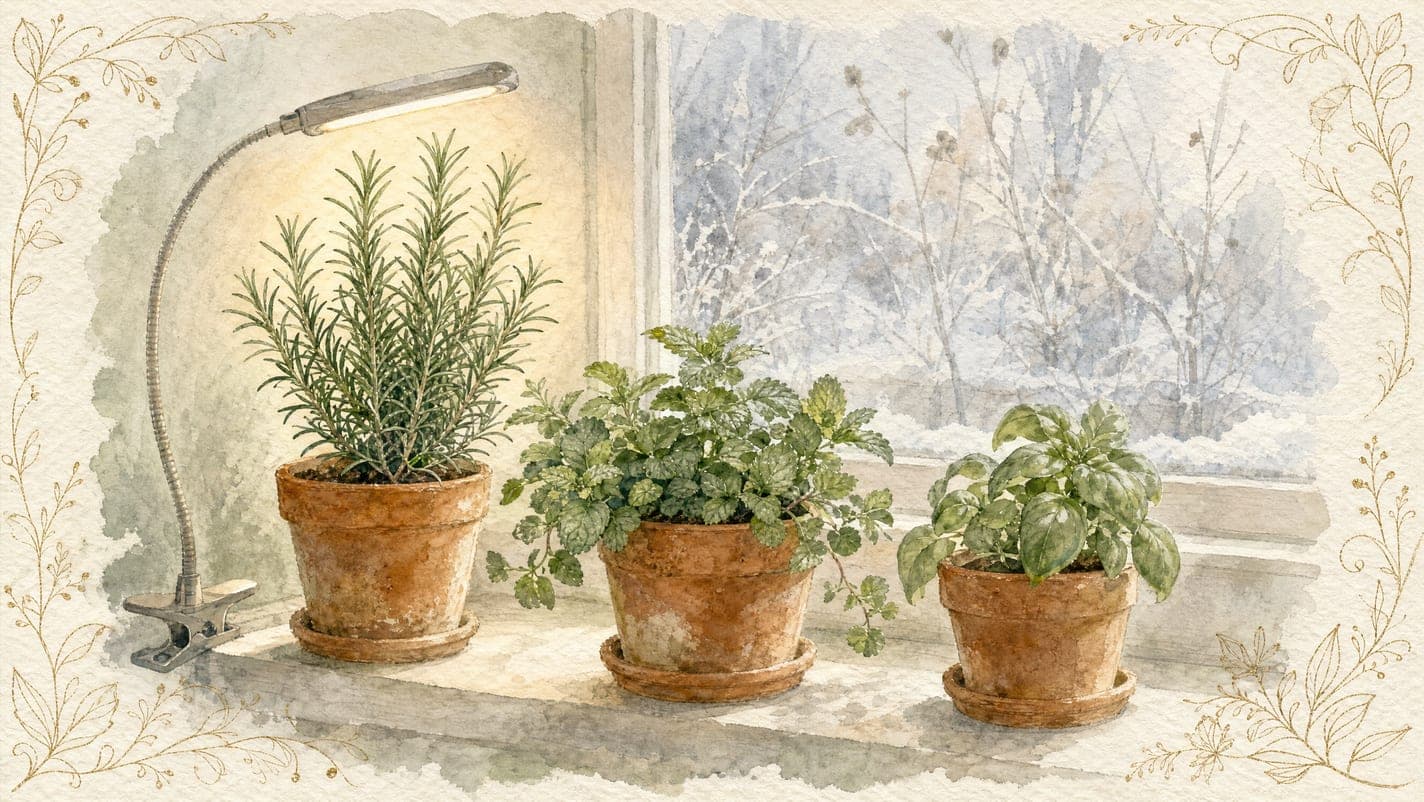
One of these three is worth your time, one does not need you, and one you should replace rather than rescue. Rosemary is worth real effort, and it needs genuine light. Mint is hardy enough that in most of the country it does not need bringing in at all. Basil is a tender annual already ending its life cycle.
That hierarchy is where most advice on bringing plants inside for winter quietly cheats — it implies every herb overwinters happily on a windowsill. Missouri Botanical Garden says of rosemary flatly: "Rosemary is often a difficult plant to overwinter indoors." Knowing why is what lets you fix it. Patio ornamentals follow different rules (overwintering tender perennials); the deadline itself is in when to bring plants inside.
Why Rosemary Dies Indoors
Penn State Extension classifies rosemary as a "Tender perennial evergreen shrub" that wants "Full sun; light, well-drained soil, sandy or gravelly." A heated winter room contradicts almost every word of that, in four ways.
The light deficit is structural
Iowa State University Extension puts it plainly: "Light is typically the most limiting factor to successfully growing herbs indoors." Its winter-specific target is "four to six hours of direct sunlight a day," while its general indoor-herb guide sets the bar higher — "Most herbs need around eight hours of direct light each day when grown indoors" — and it singles out rosemary, thyme and bay laurel as species that "may need supplemental light."
Penn State groups rosemary with bay and thyme as herbs that "do best in direct sunlight," and Illinois Extension's Ryan Pankau specifies "full sun (greater than 6 hrs per day of direct sunlight)." An average winter window in the northern half of the US does not deliver that for months. You get Penn State's symptom for any under-lit herb instead: plants "will become thin and spindly, produce smaller leaves, and have a reduced aroma."
Watering kills it from both directions
Rosemary is drought-adapted — Missouri Botanical Garden notes "Established plants have good drought tolerance" — so people underwater it. The same source is unambiguous that wet is worse: "Wet, poorly-drained soils in winter are usually fatal." Penn State agrees that "Overwatering causes root rot, which can be deadly outdoors and especially in pots overwintered indoors," and gives the tell: "Browning of tips is a sign of root rot." Missouri Botanical Garden defines the narrow window precisely: "Let soil dry out between water applications (dry on top, but not dry throughout)."
Here is the asymmetry that matters most. A pothos that wilts from thirst is usually fine an hour after you water it. Rosemary does not reliably work that way — growers very commonly report that one allowed to go bone dry browns and stays brown, and no extension source we found promises it will bounce back. The published advice is written to avoid ever getting there: Iowa State waters herbs "before the plant begins to wilt," and Minnesota Extension's rule is "do not allow plants to wilt." Treat a wilted rosemary as a possible one-way door, not a warning shot. Our root health guide covers telling a dry root ball from a rotted one.
Still air, not dry air, invites powdery mildew
Powdery mildew is the classic indoor-rosemary disease, and the sources point at air movement rather than dryness. Penn State: "Rosemary is prone to developing powdery mildew and root rot. Ensure adequate airflow between plants to prevent powdery mildew." Missouri Botanical Garden is more specific — "Rosemary is susceptible to powdery mildew, particularly in humid conditions when air circulation is poor" — and recommends overwintering the pot "in a sunny, humid but cool room with good air circulation." Dry heated air is a different problem, and Penn State names both halves: too little humidity dries leaves out, too much invites root rot and fungal disease. Our plant diseases guide shows what mildew looks like against the other winter leaf problems.
It wants a cool room, and your house is warm
Sources differ, so here is the range. Penn State's general indoor-herb guidance is a normal room — "at least 65 to 70°F during the day and 55 to 60°F at night" — and Iowa State says simply that "The typical temperatures found indoors are ideal for herbs."
Rosemary is the exception both of those hide. Writing on Illinois Extension's Garden Scoop blog, Ryan Pankau says "We typically keep our homes a little too warm and too dry for rosemary," and that the goal is a spot with "cool temperatures (around 50-60 degrees) and very bright sunlight." He suggests "a sunny basement window" as the ideal, and reports failing himself to find a location cool enough with sufficient sunlight.
Cool rooms are usually dim; bright rooms are usually warm. A cool bright room is also the right room for overwintering citrus indoors, which wants the same conditions.
How to Actually Succeed With Rosemary Indoors
Move the pot early — Penn State brings rosemary in "2 to 3 weeks before the first frost date in the fall" — and treat the indoor stretch as storage, not growth.
- Pick the spot before you carry the pot in. Missouri Botanical Garden: "Best indoor location is in a sunny southern window." Cool-and-bright beats warm-and-bright.
- Use terracotta. Penn State notes "Clay pots permit rapid drying"; Iowa State says clay or terracotta "are porous and dry out more readily."
- Water by weight, not by schedule. Learn the pot's freshly-watered weight and its weight a week later.
- Keep air moving and do not crowd the pot — Penn State wants "adequate airflow between plants."
- Do not fertilize. Iowa State is explicit: fertilize herbs "in early spring through summer and avoid fertilization during the winter months."
- Do not repot on arrival. Penn State puts the best repotting time in early spring, and Iowa State warns that containers "that are too large stay wet too long." Our soil selection guide covers the spring repot.
Supplemental light is the one justified purchase
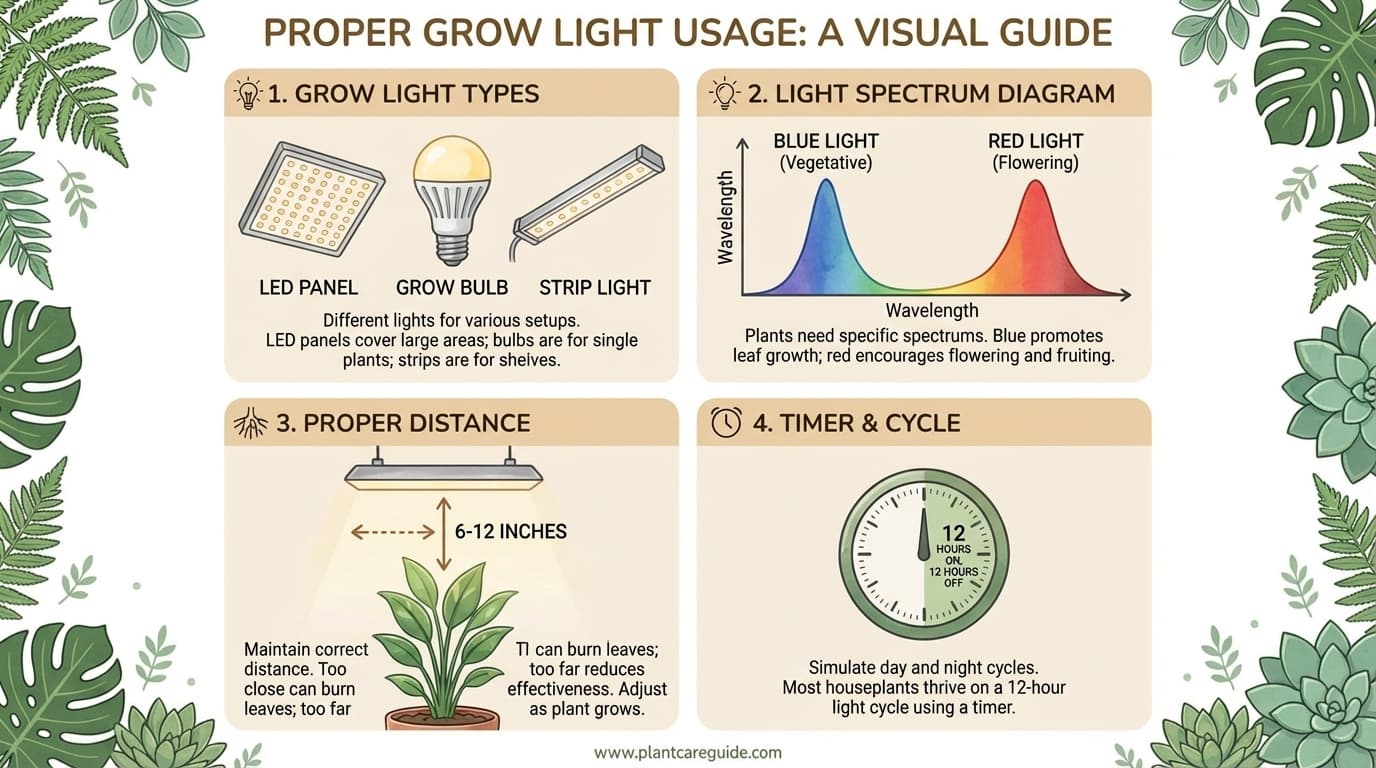
Missouri Botanical Garden makes the call for you: "If at least 6 hours of sun per day cannot be provided indoors, then use of supplemental lighting (grow lights) should be considered." Iowa State gives the setup numbers — "Place lights within 6 to 12 inches of the leaves," on a timer "for 12 to 16 hours a day for ideal growth."
Pick by scale:
- One pot, one windowsill. A clamp-on gooseneck like the GooingTop Grow Light (about $20.99 as of October 2026). GooingTop lists 10 red plus 74 white LEDs at 6000K, a timer with 4, 8 or 12-hour options, and a draw of about 10 watts.
- Three or four pots at once. The LEOTER 4-head grow light (about $23.99 as of October 2026) is listed by LEOTER with 80 LEDs across a 380 to 800nm full spectrum, a 3/9/12-hour timer, 10 dimmable levels and four gooseneck arms on one clamp.
Neither timer reaches 16 hours, so a separate plug timer is the way to the top of that range. Our grow lights guide covers fixtures and placement.
Rosemary Hardiness: A Better Option for Some Readers
If your rosemary can stay outside, the indoor problem disappears — and the sources do not fully agree on where that line sits. Penn State and Missouri Botanical Garden both put the species at USDA Plant Hardiness Zones 8 to 10, while Ryan Pankau, writing on Illinois Extension's Garden Scoop blog, describes it as "typically hardy to zone 7 in the US." Cultivars push further: Penn State lists 'Arp', 'Athens Blue Spire', 'Madalene Hill' and 'Miss Jessop's Upright' as "Hardier (to zone 7 or 6b with protection)," and Pankau names "'Arp' and 'Hills Hardy' (also known as 'Madalene Hill'), noted to be hardy to zone 6." Look up your own zone rather than translating these into temperatures.
The site matters as much as the number. Pankau's Garden Scoop post advises "a site that is protected from weather extremes, like a spot along a sunny, south facing wall," and Missouri Botanical Garden's warning about winter wet applies outdoors too. A zone-7 cultivar in heavy clay is a worse bet than a borderline one in gravel.
Mint: You Probably Do Not Need to Rescue It
Mint is a hardy herbaceous perennial, and that one fact removes most of the work. NC State Extension lists spearmint (Mentha spicata) as a herbaceous perennial for USDA zones 4a through 9b that "spreads by rhizomes," and University of Wisconsin-Madison Extension puts pineapple mint at zones 5a to 9b. Utah State University Extension calls mint "a rapid growing perennial herb" and says to "cut each plant back to the ground to discourage pests and diseases" before winter.
That is the whole protocol. The top dies, the rhizomes hold on, it comes back. Hauling the pot indoors to save a plant that is not in danger is wasted effort.
The legitimate reason to bring some in is that you want fresh mint in January. Do that with a piece, not the plant: a September outdoor mint is root-bound, enormous and carrying passengers, while a division or a rooted cutting in fresh mix is none of those. Wisconsin notes that apple mint is "easy to propagate at any time during the growing season from rhizomes or by rooting stem cuttings in water or moist potting medium."
Expect a compromise indoors. Iowa State lists mint among the best herbs for indoor growing and one that "will tolerate a little less light," but also notes "Many indoor-grown herbs are not as strong or as intensely flavored compared to those grown outside." Stretched growth is the other tell: per Iowa State, "If long, lanky growth is noticed, more light may be needed."
Basil: Replace It, Do Not Rescue It
Readers underestimate how cold-sensitive basil is. Penn State classifies it as "Annual; hardy only in warmer climates" and warns that basil "cannot survive temperatures lower than 50°F and should not be kept on windowsills during winter months." Frost is not the threshold — 50°F is, which makes a frost-free October patio night and a draughty January sill both real risks.
The deeper problem is life stage. University of Minnesota Extension is direct: even if you dig the plant up, "As annuals, basil plants will flower and die eventually, even indoors." Penn State adds that "Leaf flavor declines after bloom." A mature, flowering September basil is not a houseplant in waiting.
So reframe the job from rescue to replacement:
- Take cuttings in late summer, before the plant is spent. Penn State's basil profile: "Cuttings are easily rooted in water." Grow them on under light — Minnesota suggests artificial light "for 10-12 hours daily since indoor light will not be enough during the darker winter months." Our propagation methods guide covers technique.
- Or start seed in sequence. Iowa State: "Annual herbs can be grown by seed throughout the winter months. Stagger seedings to always have new plants ready to harvest."
- Or buy a pot in February. This is the one herb where the supermarket is a rational answer.
What About Thyme, Oregano, Sage, Chives, Parsley and Bay?
- Thyme — hardy. Penn State gives it USDA zones 5 to 9 as a perennial, so in much of the country it stays out.
- Oregano — hardy. Penn State: "a perennial that thrives in USDA Plant Hardiness Zones 5–8."
- Sage — hardy. NC State lists Salvia officinalis as a perennial for zones 4a to 8b. Iowa State puts it in the second-tier group indoors, citing "higher than normal light requirements and/or significant pests (like spider mites)."
- Chives — the easiest win. Wisconsin Extension calls chives "hardy to zone 4a" and notes "Small clumps can be potted up and moved indoors in the fall to grow in a bright windowsill through the winter." One caution: chive foliage, per Wisconsin, "is killed over the winter" in cold climates, and growers commonly report that a clump given a few weeks of cold before forcing does better than one kept warm all year — a pot that yellows back in December may be resting, not failing.
- Parsley — NC State lists it as a biennial, so it is on a two-year clock regardless. Iowa State ranks it among the best herbs for indoors and one that tolerates lower light.
- Bay — not hardy in most of the country. NC State gives Laurus nobilis zones 8b to 10b, and Iowa State says it "may need supplemental light" indoors.
The Pest and Soil Problem With Outdoor Herb Pots
Herbs that were outside all summer come in with passengers. Penn State's rosemary profile is specific: "Thrips, aphids, whiteflies, mealy bugs, and spider mites may be a problem indoors." Missouri Botanical Garden notes these are "less of a problem on outdoor plants" — the January infestation usually began as a few September survivors. Our plant debugging protocol has the step-by-step.
The soil half is easier to miss. A pot that drained fine on a windy July patio can stay wet for a fortnight in a cool room — the condition Missouri Botanical Garden calls "usually fatal" for rosemary. Minnesota Extension: "Avoid soggy soil. Constant moisture encourages root rot, especially indoors."
On spraying anything: these are plants you intend to eat, so the product label is the authority, not us. It is the legal document stating whether a product may be used on edibles at all and what pre-harvest interval applies. Penn State is cautious even about soft options: neem oil or a Bacillus thuringiensis product "can be used (following all label directions) in extreme cases, but this is not typically recommended as herbs are meant to be regularly harvested and eaten fresh," and it adds "Always wash leaves before you use them in a recipe." We name no treatment for an edible herb, and never a systemic insecticide in a home with pets. If an infestation needs chemistry, binning the plant is often cheaper.
FAQ
Why does rosemary die indoors? Four things stack up: not enough light, a watering window too narrow to hit on a schedule, still air that invites powdery mildew, and a warm room. Illinois Extension's Ryan Pankau names the conflict — homes are "a little too warm and too dry for rosemary," while the plant wants "cool temperatures (around 50-60 degrees) and very bright sunlight."
Is overwintering mint indoors worth it? Usually not, if the goal is saving the plant. Mint is a hardy herbaceous perennial — NC State gives spearmint zones 4a to 9b — so it dies back and returns from its rhizomes. Cut it back and leave it out. Bring in a division or a rooted cutting only if you want fresh leaves in midwinter, and expect weaker flavour.
Can I keep my basil plant alive through winter? Not reliably, and that is not your fault. Minnesota Extension notes that even brought inside, "basil plants will flower and die eventually, even indoors." Root cuttings in water in late summer, start seed, or buy a fresh pot in February.
The Short Version
Spend the effort on rosemary: coolest bright room you have, supplemental light on a timer, water by weight so the root ball never goes bone dry and never sits wet, air moving, no fertilizer, no repotting until spring. Check your zone and cultivar first: leaving it outside beats every indoor setup. Cut the mint back and walk away. Take basil cuttings or plan to re-buy.
If the rest of your collection is still on the patio, the full sequence is in our guide to bringing plants indoors for winter.