This guide contains affiliate links. We may earn a small commission if you purchase through our links, at no extra cost to you.
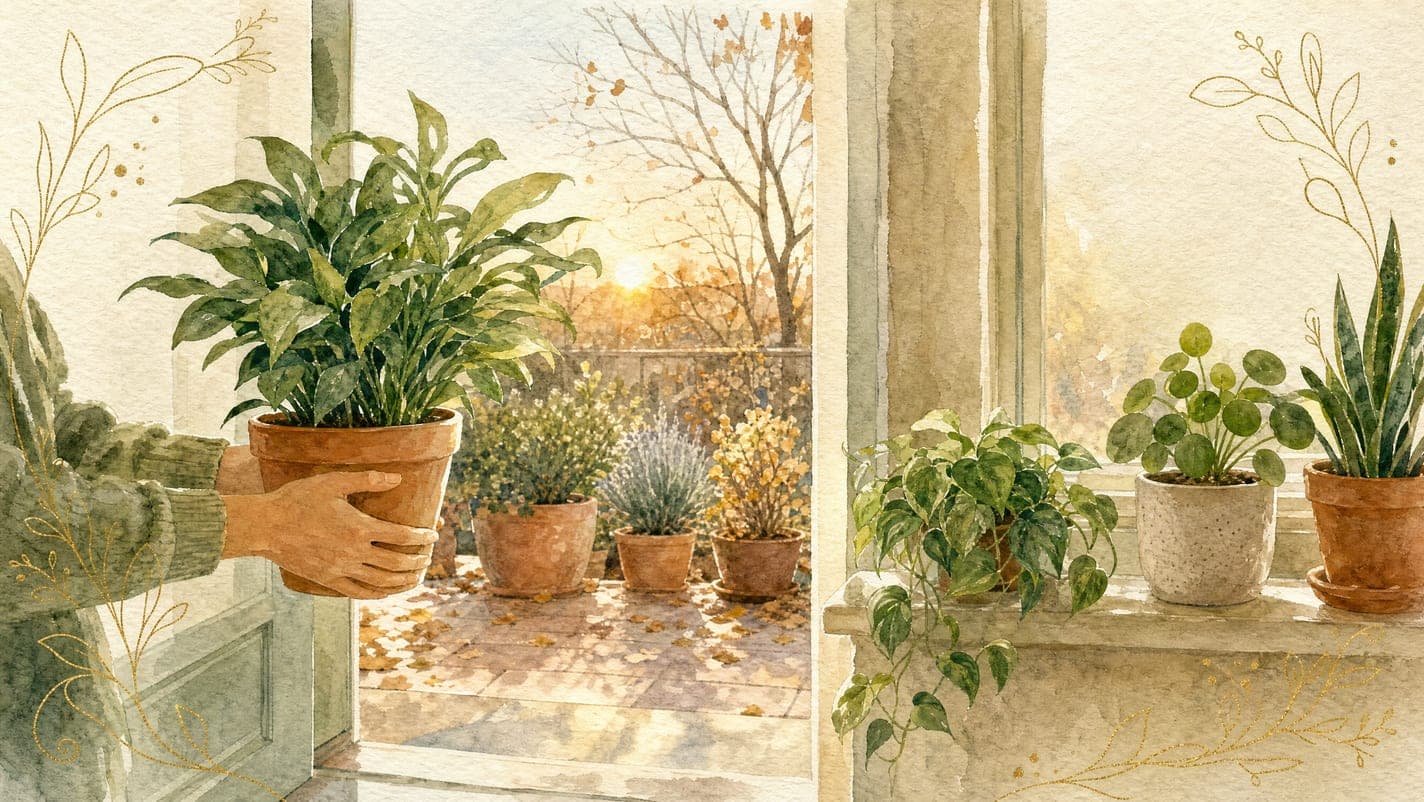
You can put your plants back outside once two things are both true: your last frost date has passed, and night temperatures have settled. Then give every plant one to two weeks in full shade before it sees any direct sun. The thing that ruins plants on this move is not cold. It is sunburn, and sunburn does not heal.
That ordering matters more than anything else here, because spring is the dangerous half of the round trip. Our guide to bringing plants indoors for winter covers the autumn half, which usually costs you a pile of dropped leaves. Going the other way, in April, can take every leaf a plant owns in one afternoon.
Going Out Is More Dangerous Than Coming In
Coming inside, a plant loses leaves it can regrow. Going outside, it loses leaf tissue that is simply dead.
The arithmetic explains why. Illinois Extension rates a high or bright indoor position at about 300 foot-candles, and says that "Outdoors, the amount of sunlight that is cast may be 10,000 to 12,000 foot-candles." Your best window is a thirtieth to a fortieth of open sun, and a plant that spent five months there built its leaves for the small number. Iowa State University Extension states the consequence flatly: "Never move houseplants from indoors into full sun. Leaf burn, discoloration, and drop can occur."
Coming indoors, a plant has an escape route: it trades sun leaves for shade leaves, which is the subject of our guide to acclimating plants from outdoor to indoor light. Going outdoors there is none for a leaf that has already cooked. One rule, then: shade first, for longer than feels necessary. Our light requirements guide covers reading your own window.
When Can Indoor Plants Go Outside? The Two Timing Gates
Two gates, and both have to be open. Most people check the first and skip the second.
Gate one: your last frost date, looked up rather than guessed
An average last-frost date is a statistic, not a promise. According to NC State Extension's explainer on the National Centers for Environmental Information freeze and frost tables, the data comes at "nine probability levels in increments of 10" — 10% through 90%. The date usually published as an average last frost is the 50% one — a median, which means the last frost lands later than that date in roughly half of years.
So look yours up rather than trusting a month name. University of Maryland Extension, which points readers at zip-code frost tables "derived from the 1991–2020 U.S. Climate Normals from NOAA," puts it bluntly: "Avoid the temptation to put tender annual plants in the ground too early."
Gate two: nights that have actually settled
Frost is not the only cold injury. Tropical foliage plants take damage well above freezing, which is why extension sources set a night-temperature threshold rather than a date. They disagree on the number, and the spread is the useful part:
- 50°F. Iowa State University Extension says to "wait until nighttime temperatures are consistently and reliably above 50°F before moving houseplants outdoors," adding that "In much of Iowa, this is mid to late May."
- 55°F. Purdue University's consumer horticulture program frames it as a plant trait: "Most houseplant species originated in the tropics and are sensitive to temperatures below 55 degrees Fahrenheit."
- 60°F. Clemson Cooperative Extension is most conservative: to be safe, wait until spring temperatures moderate and consistently exceed 60°F at night. University of Minnesota Extension sets the same bar for the last step — "Leaving houseplants outdoors permanently can occur when night time temperatures are constantly around 60 degrees."
Our working rule is 55°F for the collection, and settled 60°F nights before anything stays out permanently. Our guide to when to bring plants inside collects the figures for cold damage above freezing in the other direction. The word doing the work is settled — one warm week in April is not spring.
So your collection does not all go out on the same day. Tough foliage plants like pothos and a snake plant clear both gates first; tender tropicals wait. Anything stored dormant waits longest and moves slowest — Iowa State gives 2-3 weeks of gradual light for a plant overwintered as a houseplant, and for one stored dormant, "Gradually transition to brighter light over 2-4 weeks and plant outdoors after frost." A plant that wintered in a dark basement may have no leaves at all, only soft pale growth that has never seen sun. Our guide to overwintering geraniums, hibiscus and mandevilla covers waking those up.
Hardening Off Houseplants in Spring: A Two-Week Schedule
Hardening off comes from vegetable transplants, not houseplants. University of Maryland Extension's definition, written for seedlings, is the clearest: "Hardening is the process of exposing transplants (seedlings) gradually to outdoor conditions," done over the one to two weeks before planting out, with plants set in "a shaded, protected spot on warm days." Maryland frames the purpose as a shift from soft growth to firmer growth — which is what five months in a window leaves you needing.
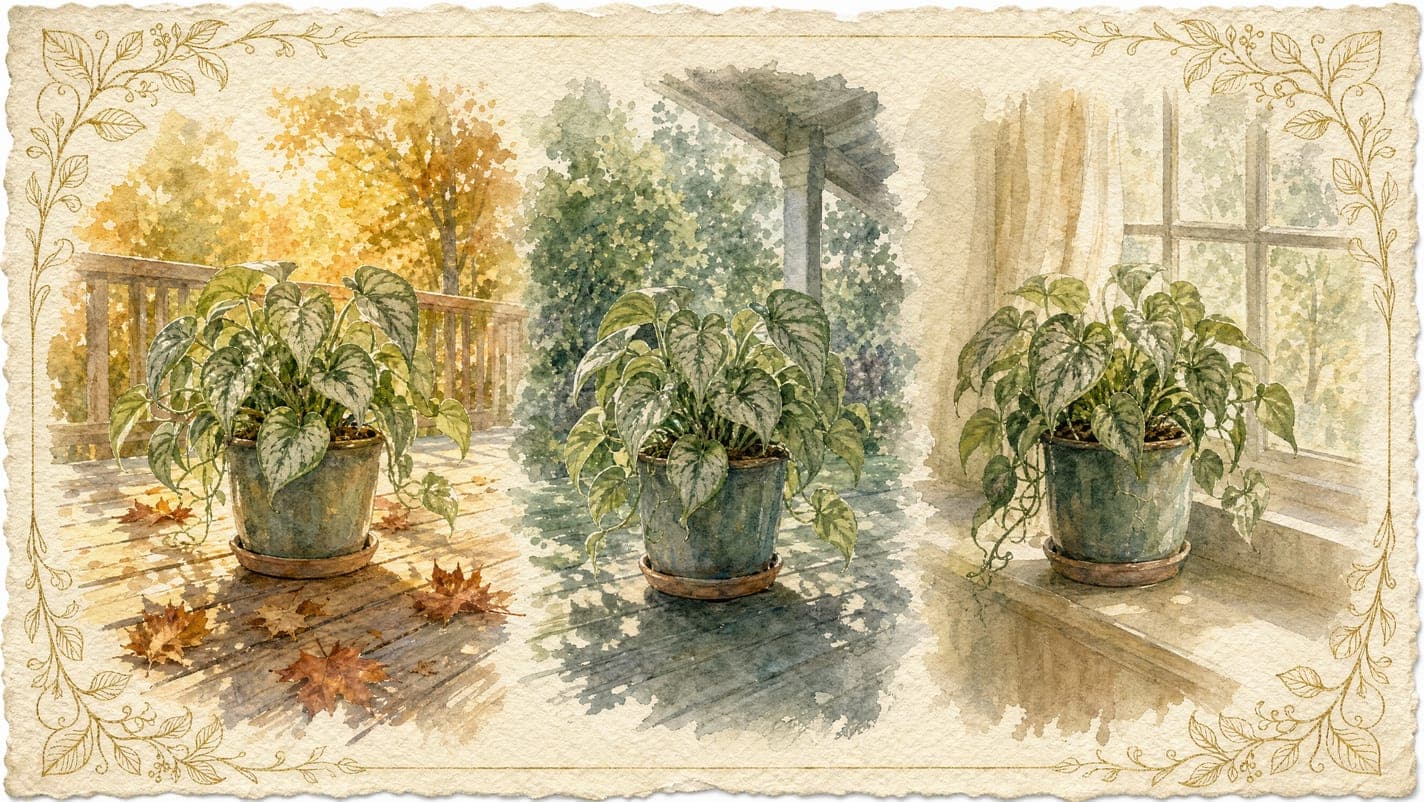
For houseplants, extension guidance gives the shape but not the hours. Iowa State says to move a plant from indoors to "a full-shade location outside," then "introduce more light over 10 to 14 days," noting that "Nearly all houseplants are tropical understory plants." Clemson has you start in "deep shade under a tree for a few days" and move into brighter sunlight from there.
The day-by-day plan below is ours, not a citation. It fits inside Iowa State's 10-to-14-day window and Maryland's one-to-two-week principle.
- Days 1 to 3: two or three hours in full shade, then back inside. Full shade means a north-facing wall, under a patio table, or under a tree — not "a shady corner that gets sun at four o'clock."
- Days 4 to 6: half a day in full shade. Still shade, still coming in overnight unless the forecast is comfortably above threshold.
- Days 7 to 10: full days in full shade, plus the first night outside once nights have settled.
- Days 11 to 14: add direct sun in one-hour steps, mornings only. One hour of early sun, then two, then three, with the plant back in shade the rest of the day.
- Week three onward, sun-destined plants only: extend the morning sun, never the afternoon. Purdue's ceiling holds all season — "houseplants outdoors should receive no more than a half-day of morning sun."
Overcast days are a gift. On a flat grey day, leave a plant out twice as long as the schedule says and bank the acclimation for free.
A cold night mid-schedule means the plant comes in. Clemson's instruction is to take plants in if an unexpected cold night is predicted. Interrupting costs you nothing; a 40°F night sits inside the range where Iowa State University Extension reports that several species of indoor plants see damage below 45°F, and a half-hardened monstera has no margin to spare.
Shade-hardening is not sun-hardening. This is the mistake that undoes two careful weeks: a plant that sat in deep shade for ten days is hardened to deep shade. Direct sun is a separate adaptation with its own increments, which is why the first hour of morning sun counts as a brand-new exposure rather than a graduation.
If you have nowhere shaded to stage them
Shade cloth builds a staging area where none exists. TrekXGD lists a 40% shade cloth in 3x6 ft at about $11.99 as of October 2026, enough for a few pots, and the 8x10 ft size at about $17.99 as of October 2026 for a patio. Both are listed by TrekXGD at 40% shade, and that is all we will say about them, because our product data says nothing else.
The honest version: an old bedsheet, the north side of your house, or the shade of a tree works just as well and costs nothing. Clemson's own instruction is literally "deep shade under a tree." Buy cloth only for a bare south-facing balcony with no alternatives.
Sunburn on Houseplants Outdoors: Bleached Patches That Never Green Up
What it is. The UC Statewide IPM Program's note on sunburn in garden flowers defines it as "damage to foliage and other herbaceous plant parts caused by a combination of too much light and heat and insufficient moisture," and gives the progression: "A yellow or brown area develops on foliage, which then dies beginning in areas between the veins." Purdue describes the houseplant version as "turning the leaves yellow or white and eventually brown."
Where it shows. On the most exposed leaves first — upper surfaces at the top of the plant, and the side that faced the sun. UC IPM's houseplant problem list names "Excess light (sunburn) associated with a recent move of the plant" as a cause of leaf spots and blotches. Growers commonly report the patches surfacing a day or two afterwards.
Why it is permanent. UC IPM's one note on recovery is conditional, and the condition is the point: "Appropriate irrigation before discolored leaf tissue is killed can usually restore the green color to sunburned foliage." Before it is killed. After that the tissue is dead, and the plant replaces the leaf rather than repairing it.
Succulents burn too, and their owners are the most surprised. University of Minnesota Extension is explicit: "If houseplants are exposed to direct sunlight immediately, the leaves will often burn, this is true for succulents too." An aloe or a jade plant content in full sun in August will still scorch in May.
If it has already happened: move the plant back to full shade and restart the sun portion from zero. Leave the damaged leaves on unless they are fully dead and dry — a scarred leaf still photosynthesizes around the dead patches and shades the stem beneath it. Keep watering normally, since UC IPM's advice is "providing shade and proper cultural care, especially adequate irrigation" and a plant short of water burns worse. Do not fertilize to fix it. Our brown leaf tips guide separates scorch from the other things that brown a leaf.
Wind Is the Other Half, and Nobody Warns You
Light gets all the attention. Wind does much of the actual damage, to plants that would have handled the light fine.
Indoor growth is soft growth. University of Minnesota Extension describes what the winter did: plants "have been stretching to reach the sunlight in windows, which can cause the stems to become weak." Minnesota's first instruction is therefore about air as much as sun — "Choose a space that is out of the wind and direct sunlight in the beginning." Clemson agrees: "Try to place them out of drying winds and in a spot where they will receive rain."
Large thin leaves are sails. A monstera or a fiddle leaf fig carries close to a square foot of surface per leaf on a petiole that has never been asked to resist anything, and alocasia and banana are worse. What fails is rarely the blade. It is the petiole, the stem, or the whole pot going over.
- Give everything a sheltered spot for the first two or three weeks, then move only what needs more light.
- Weight the pot. Iowa State's repotting advice for plants heading outdoors is to choose "a broad wide-based pot or one made from a heavy material like ceramic so they will be stable and less likely to tip over in the wind."
- Stake before you need to. Five minutes with a cane and a soft tie beats a snapped stem.
- Move the big-leaved plants out of the wind, not just the sun. Two separate problems.
Watering Changes Completely
Three things change at once: more light, more heat, moving air. Purdue: "plants outdoors are exposed to much greater wind which translates into watering more often to prevent the plants from wilting." Clemson on the summer peak: "In the heat of summer, it may be necessary to water daily, especially when rainfall is not adequate."
So a plant that wanted water every ten days in a February window can want it every two or three days on a July patio. Stop using the calendar and start using your finger. Iowa State's instruction outdoors is to check soil moisture frequently and water thoroughly when it is dry to the touch. Our watering guide covers reading a pot properly.
And a pot sitting in a saucer outdoors is a bucket. One thunderstorm fills it, the drainage holes sit under standing water, and the roots suffocate. Take the saucers off; Clemson sets containers "on pot feet or bricks, making sure that the drainage holes are not blocked."
What Else Changes Outside
Fertilizer resumes. Iowa State's outdoor regime is a balanced, water-soluble fertilizer at half strength weekly or every other week, and its overwintering guidance starts earlier still: "begin fertilizing every 2-4 weeks in late winter/early spring."
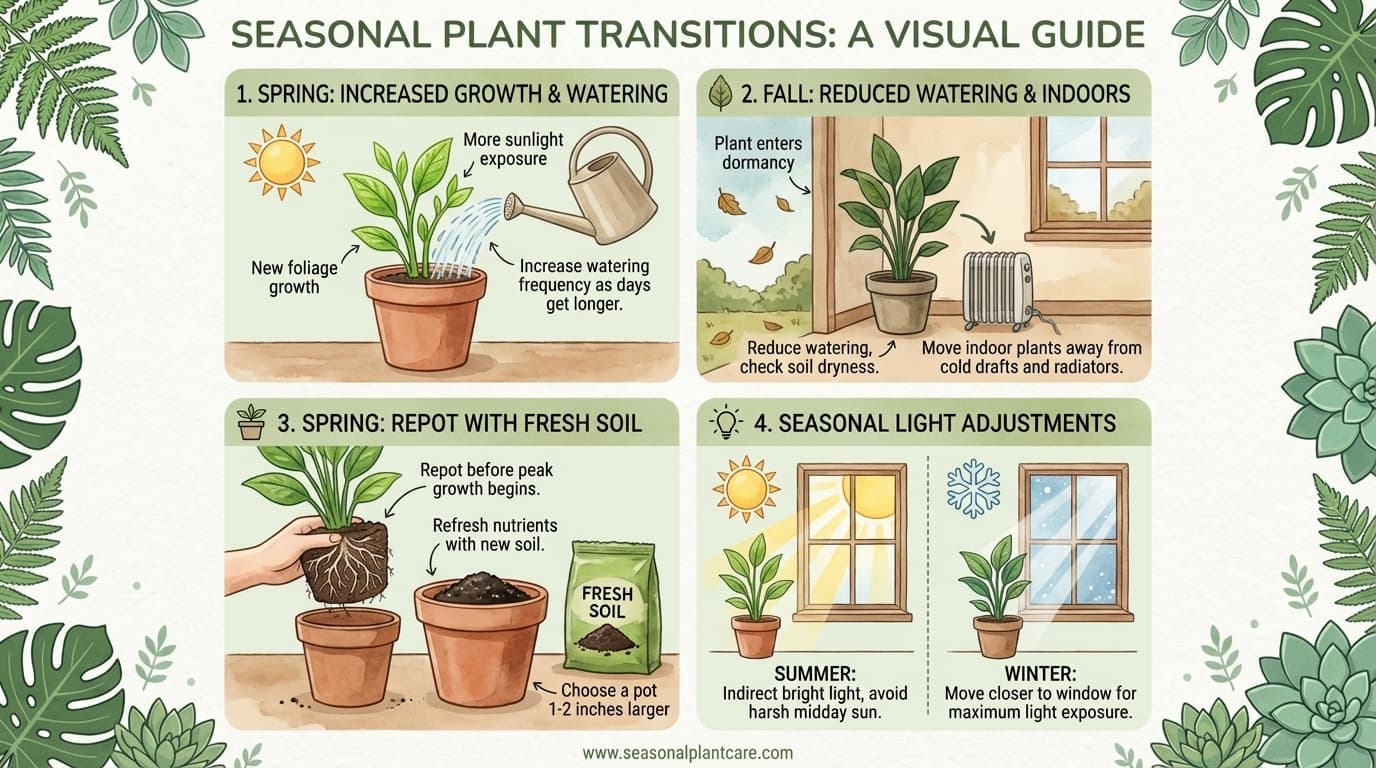
This is the repotting window. Do it before the hardening-off schedule, not during it, and keep it modest — Iowa State advises not bumping plants up more than one or two pot sizes. Our repotting guide has the method.
Growth gets much faster. Purdue: "most plants will grow faster outdoors, which also contributes to a greater need for both water and fertilizer."
And expect pests. Purdue is direct: "Many houseplant pests are picked up while the plants are outdoors for the summer." Plan on a real inspection and quarantine in autumn; our seasonal pest management guide covers that calendar. It cuts both ways, though. University of Minnesota Extension: "Spider mites are one of the hardest insect pests to control in an indoor environment. Summer weather like rain and humidity can keep them at bay. Natural predators are abundant outside too." A summer outdoors frequently fixes a mite problem that three rounds of spraying did not.
Which Plants Should Not Go Outside
Most things benefit from a summer outdoors. These do not:
- Fuzzy-leaved plants. Clemson's exception is specific: "Most plants, except those with fuzzy leaves (e.g., African violet), benefit from a summer outdoors."
- Anything in active bloom. The move plus changes in light, temperature and watering is how you get bud drop.
- Anything freshly repotted. New roots plus a hardening-off schedule is two jobs at once. Repot, wait a few weeks, then start.
- Anything you cannot carry. If the pot takes two people and a cold night lands on Thursday, the plant cannot be rescued — and this schedule assumes you can.
- Plants with nowhere to go but sun. A Boston fern in deep outdoor shade will be the best fern you have grown. On a south-facing balcony it will be brown in a week.
- Anything you cannot stage in shade. With no shaded spot and no cloth, leave the plant indoors. It will be fine; a burned plant will not.
Citrus is its own case: it does well with a summer outdoors, and it is hardier than a tropical foliage plant, though published cold figures differ by type and a tree in a pot has less margin than one in the ground. If you overwintered a kishu mikan or another container citrus, give it the slowest version of the schedule — our overwintering citrus guide covers both ends of its year.
The Full Cycle, Closed
That is the loop. Out in spring behind two gates and a shade schedule, where the risk is light; in again in autumn before nights fall below 55°F, where the risk is cold. Our summer care guide picks up where the hardening-off schedule ends, and our complete Indoor Move guide ties the sequence together in both directions.
Change one thing this year: start a week earlier, in deeper shade than you think is necessary. Nothing bad has ever happened to a plant that spent an extra week under a table.
Frequently Asked Questions
When should I put indoor plants outside?
After your last frost date has passed and night temperatures have settled — we use 55°F. Iowa State says consistently and reliably above 50°F, Purdue puts most houseplants as sensitive below 55°F, and Clemson and Minnesota prefer 60°F. The shade schedule adds one to two weeks before full exposure.
What does hardening off houseplants in spring actually involve?
Short sessions in deep shade that get longer over ten days to two weeks, then direct morning sun added an hour at a time. Iowa State's version is full shade first, then "introduce more light over 10 to 14 days."
When can indoor plants go outside overnight, for good?
Once night temperatures stop dropping below your threshold. Minnesota's bar for leaving houseplants out permanently is nights "constantly around 60 degrees."
Can I just put it in the shade permanently and skip the sun part?
Yes, and for most people it is the right call. Outdoor shade is far brighter than any indoor window, so a plant parked in shade all summer gets most of the benefit and almost none of the risk. Iowa State's framing holds: "Nearly all houseplants are tropical understory plants." Understory means shade.
My plant burned. Will those leaves recover?
The bleached patches will not. UC IPM's recovery note applies only "before discolored leaf tissue is killed"; after that the plant replaces the leaf instead of repairing it. Move it back to shade, leave damaged leaves attached unless fully dry, water normally, skip the fertilizer, and restart the sun schedule at hour one.