This guide contains affiliate links. We may earn a small commission if you purchase through our links, at no extra cost to you.
This guide is part of our comprehensive Houseplant Pest Mastery Guide.
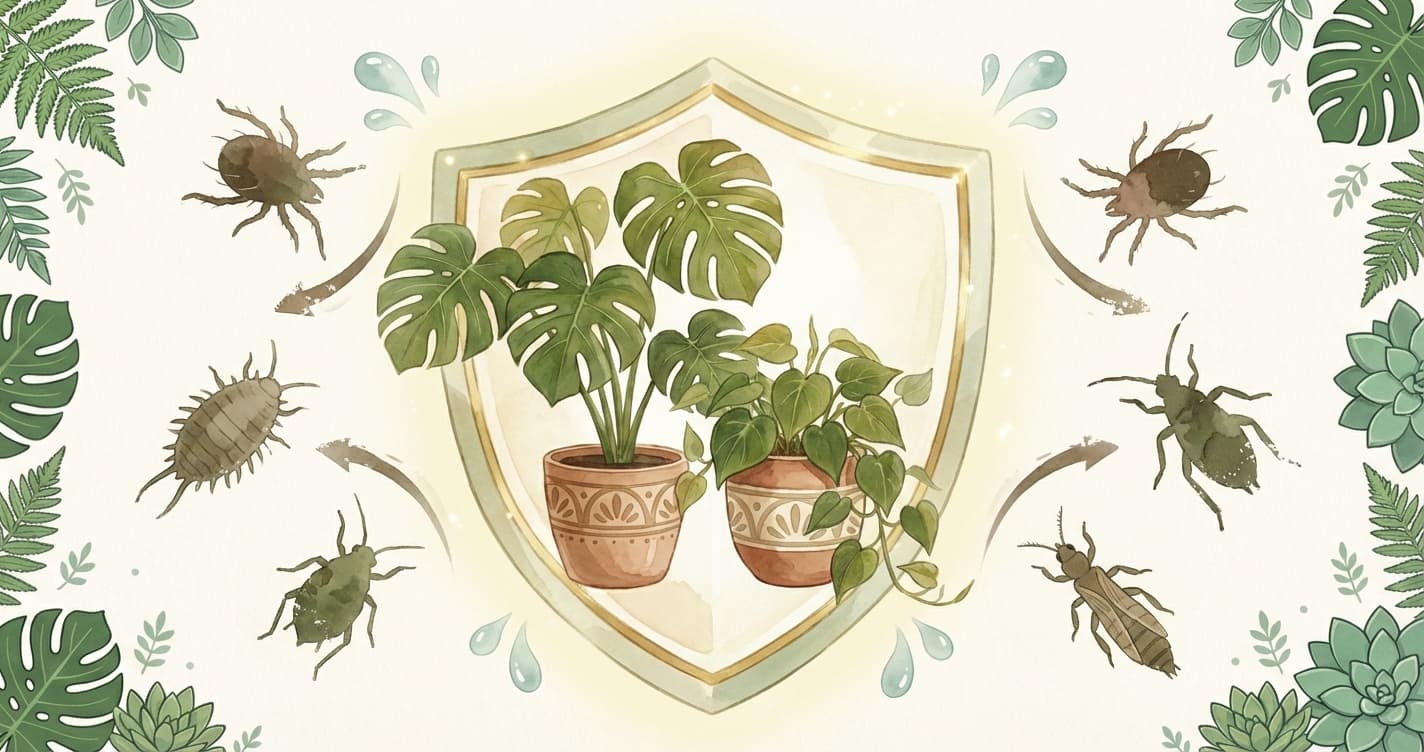
You've identified the pest. Now what do you spray? The houseplant section offers neem oil, insecticidal soap, systemic granules, pyrethrin, and a dozen other options. Which actually works for your specific problem?
The answer depends on your pest, your plants, and how severe the infestation is. This guide compares every major treatment category so you can choose confidently—and build a treatment kit that covers all scenarios.
Table of Contents
- Physical Methods
- Organic Sprays
- Biological Controls
- Systemic Treatments
- Treatment Comparison Matrix
- Application Best Practices
- Treatment Kit Recommendations
- Frequently Asked Questions
Physical Methods
Start here for light infestations. Physical methods are free, chemical-free, and often sufficient when you catch problems early.
Water Spray
How it works: Strong water pressure dislodges pests from plants. Repeated applications prevent them from re-establishing.
Best for: Aphids, spider mites, whiteflies (adults), and light infestations of most soft-bodied pests.
Technique: Take plants to shower or sink. Spray all surfaces, focusing on leaf undersides. Use lukewarm water and moderate pressure—enough to dislodge pests without damaging foliage.
Frequency: Every 2-3 days for 2 weeks.
Limitations: Doesn't kill pests, only displaces them. Won't eliminate established infestations. Not effective on scale or mealybugs that grip tightly.
Manual Removal
How it works: Physically picking, wiping, or scraping pests off plants.
Best for: Mealybugs, scale, and isolated pest sightings.
Tools needed: Cotton swabs, soft brushes, fingernails, damp cloth.
Technique: Dab mealybugs with rubbing alcohol on cotton swabs—kills on contact. Scrape scale with fingernail or soft brush. Wipe leaves with damp cloth to remove eggs and tiny pests.
Limitations: Labor-intensive for large infestations. Easy to miss pests hiding in crevices.
Pruning
How it works: Removing heavily infested plant parts eliminates pest populations immediately.
Best for: Severe localized infestations, especially on plants that tolerate pruning.
Technique: Cut infested leaves, stems, or branches. Seal in plastic bag before disposal. Disinfect pruning tools with rubbing alcohol between cuts.
Limitations: Only works when infestation is concentrated. Removes plant material you may want to keep.
Sticky Traps
How it works: Adhesive-coated traps attract and capture flying adult pests.
Products:
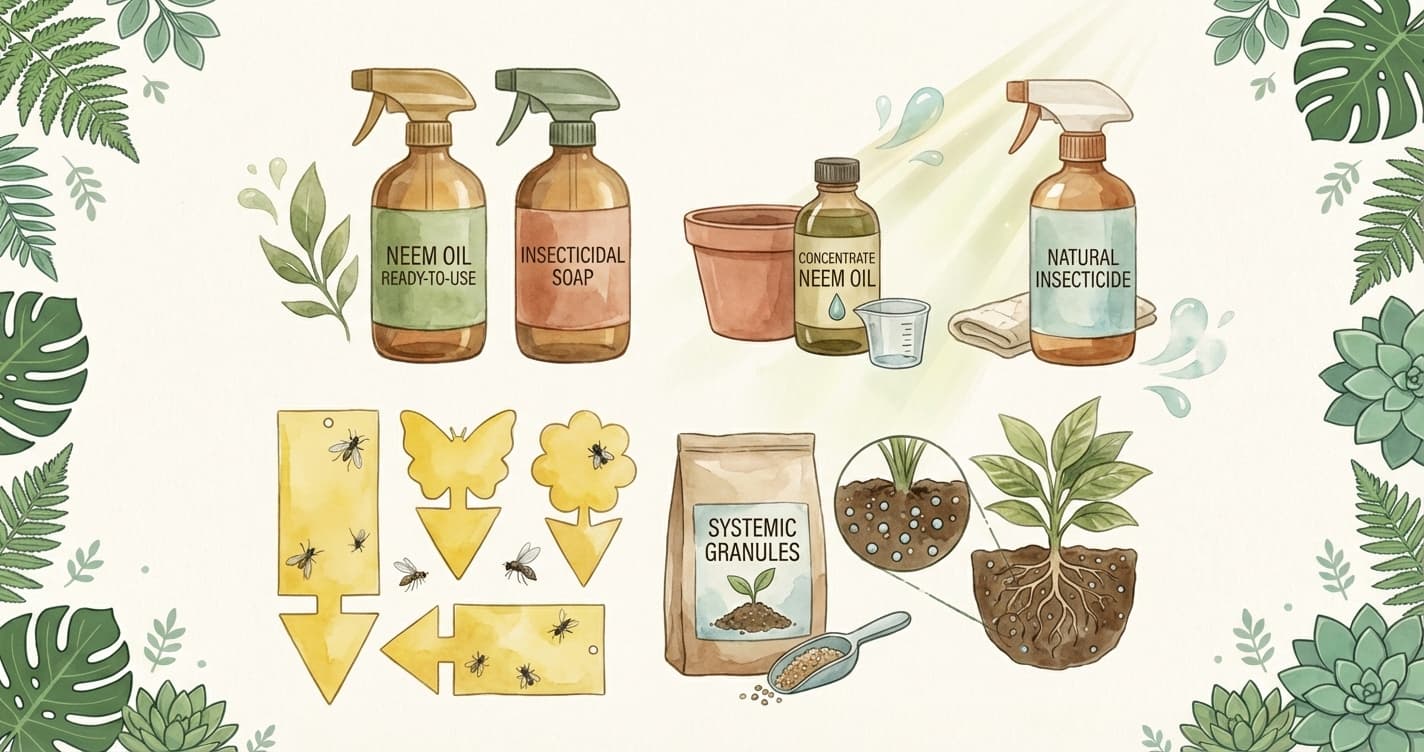
- Yellow sticky traps – catch fungus gnats, whiteflies, aphids ($8-12 for 20-pack)
- Blue sticky traps – catch thrips more effectively ($10-15 for 20-pack)
Best for: Fungus gnats (highly effective), monitoring all flying pests, reducing adult populations.
Limitations: Don't eliminate infestations alone—catch adults but not eggs, larvae, or nymphs.
Organic Sprays
The workhorses of houseplant pest treatment. These plant-derived or naturally-sourced products kill pests while remaining safer than synthetic chemicals.
Insecticidal Soap
How it works: Fatty acid salts penetrate pest cell membranes, causing dehydration. Kills soft-bodied insects on contact.
Products:
- Safer Brand Insecticidal Soap – ready-to-use ($10-12)
- Insecticidal soap concentrate – mix your own, more economical ($12-15)
Best for: Aphids, mealybugs, whiteflies, spider mites, soft-bodied pests.
Effectiveness: ★★★★☆ – Very effective when applied thoroughly. No residual action.
Pros:
- Kills on contact
- Safe for most plants
- No residual toxicity
- Inexpensive
Cons:
- Must hit pest directly
- No lasting protection
- Requires repeated applications
- Can damage sensitive plants (test first)
Application: Spray all plant surfaces thoroughly, especially leaf undersides. Repeat every 3-5 days for 2-3 weeks.
Neem Oil
How it works: Azadirachtin (active compound) disrupts pest feeding, growth, and reproduction. Also suffocates pests on contact.
Products:
- Cold-pressed neem oil – contains more active compounds ($12-18)
- Neem oil spray ready-to-use – convenient ($10-15)
Best for: Broad-spectrum prevention, scale, mealybugs, aphids, fungal issues.
Effectiveness: ★★★★☆ – Works on many pests but slower than soap. Better for prevention.
Pros:
- Broad-spectrum effectiveness
- Disrupts pest life cycle
- Some fungicidal properties
- Natural and organic
Cons:
- Works slowly (days to weeks)
- Unpleasant smell
- Can damage some plants in direct sun
- Less effective on fast-moving infestations
Application: Spray thoroughly in evening or when plants won't receive direct sun for several hours. Repeat every 7-14 days.
Horticultural Oil
How it works: Refined petroleum or plant-based oil suffocates pests by coating and clogging their breathing pores.
Products:
- Horticultural oil spray ($10-15)
- Year-round horticultural oil – safe for use during growing season ($12-18)
Best for: Scale (very effective), spider mites, mealybugs, whitefly eggs.
Effectiveness: ★★★★☆ – Excellent on scale and eggs. Physical mode of action means no resistance.
Pros:
- Suffocates pests under protective coverings
- No resistance development
- Low toxicity
- Effective on eggs
Cons:
- Can damage sensitive plants
- Don't apply in hot conditions
- Residue can attract dust
Application: Spray to coat all surfaces. Apply when temperatures are moderate (40-90°F). Avoid applying before rain or high humidity.
Pyrethrin
How it works: Natural compounds from chrysanthemum flowers disrupt insect nervous systems, causing rapid knockdown.
Products:
- Pyrethrin spray ($12-18)
- PyGanic – organic pyrethrin concentrate ($20-30)
Best for: Quick knockdown of heavy infestations, all soft-bodied pests.
Effectiveness: ★★★★☆ – Fast-acting but breaks down quickly in light.
Pros:
- Rapid knockdown
- Natural origin
- Broad effectiveness
- Breaks down quickly (low residual)
Cons:
- No lasting protection
- Toxic to beneficial insects
- Breaks down in sunlight
- More expensive than soap/neem
Application: Spray directly on pests. Apply in evening when light won't degrade product. Follow with soap or neem for ongoing control.
Spinosad
How it works: Derived from soil bacteria, affects insect nervous systems through contact and ingestion.
Products:
- Captain Jack's Dead Bug Brew – most popular spinosad product ($12-18)
- Spinosad concentrate ($18-25)
Best for: Thrips (most effective treatment), caterpillars, some beetles.
Effectiveness: ★★★★★ – The gold standard for thrips control.
Pros:
- Highly effective on thrips
- Works through ingestion (pests don't need direct contact)
- Organic-approved
- Low toxicity to mammals
Cons:
- Less effective on some pest types
- Degrades in sunlight
- Can harm beneficial insects
Application: Spray thoroughly. Apply in evening. Repeat every 5-7 days for 3+ applications.
Biological Controls
Living organisms that prey on or parasitize pests. Best for ongoing prevention rather than emergency treatment.
Beneficial Nematodes
How they work: Microscopic worms that enter and kill soil-dwelling pest larvae.
Products:
- Steinernema feltiae nematodes – targets fungus gnats, thrips pupae ($15-25)
Best for: Fungus gnat larvae, thrips pupae in soil.
Effectiveness: ★★★★☆ – Excellent for soil pests when applied correctly.
Pros:
- Completely natural
- No chemical residue
- Ongoing control once established
Cons:
- Require proper soil moisture and temperature
- Must be refrigerated; limited shelf life
- Won't address pests on foliage
Application: Mix with water and drench soil according to package directions. Keep soil moist for 2 weeks after application.
Predatory Mites
How they work: Beneficial mites that consume pest mites.
Products:
- Phytoseiulus persimilis – spider mite predator ($25-40)
- Amblyseius cucumeris – thrips predator ($30-50)
Best for: Spider mites, thrips (in controlled environments).
Effectiveness: ★★★☆☆ – Effective in proper conditions; challenging for typical home use.
Pros:
- Natural, ongoing control
- No resistance development
- No chemical exposure
Cons:
- Require 60%+ humidity
- Need pest population to sustain them
- More practical for greenhouse than home
Systemic Treatments
Plants absorb these insecticides, which then kill pests feeding on plant tissue. The nuclear option for persistent problems.
Imidacloprid Granules
How it works: Applied to soil, absorbed by roots, circulates through plant. Pests die when they feed on treated tissue.
Products:
- Bonide Systemic Houseplant Insect Control ($12-18)
- Bayer Advanced 3-in-1 Insect, Disease & Mite Control ($15-22)
Best for: Persistent scale, mealybugs, aphids, whiteflies. NOT effective on spider mites (they're not insects).
Effectiveness: ★★★★☆ – Very effective on true insects; useless on mites.
Pros:
- Long-lasting (6-8 weeks)
- Reaches pests in crevices
- Easy application
Cons:
- Takes 1-2 weeks to reach full effect
- Not for edible plants
- Toxic to pollinators
- Doesn't work on mites
Application: Sprinkle granules on soil surface, water in. Follow package rates carefully.
If you have a cat or a dog, stop here. Systemics put the insecticide inside the plant tissue, where you cannot wipe it off or wait for it to dry — which removes every mitigation that makes the other treatments on this page workable around animals. Our guide to pet-safe pest control ranks the whole ladder from safest upward and explains why "natural" and "safe around cats" are not the same claim.
Treatment Comparison Matrix
| Treatment | Aphids | Mealybugs | Scale | Spider Mites | Thrips | Whiteflies | Fungus Gnats |
|---|---|---|---|---|---|---|---|
| Water spray | ★★★★ | ★★ | ★ | ★★★ | ★★ | ★★★ | ★ |
| Insecticidal soap | ★★★★★ | ★★★★ | ★★★ | ★★★★ | ★★★ | ★★★★ | ★★ |
| Neem oil | ★★★★ | ★★★★ | ★★★★ | ★★★ | ★★★ | ★★★★ | ★★ |
| Horticultural oil | ★★★ | ★★★★ | ★★★★★ | ★★★★ | ★★ | ★★★ | ★ |
| Pyrethrin | ★★★★ | ★★★ | ★★ | ★★★ | ★★★ | ★★★★ | ★★ |
| Spinosad | ★★★ | ★★ | ★★ | ★★ | ★★★★★ | ★★★ | ★★★ |
| Systemics | ★★★★★ | ★★★★★ | ★★★★★ | ★ | ★★★ | ★★★★★ | ★★ |
| Beneficial nematodes | ★ | ★ | ★ | ★ | ★★★ | ★ | ★★★★★ |
★ = minimal effect | ★★★ = moderate | ★★★★★ = highly effective
Application Best Practices
Regardless of product, proper application dramatically improves results:
Timing
- Evening application: Many products (neem, pyrethrin, spinosad) degrade in sunlight. Apply when plants won't receive direct sun for several hours.
- After watering: Hydrated plants tolerate treatments better than stressed, dry ones.
- Repeated applications: One treatment never eliminates infestations. Plan for 3-4 applications over 2-3 weeks.
Technique
- Complete coverage: Most products kill on contact—you must hit every pest. Spray all surfaces, especially leaf undersides.
- Get into crevices: Mealybugs and scale hide in leaf axils and stem joints. Direct spray into these areas.
- Test first: Some plants are sensitive to certain treatments. Test on a few leaves and wait 24 hours before full application.
Rotation
Using the same treatment repeatedly can lead to resistance. Rotate between products with different modes of action:
- Week 1: Insecticidal soap
- Week 2: Neem oil
- Week 3: Insecticidal soap
- Week 4: Neem oil
Treatment Kit Recommendations
Build your kit based on your collection size and risk tolerance:
Budget Kit (~$25-30)
Essential supplies for most situations:
| Product | Purpose | Price |
|---|---|---|
| Yellow sticky traps (20-pack) | Monitoring, fungus gnat control | $8-10 |
| Insecticidal soap ready-to-use | Primary treatment | $10-12 |
| Isopropyl alcohol 70% | Mealybug treatment | $4-6 |
| Cotton swabs | Manual removal | $2-3 |
Covers: Fungus gnats, aphids, light mealybug/whitefly/spider mite infestations.
Complete Kit (~$60-75)
Comprehensive coverage for serious collectors:
| Product | Purpose | Price |
|---|---|---|
| Everything in budget kit | - | ~$25 |
| Cold-pressed neem oil | Broad-spectrum treatment | $12-15 |
| Blue sticky traps | Thrips monitoring | $10-12 |
| Mosquito Bits (BTI) | Fungus gnat larvae | $10-12 |
| Magnifying loupe | Pest identification | $8-10 |
Covers: All common pests with multiple treatment options.
Pro Kit (~$100+)
Everything for any situation:
| Product | Purpose | Price |
|---|---|---|
| Everything in complete kit | - | ~$65 |
| Spinosad (Captain Jack's) | Thrips treatment | $12-15 |
| Horticultural oil | Scale treatment | $10-12 |
| Systemic granules | Persistent infestations | $12-15 |
| Beneficial nematodes | Soil pest control | $15-20 |
Covers: Any pest, any severity level.
Frequently Asked Questions
Which is better, neem oil or insecticidal soap?
They work differently and complement each other. Soap kills on contact but has no residual effect. Neem works more slowly but disrupts pest reproduction. Use both, alternating applications.
Can I mix treatments together?
Generally, don't mix unless specifically directed. Some combinations can damage plants. Apply one treatment, wait 3-5 days, then apply another.
How do I know if treatment is working?
Sticky trap catches should decline. Visible pest populations should decrease. New damage should stop appearing. Allow 2-3 weeks to assess—results aren't immediate.
Will systemic insecticides kill spider mites?
No. Spider mites are arachnids, not insects. Systemic insecticides don't affect them. Use insecticidal soap, neem oil, or horticultural oil for spider mites.
Are these treatments safe for pets?
Most organic treatments (soap, neem) are low-toxicity but can cause stomach upset if ingested. Systemic insecticides are more concerning—keep treated plants away from pets who might chew leaves. Always follow label directions.
How long do treatments last?
- Insecticidal soap: No residual effect—only kills pests present at application
- Neem oil: 5-7 days of deterrent effect
- Systemic granules: 6-8 weeks of protection
The right treatment depends on your specific pest and situation. Start with the least toxic effective option, apply thoroughly, and be consistent. For the complete pest management framework, return to our Houseplant Pest Mastery Guide.