This guide contains affiliate links. We may earn a small commission if you purchase through our links, at no extra cost to you.
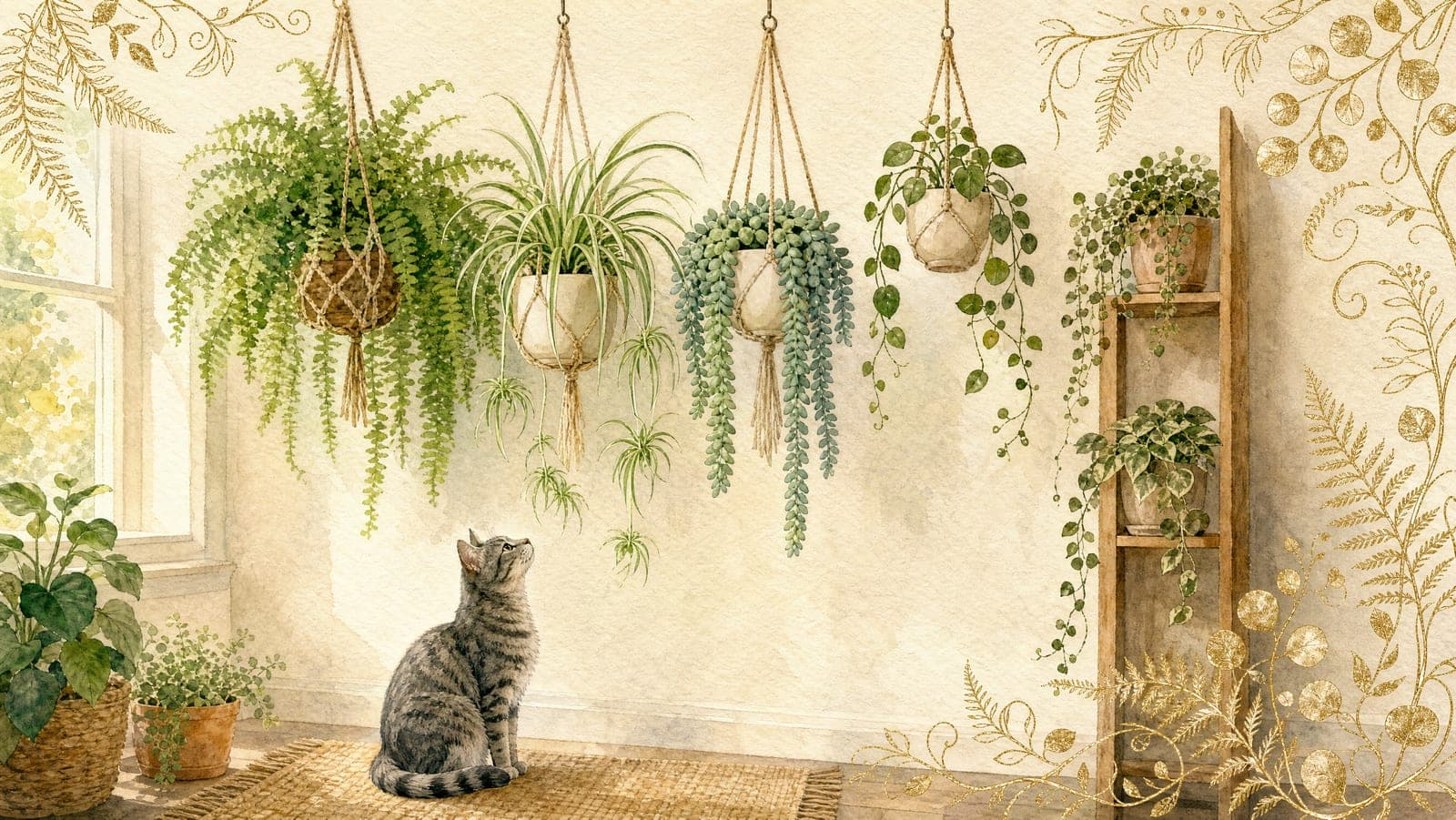
Pet safe hanging plants solve most of the problem if you have a dog, and about half of it if you have a cat. A dog cannot reach a basket at ceiling height, and that is the end of the discussion. A cat can reach almost anything — and the plants people hang are trailers, whose whole appeal is stems dangling back down into swatting range.
That asymmetry is the part most roundups skip. Hanging is a placement strategy, not a safety strategy. With a dog it does nearly all the work. With a cat it buys time and lowers frequency, and the actual safety still comes from the plant being non-toxic. Height plus a toxic plant is a gamble; height plus a non-toxic plant is a system.
So the picks below are graded by how far each one trails, not only by whether it is safe — a plant that hangs four feet down has undone the ceiling hook you paid for. For the wider strategy, start with our complete pet-safe houseplant guide.
One framing note: we are plant people, not veterinarians. Every toxicity status here is attributed, mostly to the ASPCA, which says outright that its plant list is "not meant to be all-inclusive." Where a plant is covered only at genus level or by a sibling species, we say so. If your pet has eaten something, call your vet.
What Hanging Actually Solves — and What It Doesn't
Height is not measured from the floor. It is measured from the nearest surface a cat can stand on.
Cats climb to things rather than at them. A hook eight feet up is not eight feet up if a bookshelf, curtain rod, radiator cover or sofa back sits within one hop. According to The International Cat Association, cats can jump roughly five to six times their body length in a single leap — and that is before you hand them a launch pad. Trace the approach route before you buy the hook.
The second limit is motive. Height changes opportunity; it does not change why a cat wants the plant. Boredom, texture and movement in a draught are all still there, and a cat that has decided a trailing stem is a toy keeps coming back at whatever height you set. That is a behaviour problem with behaviour fixes — see how to stop cats from eating your plants.
Two practical notes. Hanging spots are usually the dimmest part of a room, so check your shortlist against our pet-safe low-light plants guide. And if the plant is going on the floor instead, the species list changes completely — see large pet-safe houseplants.
Short and Tidy: The Best Picks for Cat Homes
The counterintuitive tier. Slow, compact plants that stay near their pot beat fast dramatic ones in a cat household: they never re-enter the danger zone.
Hoya bella (Miniature Wax Plant)
Thick, waxy, semi-succulent leaves on short stems that spill just past the rim. Missouri Botanical Garden describes Hoya lanceolata subsp. bella as a miniature form growing to only 18 inches. Sourcing note — the ASPCA's wax plant entry is Hoya carnosa, non-toxic to dogs and cats, so Hoya bella is a genus-level read; NC State Extension separately tags it non-toxic for dogs and cats.
Trails under 18 inches. NC State notes the leaves store water and the soil should go almost dry between waterings — you rot this plant, you do not dry it out. The bushier shooting star hoya suits the same shelf.
Button Fern (Pellaea rotundifolia)
Small, round, almost leathery leaflets on wiry stems, far less humidity-dependent than a lacy fern. The ASPCA lists the button fern as cliff brake, Pellaea rotundifolia, non-toxic to dogs, cats and horses. Trails about a foot, resents being kept soggy, and is the easiest fern here to keep alive in a centrally heated room.
Trailing and Ripple Peperomia
The ASPCA lists several Peperomia species as non-toxic to dogs and cats, ripple peperomia among them. Peperomia caperata mounds rather than trails, which makes it a shelf plant; Peperomia serpens creeps modestly over the edge and is a genus-level read. Trails a few inches to a foot, and thick leaves plus a dim ceiling corner is an easy way to rot one — keep it bright.
Chinese Money Plant (Pilea peperomioides)
Not a trailer at all, but a shelf is often the better answer than a hook. Sourcing note — the ASPCA's Pilea entries are aluminium plant and friendship plant, both non-toxic to dogs and cats, so Pilea peperomioides is a genus-level read. No trail, and it leans hard toward the light, so rotate it.
Medium Trailers: One to Three Feet
Manageable, but now you have to think about where the ends of the stems land.
Swedish Ivy (Plectranthus verticillatus)
Fast, forgiving and cheap enough that you will not mourn a chewed one. The ASPCA lists Swedish ivy as Plectranthus australis, non-toxic to dogs, cats and horses, so Swedish ivy sold as P. verticillatus is a sibling read. Trails two to three feet, goes leggy in shade, and looks better pinched back — which conveniently keeps it short.
Rabbit's Foot Fern (Davallia fejeensis)
The furry rhizomes creeping over the rim are the point, and they do the visual work without long fronds. The ASPCA lists rabbit's foot fern at genus level as Davallia spp., non-toxic to dogs and cats. Fronds around a foot. Those rhizomes must sit on top of the mix, not buried — give the rabbit's foot fern a wide, shallow pot.
String of Hearts (Ceropegia woodii)
Silver-marbled heart-shaped leaves on thread-fine stems. An honest caveat first: we could not find Ceropegia woodii in the ASPCA's database in either direction, and Wisconsin Horticulture's profile makes no toxicity claim. Our own non-toxic rating for string of hearts is not the same thing as an ASPCA listing, and we would rather say so than let you assume a checked box.
Trails long. Wisconsin Horticulture describes branches that "can grow several feet long hanging down," and notes it "tolerates dry soil much better than soggy soil; it is easily killed by overwatering." Hang it bright and trim to length.
Burro's Tail (Sedum morganianum)
The most useful swap in this article. It reads as a beaded trailing succulent — exactly why people reach for string of pearls — and according to the ASPCA, burro's tail (Sedum morganianum, also listed as donkey's tail and lamb's tail) is non-toxic to dogs, cats and horses.
Trails two to three feet. The plump leaves drop at the lightest brush, so hang burro's tail where nothing — a door, a shoulder, a passing tail — touches it.
Big and Dramatic: Great With a Dog, Think Twice With a Cat
The classic hanging plants, and the ones whose foliage comes back down to meet your cat.
Boston Fern (Nephrolepis exaltata)
Still the best big hanging fern, and the ASPCA lists Boston fern as non-toxic to dogs and cats. Wisconsin Horticulture notes the fronds "can grow up to 4 feet long and 6 inches wide," which is why we file it here rather than in the cat tier.
Trails up to four feet. Humidity, not light, is what kills these: Wisconsin Horticulture calls for medium bright light and a medium kept "evenly moist but not saturated," and our humidity management guide covers the fixes. With a cat, hang a Boston fern over open floor, or buy the 'Compacta' cultivar, whose fronds Wisconsin Horticulture puts at 15 to 18 inches. A basket that size needs a pot that will not drip: the TYMENSH 12-inch self-watering hanging planters, a set of two with chains and a removable saucer, were $22.99 as of August 2026, and lightweight plastic beats ceramic overhead.
Spider Plant (Chlorophytum comosum)
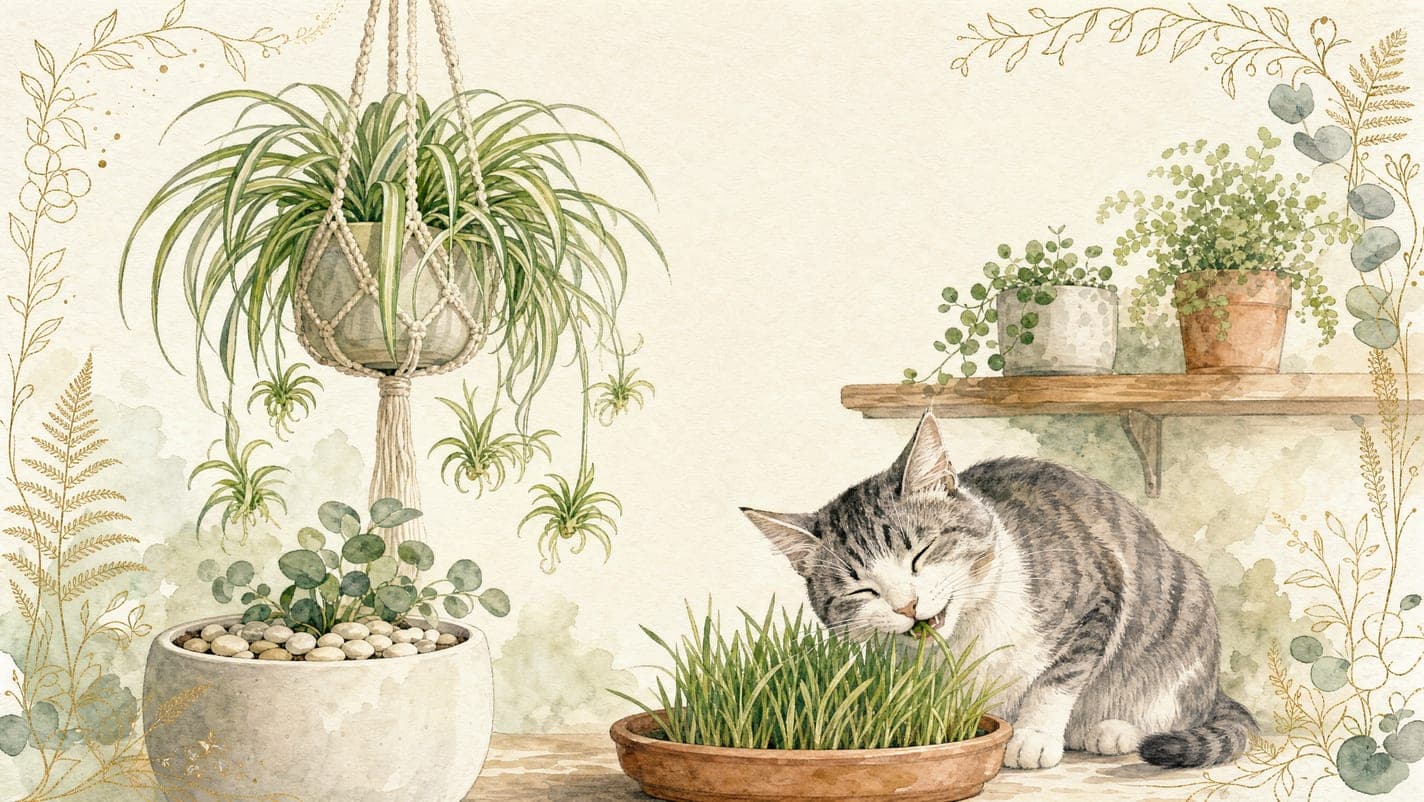
According to the ASPCA, the spider plant is non-toxic to dogs and cats. It is also the most cat-attractive plant on this page, which we cover honestly below. Plantlets dangle one to two feet below the rim. In a cat household that non-toxic listing covers your cat, not the plant — hang it high, over open floor, and expect to trim.
Kangaroo Vine (Cissus antarctica)
A genuine stand-in for the vining aroids everyone reaches for, with glossy toothed leaves and a real climbing habit. Sourcing note — we found no ASPCA entry for Cissus antarctica; the ASPCA's grape ivy entry, Cissus rhombifolia, is non-toxic to dogs, cats and horses, so kangaroo vine is a sibling-species read. Trails several feet, or climbs instead — give it a trellis and the growth goes up rather than down.
Staghorn Fern (Platycerium bifurcatum)
The answer for a room where nothing can hang safely. Mounted on a board it becomes wall art: no pot to knock down, no basket to fall. According to the ASPCA, staghorn fern is non-toxic to dogs, cats and horses. Fronds arch outward rather than hanging, and a mounted staghorn fern is watered by soaking the board.
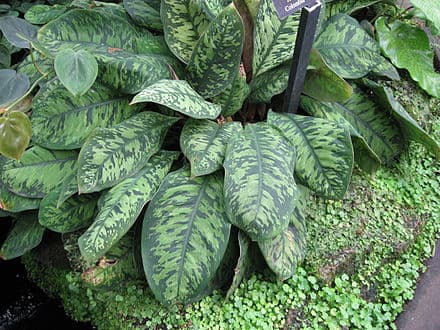
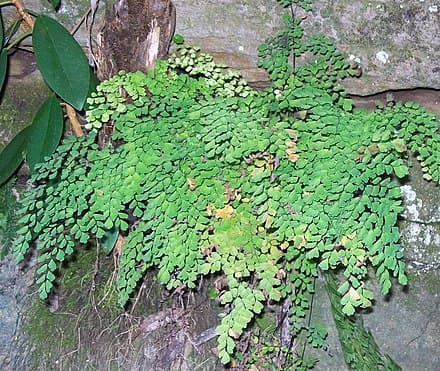
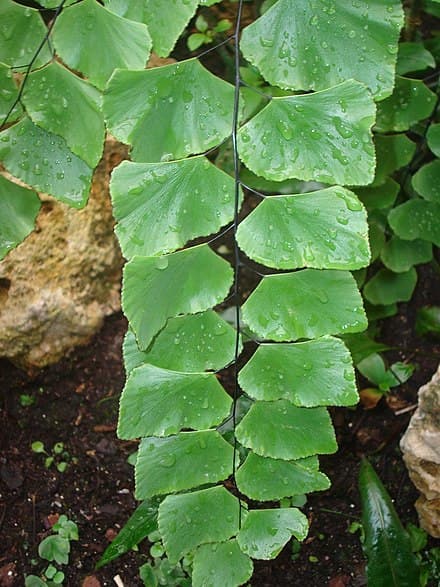
Two shelf options with caveats: the ASPCA lists prayer plant as non-toxic to dogs, cats and horses but files that entry under Calathea insignis, not Maranta leuconeura, and we could not confirm an ASPCA listing for elephant bush. We would skip maidenhair fern — Adiantum has no ASPCA entry either way.
The Popular Hanging Plants That Are Not Pet-Safe
Almost every "best hanging plants" list is built from this group.
String of pearls is the headline: the most-recommended trailing plant on the internet, and not a safe pick. In the ASPCA's own article on succulents it is named among the toxic ones, and the ASPCA states that "if ingested, it can cause stomach upset — predominately vomiting — and lethargy." The nuance we owe you: string of pearls (Curio × peregrinus, formerly Senecio rowleyanus) has no entry of its own in the ASPCA's searchable database, so this is published ASPCA guidance rather than a database row. Same caution for relatives sold under the Curio name, such as string of trident blue. Swap: burro's tail.
Pothos and its lookalikes. According to the ASPCA, golden pothos (Epipremnum aureum, also listed as devil's ivy and taro vine) is toxic to dogs, cats and horses. The toxic principle is insoluble calcium oxalates: the ASPCA explains that the leaves and stems contain needle-like crystals called raphides, released when a pet chews, causing intense burning of the mouth, tongue and lips, drooling, vomiting and difficulty swallowing. That covers pothos, dragon-tail and satin pothos. Swaps: kangaroo vine for the vining habit; string of hearts for the silver marbling.
Heartleaf philodendron and arrowhead vine. Both are aroids carrying insoluble calcium oxalates according to the ASPCA, which lists arrow-head vine (Syngonium podophyllum) as toxic to dogs and cats. Heartleaf philodendron and arrowhead vine are both off the list. Swaps: Swedish ivy for the fast green cascade; prayer plant for the patterned leaf.
Monstera adansonii and the shingling aroids. The ASPCA has no entry for Monstera adansonii by name; its Swiss cheese plant and cutleaf philodendron entries cover Monstera deliciosa, toxic to dogs and cats via insoluble calcium oxalates. Same family, same toxic principle, so we read Monstera adansonii and relatives like Rhaphidophora hayi at genus level.
Creeping fig. The ASPCA lists weeping fig, Ficus benjamina, as toxic to dogs, cats and horses, and names the toxic principles as a proteolytic enzyme (ficin) and a psoralen (ficusin) — compounds carried in the plant's milky sap. We found no separate ASPCA entry for creeping fig, but all Ficus produce that latex, so we would not hang one within reach. Swap: Hoya bella.
The full list lives in our guide to toxic houseplants to avoid with pets; for one species at a time, use our pet toxicity checker. Cat-specific reading is in cat-safe houseplants.
Hooks, Shelves and Macrame: The Part Nobody Checks
Here is the failure mode nobody writes about: a hanging basket that comes down. A wet basket landing on an animal is a far worse outcome than a chewed leaf, and it is the one risk here unrelated to toxicity.
We could not find an authoritative published weight for a fully watered 14-inch basket — it varies with the pot, the mix and the plant, and the hobby estimates we found range from roughly 12 pounds to over 20. Assume the top of that range and hold it against a hook rating: NACETURE rates its large ceiling swag hooks — a zinc-alloy four-pack, $13.99 as of August 2026 — to 25 lbs in a solid wall and 15 lbs in a hollow wall. Those are manufacturer figures, not test results, and the hollow-wall number is the one to sit with: a big wet basket lands right on it, with no margin for a cat pulling on a stem. Find a joist.
Three rules we would not bend:
- Plastic beats ceramic overhead. Less mass if a fixing fails, and nothing to shatter into something a paw finds.
- Drop length decides everything. A short hanger over bare floor beats a long one in a busy corner. The Mkono macrame plant hangers come three to a pack in roughly 35, 29 and 23 inch lengths for $15.99 as of August 2026, so you can match the drop to the room; pots are not included. One honest caveat — a macrame hanger is also a rope, and some cats will bat at it.
- Shelves and wall mounts often beat hooks. A flat surface, no swing, nothing dangling to grab.
Keeping a Hanging Plant Alive
Hanging baskets die of thirst more than anything else: the smallest soil volume in the house, warm air collecting at ceiling height, and the nuisance of reaching them. A basket you cannot water comfortably is a basket you will neglect. If it needs a stool, be honest about how often you will fetch it.
The fixes are a shorter drop, a bigger pot, or a reservoir. The ZMTECH 6.5-inch self-watering hanging planters — a two-pack at $19.99 as of August 2026, with drainage holes, a removable saucer and a wick-and-reservoir design — suit the short, tidy picks above, and that saucer stops drips onto a floor a pet uses. Worth one dry note: the listing's own suggested plants include peace lilies and snake plants, both on the ASPCA's toxic list. A pot maker is not a safety source, and neither is a "pet-friendly" label.
Do not swing to the opposite error: a reservoir kept permanently full will rot a Hoya or a burro's tail. Judge by the mix and the pot's weight rather than the calendar — our watering 101 guide covers how.
Spider Plants and Cats, Honestly
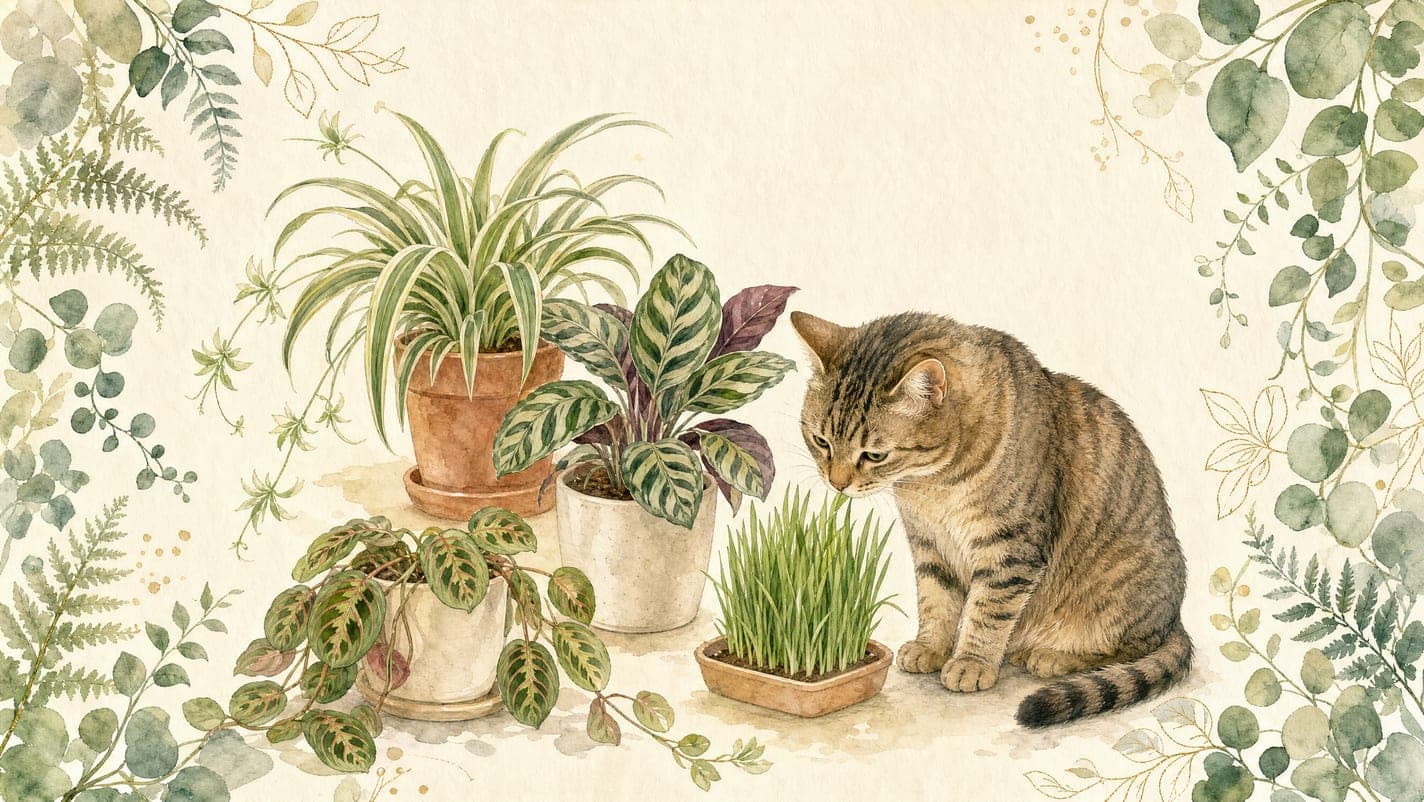
The special case. According to the ASPCA, Chlorophytum comosum is non-toxic to dogs and cats. It is also unusually attractive to cats, which nobody who has owned both disputes.
The widely repeated explanation — that spider plants are mildly hallucinogenic for cats — is not well supported. Reviewing the claim, what we found is that it circulates constantly and that the sources repeating it consistently note there is no research behind it. We will not assert it, and we will not flatly debunk it either: cats plainly find the plant interesting, and the mechanism is not established.
Practically, treat a spider plant as non-toxic but not undamaged. The plantlets move in a draught, which is close to a definition of cat bait. Hang it high with no launch pad, and accept some trimming.
The Bottom Line
Hanging works. It just works differently depending on which animal you live with. With a dog, height solves the problem and you can hang anything from the non-toxic list. With a cat, height is one layer of three: pick a non-toxic species, keep the trailing length short, and check the approach route rather than the ceiling measurement. If you take one thing away, make it the swap — burro's tail instead of string of pearls.
Keep the language precise, too. Non-toxic means no toxic principle is documented, not that the plant is food: the ASPCA notes that "consumption of any plant material may cause vomiting and gastrointestinal upset," and its list is not all-inclusive. If your pet has eaten something and you are worried, call your vet or the ASPCA Animal Poison Control Center at (888) 426-4435.
One closing upside: trailing plants are the easiest things in the house to propagate, so a chewed Swedish ivy or string of hearts is a free replacement rather than a loss — our propagation methods guide has the cuttings. For the full picture on safe lists, chewing and emergency steps, go back to Better Indoor Houseplants' pet-safe plant guide.