This guide contains affiliate links. We may earn a small commission if you purchase through our links, at no extra cost to you.
To stop cats eating plants, first work out which of four things your cat is doing: chewing grassy leaves, digging in the soil, batting the pot off a shelf, or fixating on one specific plant. Each has a different fix. Most advice recommends the same handful of deterrents for all four, which is why it so often does nothing.
A cat working a strappy leaf between its back teeth is doing something normal that you redirect. A cat squatting in a pot is telling you about the litter box. A cat shouldering a plant off a windowsill at 4am is playing. Treat all three with an orange-scented spray and you get one result out of three.
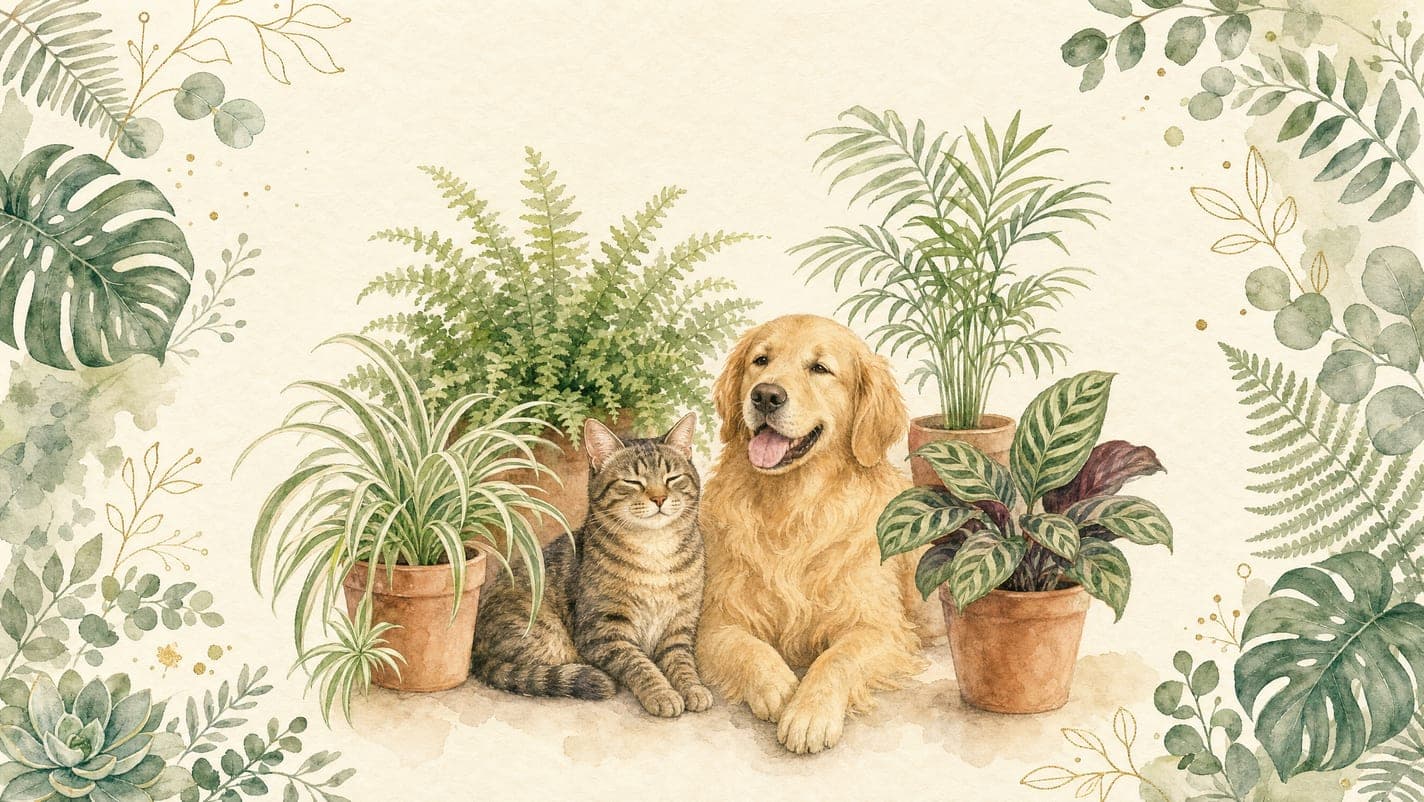
Species matters at least as much as deterrents, which is why this sits inside our tower on pet-safe houseplants. If a cat is going to chew regardless, you would rather it chewed something the ASPCA lists as non-toxic.
First, Diagnose the Behavior
Watch for a week before you buy anything.
| What you see | What it usually is | Where the fix lives |
|---|---|---|
| Chewing long, strappy, grassy leaves | Normal feline plant-eating | Redirect to cat grass |
| Digging and covering; soil on the floor | Pot reads as a litter box | Barrier plus a litter box audit |
| Pot on the floor, plant intact | Play and gravity testing | Placement and vertical enrichment |
| One plant, repeatedly, ignoring others | Possibly preference, possibly not | A conversation with your vet |
Most households have two of these at once. Fix them separately.
Reason 1: Chewing Grassy Leaves Is Normal, So Redirect It
The folk explanation — that cats eat plants to make themselves vomit when they feel unwell — is wrong. Benjamin Hart and colleagues at the University of California, Davis tested it with two large owner surveys, published as Characteristics of Plant Eating in Domestic Cats. Overall, cats showed signs of illness beforehand only 6 percent of the time in the first survey and 9 percent in the second, and only 27 to 37 percent vomited afterward. Long-haired cats did not eat more plants than short-haired ones, which undercuts the hairball theory too. Roughly 65 percent of cats ate plants at least weekly, most often the youngest. Hart's proposed explanation is that plant eating is inherited from wild ancestors, where fibrous material helps move intestinal parasites along.
The practical takeaway is the same either way: for most cats this is not a symptom and not a training problem. It is an appetite. So give it a better target.
Cat Grass Is the Highest-Success Intervention Here
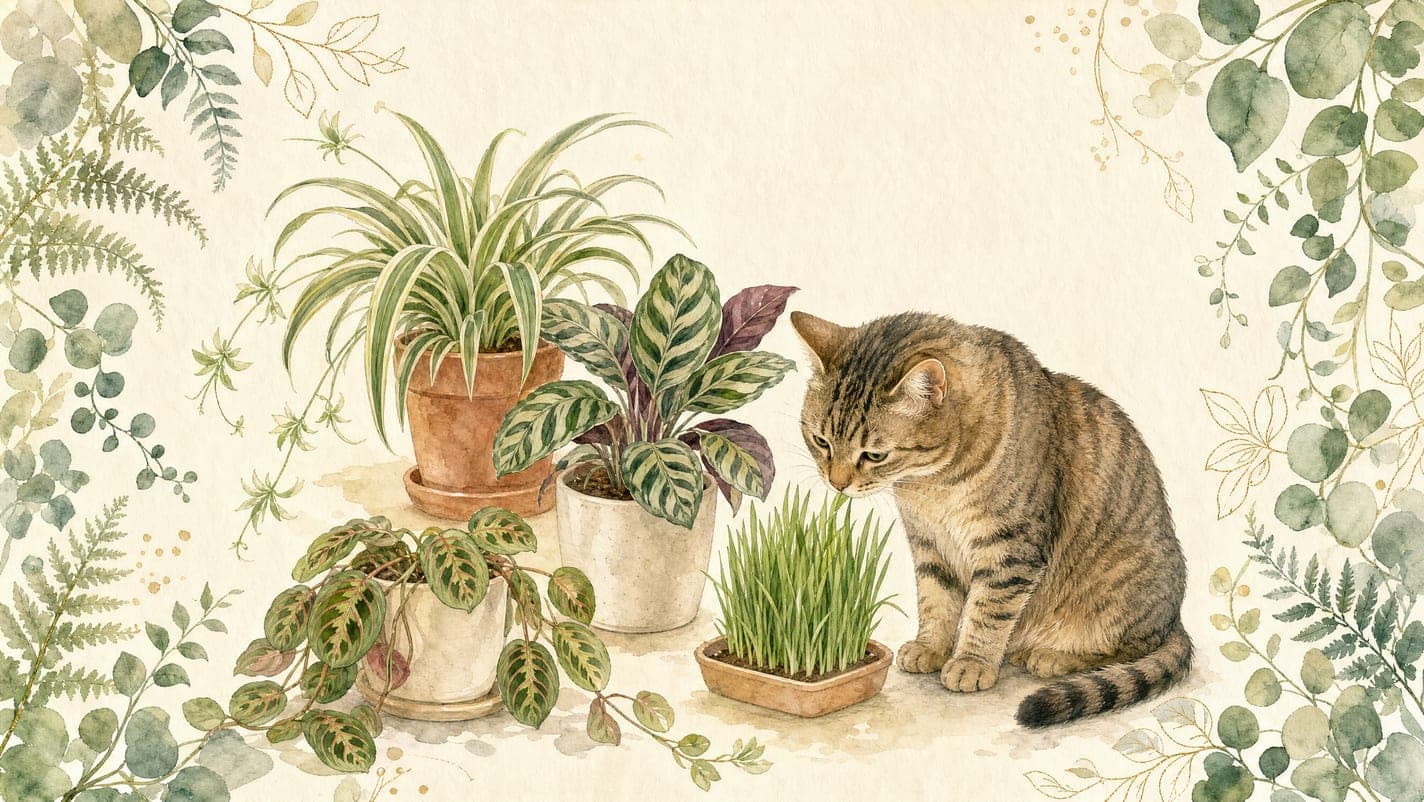
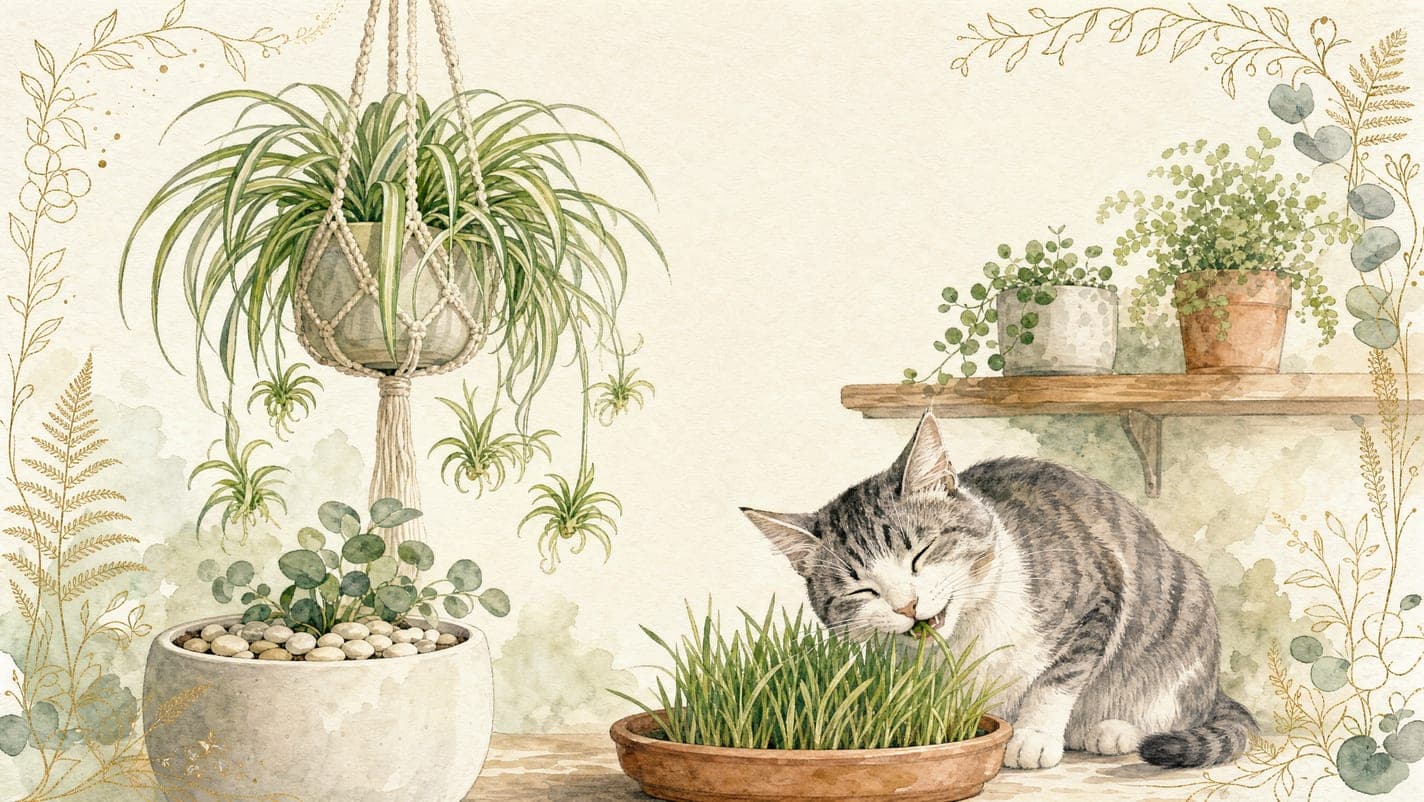
Cat grass is not one plant. Hill's Pet Nutrition describes it as a grass mixture grown from seed — usually wheat, barley, oat, or rye — and safe for cats to eat. The point is that these cereal grasses are grown specifically to be eaten, which no houseplant is.
The Cat Ladies three-pack kit was $14.90 as of July 2026 and includes three organic soil disks, three seed packets, and three BPA-free containers; the maker states the grass sprouts up to 4 inches in 4 to 7 days. Three containers is the point, not a bulk discount — grass gets chewed to stubs in a couple of weeks, so you want a rotation: one being eaten, one sprouting, one seeded. To test the idea first, the single-container version was $9.99 as of July 2026.
The maker also claims the grass "deters them from eating toxic household plants and digging up your favorite blooms." Treat that as marketing, not a finding — we found no independent source testing it. Offering an appropriate outlet is still the standard first move in behavior work, and it is the cheapest thing on this page.
Put the grass where the cat already goes, not where it suits you. And expect some vomiting: in the Hart surveys, 27 to 37 percent of cats were reported as frequently vomiting after eating plants. Repeated vomiting is a vet question.
Some Houseplants Look Exactly Like Cat Grass
If your cat targets one plant and ignores twelve others, look at the leaf shape: cats go for long, thin, arching foliage, because that is what grass looks like.
That is why the spider plant gets chewed in nearly every cat household. It sits on the ASPCA's non-toxic list, which is good news, but it is also the most cat-attractive shape you can own. Boston fern, bamboo palm, and burro's tail have both traits too — each has its own ASPCA non-toxic entry, and each trails or arches the way grass does. String of hearts has the shape, but the ASPCA database carries no Ceropegia entry at all, so treat it as unchecked rather than cleared.
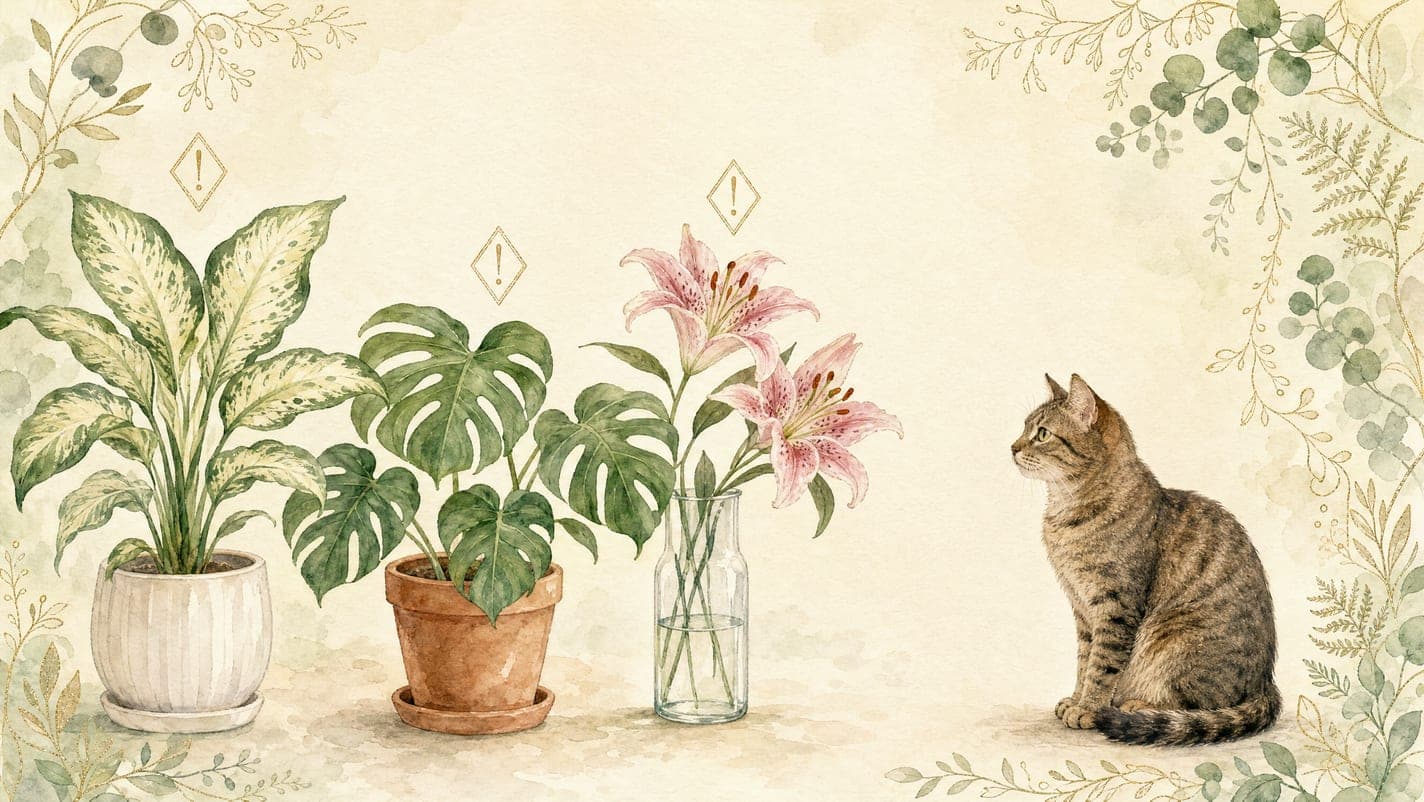
The risk is not those plants. It is that the same instinct sends the cat at pothos, dieffenbachia, or peace lily. According to the ASPCA, all three contain insoluble calcium oxalates: the leaves carry crystals that can cause oral irritation, intense burning of the mouth and tongue, drooling, vomiting, and difficulty swallowing when chewed. Those crystals are not absorbed systemically, so they do not damage organs the way true lilies do — peace lily is a Spathiphyllum, not a lily, and it is the true lilies (Lilium) and daylilies (Hemerocallis) that are associated with acute kidney injury in cats. That distinction is not a reassurance: a bad mouthful of oxalate crystals is genuinely painful. The ASPCA Animal Poison Control Center line is (888) 426-4435.
Unsure what you own? Our pet toxicity checker searches cat and dog toxicity by plant name, and our list of toxic houseplants to avoid covers what we would not keep in a chewer's house.
Reason 2: Digging Means the Pot Reads as a Litter Box
A digging cat is usually not interested in the plant.
Cats bury waste and choose the substrate that feels right underfoot, and potting mix is loose, granular, and slightly damp — a fair description of cat litter. Pets Best lists three usual drivers when a cat starts using pots: the box is not clean enough for that cat's standards, it is too small or badly located, or the cat prefers the texture of soil. Preventive Vet makes the same point about cleanliness and size, adding that the box should be at least as long as the cat from nose to tail tip. And substrate preference is measurable, not folklore: a field study by Villeneuve-Beugnet and Beugnet in the Journal of Veterinary Behavior found cats significantly preferred clay and silicate litters over wood pellets.
So audit the box before you touch the plants: scoop daily at minimum, check it is big enough to turn around in and sits somewhere quiet. If this started suddenly, call your veterinarian — urinary discomfort is a common reason cats begin avoiding a box, and it is not something you can rule out from the sofa.
Then Make the Soil Unpleasant to Stand On
Once the box is genuinely sorted, cover the soil. This is the one physical intervention we would call reliable, because it works on texture rather than opinion.
Preventive Vet suggests covering the soil with small decorative rocks. Other pet-safety and gardening publishers extend the same idea to river rock, lava rock, seashells, pine cones, or plastic mesh. A few rules:
- Use stones too big to bat around. Preventive Vet's advice is that if your cat starts batting the small pebbles around, switch to a larger, heavier one.
- If you use pine cones, use dry ones, not fresh, sappy ones straight off a tree.
- Choose materials that are safe if chewed, because at some point one will be.
- Leave the crown clear. Piling top dressing against the stem traps moisture at the worst possible point.
A chunky mineral layer changes how the pot dries, so check moisture by finger for a few weeks; our soil and potting mix guide covers what a covered surface does to drainage. Mesh cut to fit under the top dressing installs most easily during a repot — see our repotting guide for timing. A heavy, narrow-necked pot works too.
Reason 3: Batting and Knocking Things Off Is Play
If the plant is intact on the floor and the soil is undisturbed, you have a bored cat with access to a ledge.
The fix is placement plus enrichment. The AAFP and ISFM Feline Environmental Needs Guidelines describe vertical space as a core need: raised areas let cats survey their territory, and shelving, perches, and climbing structures make otherwise unusable volume in a room accessible. A cat with three legitimate high places spends less time auditing yours.
Then move the plant. The Mkono macrame hanger is a 35-inch cotton cord hanger that fits planters up to 9 inches across and was $7.99 as of July 2026; pot and plant are not included. Hang it clear of any shelf or cat tree the cat can launch from, or you have built a piñata. Trailing species suit this best, and pet-safe hanging plants are a category worth building around if you have a determined jumper.
The complication is light. "Somewhere the cat cannot reach" usually means a high shelf or an interior wall, both darker than a windowsill, so pick species that tolerate the shade. Our roundup of pet-safe plants for low light is built for this trade-off, and cast iron plant, prayer plant, and baby rubber plant are reasonable candidates.
Reason 4: One Plant, Obsessively, Is Worth Mentioning to Your Vet
Set aside the cat that grazes casually. If a cat starts eating non-food material persistently, or its appetite or behavior changes suddenly, that is a veterinary conversation rather than a deterrent problem.
Persistent chewing and swallowing of non-nutritional material is known as pica. Veterinary sources including the UC Davis School of Veterinary Medicine and VCA Animal Hospitals describe several possible contributors — gastrointestinal, metabolic, and neurological conditions among them, alongside stress and boredom — and advise investigating medical causes before treating the behavior as purely behavioral. Siamese and Burmese cats are noted as more prone to wool-sucking and chewing.
We are not going to guess at your cat from here, and no article should. But swallowed plant material can cause an intestinal obstruction, and a sudden change in eating behavior is one of the few signals a cat reliably gives you. Your veterinarian — or a qualified feline behavior consultant, if it turns out not to be medical — is the right next step.
What Actually Works, Ranked Honestly
These are not equivalent, and the usual nine-hacks list presents them as if they were.
1. Redirect to cat grass. Cheap, addresses the actual behavior, and the only item here that gives the cat something rather than taking something away.
2. Physical barriers on the soil. Reliable for digging, because texture is not negotiable.
3. Placement — height, hangers, closed doors. Unglamorous and close to fully effective. A plant in a room the cat cannot enter is not a behavior problem.
4. Species substitution. If a plant keeps getting chewed, the fastest fix is often a different plant. See cat-safe houseplants for non-toxic options and our pet safety and plant toxicity guide for the reasoning behind the lists.
5. Aluminum foil and double-sided tape. These work for some cats and not others. Worth a free week's trial; we would not build a plan around them.
6. Commercial deterrent sprays. The weakest tier we would still consider.
Not on the list: the spray bottle. Squirting a cat is widely recommended and widely advised against by people who work with cat behavior. The consistent objection across behavior consultants and vet-reviewed pet publications: the cat does not connect the water with its own behavior — it connects it with you, and loses trust in the process. We would skip it.
On Deterrent Sprays, Specifically
Cats do have a far sharper sense of smell than we do, and strong scents can genuinely be aversive. Cats Protection says cats rely much more on scent than on eyesight, and that orange peel left among soil may put some cats off digging in it. But "cats hate citrus" is repeated more confidently than the evidence supports: none of the sources we found claim it works on every cat, none say how long a given application keeps working, and nobody offers a controlled trial showing a citrus product stops plant chewing.
If you want to try one, treat it as a low-confidence experiment. The TPBEHMZ two-pack is two 7-ounce orange-scented bottles, $22.99 as of July 2026. The maker states the formula uses natural plant extracts including citrus and rosemary and is non-toxic and safe for cats and kittens, and markets it for scratching and chewing on furniture and carpets. That is the manufacturer's claim, not a finding, and not a plant-specific product.
You will also see Nature's Miracle's training spray suggested here — $12.72 for 24 ounces as of July 2026, which the maker states deters cats from revisiting a treated spot and is safe for pets and home when used as directed. Read the label: it is marketed for urine-marking rather than plant chewing, and its repellent scent is essential-oil-based. For the reason below, that is not what we would put on a leaf a cat mouths.
Whatever you use, read the full label, test one leaf first, keep the cat off treated surfaces until dry, and stop if you see any reaction.
The Essential Oil Warning DIY Deterrent Advice Skips
Plenty of homemade deterrent recipes tell you to mix citrus, tea tree, eucalyptus, or peppermint oil with water and spray it on your plants. We are not publishing one.
The Merck Veterinary Manual states that cats are deficient in the liver enzyme glucuronyl transferase, and that this deficiency makes them very sensitive to the phenolic compounds some oils contain — which is why oils that people or dogs tolerate can affect cats differently. VCA Animal Hospitals puts it the same way: cats have fewer of the liver enzymes needed to metabolize these oils. Between the two, the oils flagged as hazardous include tea tree, eucalyptus, peppermint, citrus, pine, wintergreen, cinnamon, pennyroyal, and ylang ylang, and VCA notes that exposure routes include skin contact and grooming, not only swallowing.
The ASPCA's own guidance is that concentrated tea tree oil may cause problems "with only seven or eight drops," that a scent seeming light to us may be overwhelming to a pet, and that it is best to completely avoid applying essential oils directly to your pet. A cat brushes a treated leaf, picks up residue on its coat, and grooms it off. That is the exact route you do not want.
Commercial repellents are formulated at dilutions their makers consider safe, so none of this makes every scented product dangerous. It does mean a homemade oil spray, mixed by eye, on a plant your cat already mouths is a poor trade for something that may not work anyway. If you have used one and your cat seems unwell, the APCC number is (888) 426-4435.
Your First Two Weeks
Cheapest and most reversible first:
- Watch and classify. Chewing, digging, batting, or fixating — and which plants.
- Start cat grass now. It needs about a week, so it can sprout while you do the rest.
- Audit the litter box if there is any digging: cleanliness, size, location.
- Top-dress the targeted pots. Stones too heavy to bat, crown left clear.
- Move the plants that keep losing. Height, a hanger, or a closed door.
- Only then consider a spray, with the label read and one leaf tested.
- Book the vet for anything sudden, persistent, or focused on one object.
Give each change two weeks. Change five things at once and you learn nothing about which one worked.
What to Do Next
Cats will keep being cats. The realistic goal is not a cat that ignores plants; it is a house where the chewing lands on grass, the digging is physically impossible, and the plants worth losing are not the toxic ones.
If you are building a collection from scratch, start with our guide to pet-safe houseplants, and pair it with our best first houseplants roundup — the tough, forgiving species are also the ones that shrug off a chewed leaf.
Keep the APCC number, (888) 426-4435, somewhere you can find it at midnight.