This guide contains affiliate links. We may earn a small commission if you purchase through our links, at no extra cost to you.
You have three options for overwintering geraniums indoors, and the same three apply to hibiscus and mandevilla: keep the plant growing in your brightest window, store it dormant in a cool dim room, or store it bare-root and take cuttings. Which one wins depends on your light and your basement more than on the plant, and the frost forecast sets the deadline.
Most advice blurs that choice by presenting one method as the method. These are not houseplants: they summered on a patio and they die at frost. This is the patio-plant chapter of our guide to bringing potted plants indoors for winter.
First, Decide Whether the Plant Is Worth Saving
An Illinois Extension news release by Edgar County Master Gardener Jan Phipps is blunt about small bedding stock: saving petunias, marigolds and snapdragons "doesn't work very well, and at $2 per 4 or 6 pack, it is hardly worth the trouble, space, or mess." Missouri Botanical Garden is equally candid about zonal geraniums — "many gardeners simply grow them as annuals and repurchase new plants each spring."
Save a plant when it is not interchangeable with a $4 pot in May: a cultivar you can't find locally, a hibiscus standard you spent four years training, something a relative gave you. Otherwise, buying new is the right answer.
The Deadline Is the Frost Forecast, Not a Comfort Threshold
Tropical houseplants come in on a comfort number around 55°F. These are judged differently, because they are frost-tender. Illinois Extension's Good Growing blog: "Geraniums must be dug or moved indoors before the first frost, so don't wait until the last minute." Iowa State University Extension agrees — dig "before the first fall frost." Wisconsin Horticulture sets the limit one step later: dig them "again before a hard freeze."
Treat that as a window, not a contradiction. Light frost may only scorch leaf tips; a frozen stem rarely recovers, whichever strategy you planned. Working backward from your own first-frost date is covered in when to bring plants inside.
Strategy 1: Keep It Growing in Your Brightest Window
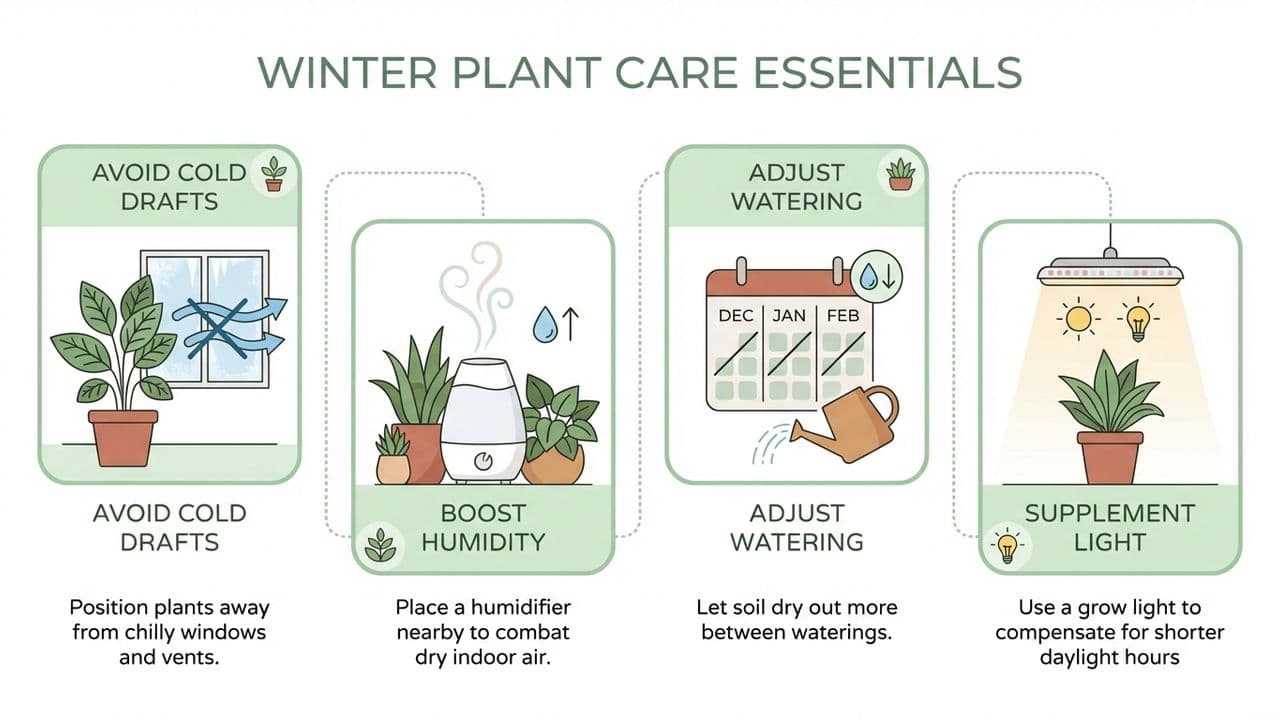
Pot the plant up if it was in the ground, cut it back to fit, put it in the best window you have, water less, stop feeding.
Illinois Extension prunes geraniums "by one-third to one-half" on the way in, then treats them as houseplants at around 65°F by day "with nighttime temperatures slightly cooler." Wisconsin Horticulture keeps them off heat vents because they "fare much better in cooler temperatures (60 to 65 degrees F)," and waters "when the soil feels dry to the touch."
Cost: a south window, plus five months of weekly attention.
March outcome: not good. Iowa State University Extension is blunt — "Geraniums are likely to become tall and lanky by late winter" — and Illinois names the cause: "They will become lanky when grown in warm conditions and not given enough light." Leggy, pale and flowerless is normal in an average window, not a sign you did something wrong.
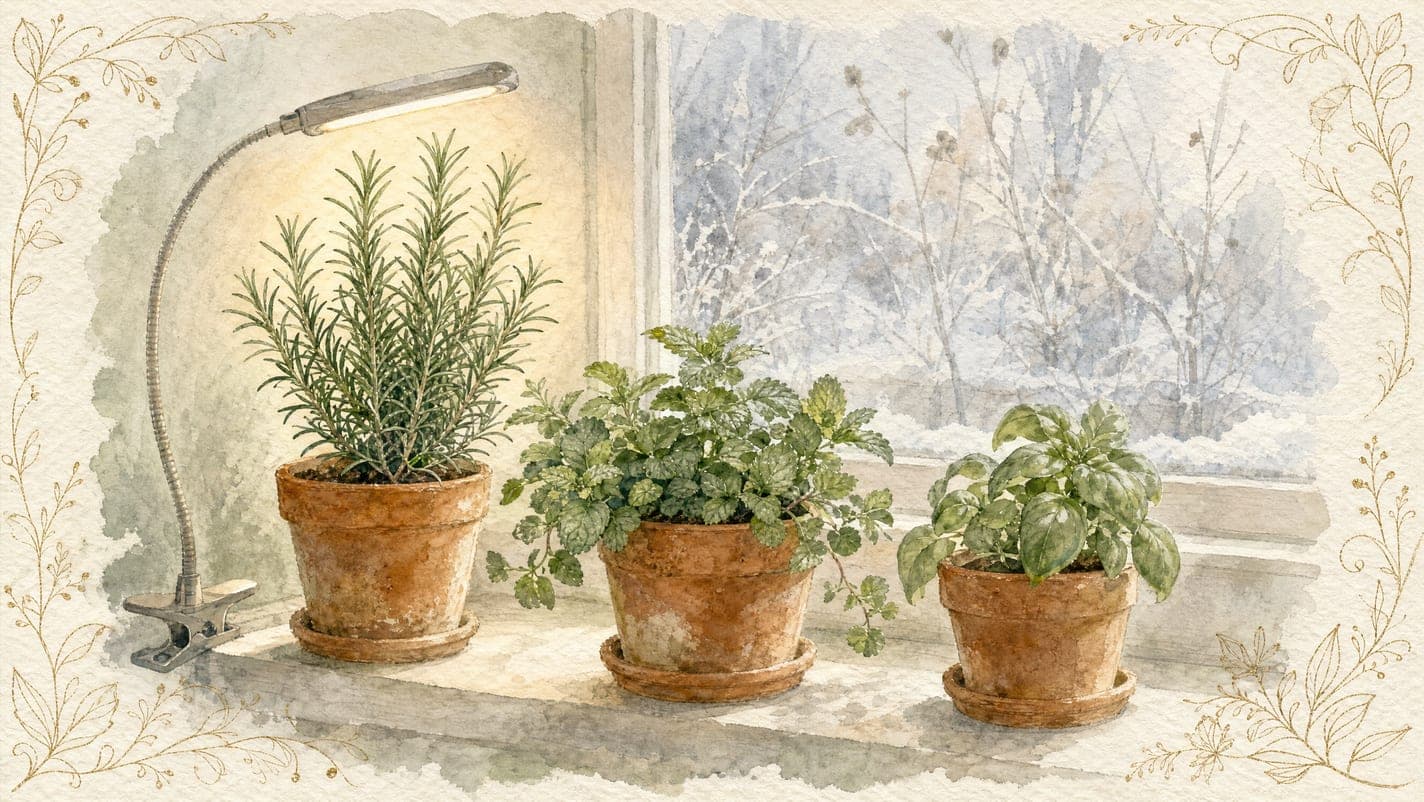
How it fails: light. So add light rather than hope. Iowa State's supplemental-light guidance is to install an LED or fluorescent grow light per the package directions and "leave lights on for 14 hours a day," never "less than 8 hours or more than 16 hours."
A clamp fixture is the low-commitment version. The GooingTop Grow Light is about $20.99 as of October 2026; GooingTop describes it as a 6000K lamp with 10 red and 74 white LEDs, rates its draw at about 10 W, and lists timer settings of 4, 8 or 12 hours — so 12 hours is its ceiling, short of Iowa State's 14, and a cheap outlet timer fixes that. Those are the manufacturer's specifications, not our test results. Our grow lights guide covers fixtures and mounting distance.
Strategy 2: Dormant Storage in a Cool, Dim Room
Cut the plant back, move the whole pot somewhere cool and dim, water just enough to keep the roots alive. No window needed.
"Cool and dim" has numbers, though most of the published ones are for bare-root storage rather than whole pots. For bare-root geraniums, Illinois Extension specifies "a cool (45-50°F), dry location" and Iowa State "a cool (45 to 55 degree Fahrenheit), dry location," suggesting an unheated bedroom or indoor porch; for pots, Missouri Botanical Garden gives no number at all, just "a cool dark corner of the basement or frost free area of a garage." Iowa State's figure for a potted fuchsia is the low end, a "cool (40 to 50°F), dimly lit location." Call it roughly 40–55°F, dim, on the dry side — and per University of Maryland Extension, "water sparingly to keep the roots alive. But do not let plants sit in wet soil."
The garage warning matters. An attached garage in a cold climate can drop below freezing — Iowa State University Extension warns that "Most garages, even though attached, can get below freezing during extreme weather, making them too cold for survival." Illinois Extension's requirement is emphatic: a garage or shed "that gets cold but doesn't freeze, ever." Leave a min/max thermometer there for a week first.
Cost: almost nothing but floor space. March outcome: leafless and alarming. University of Maryland is reassuring — "With little or no light all of the leaves will drop but this is not a concern."
How it fails: at both extremes of water. A soaked pot in a cool dark room rots; a bone-dry one kills the roots. Illinois describes the target as "just moist."
One upside: for zonal geraniums, Missouri Botanical Garden holds that "Dormant overwintering is generally advisable in order to promote the most vigorous flowering the following season." It lists the same two options for scented-leaf pelargoniums such as Pelargonium radens.
Strategy 3: Bare Root and Cuttings
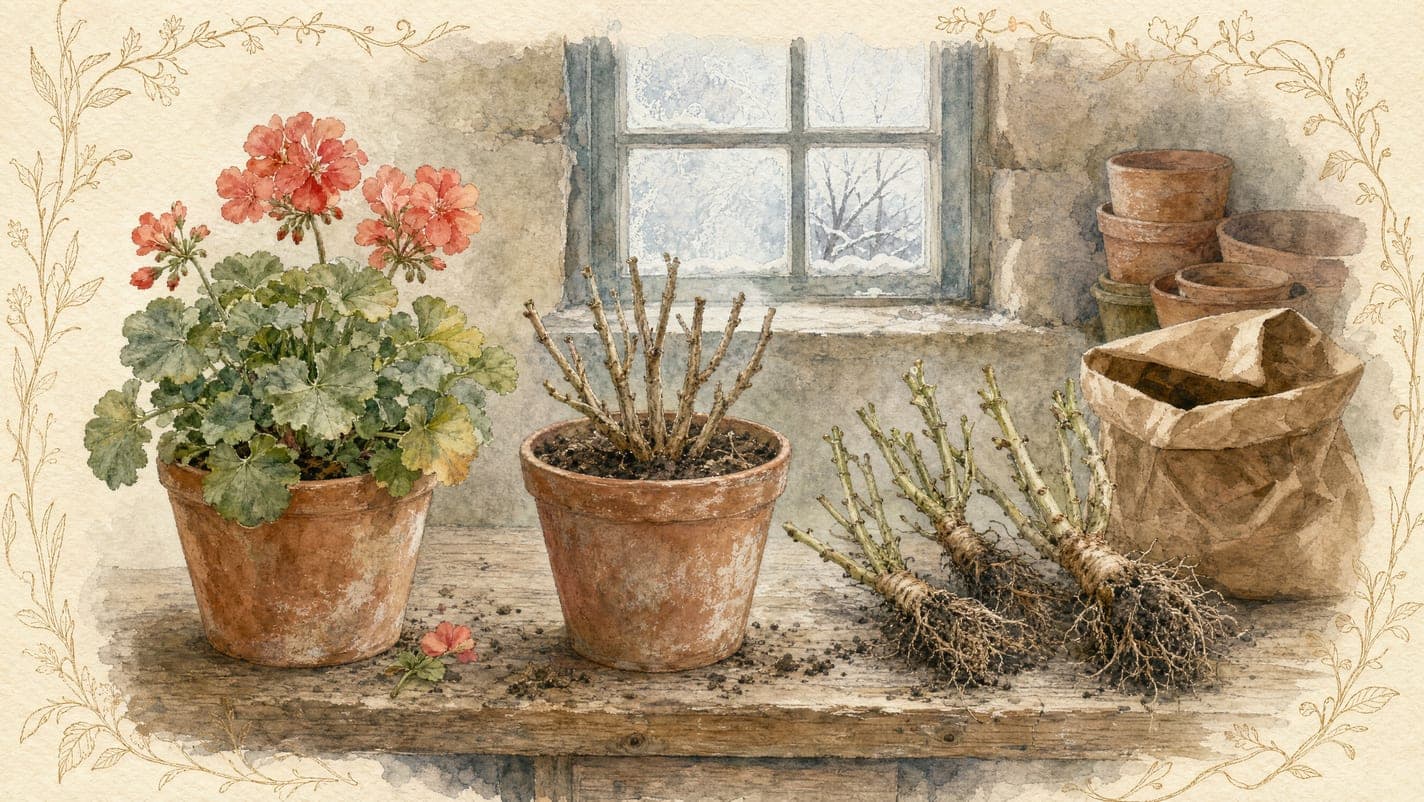
Bare root geranium storage is the classic extension technique. Iowa State digs before the first fall frost, shakes the soil from the roots, and places "one or two plants in a large paper sack" stored in "a cool (45 to 55 degree Fahrenheit), dry location"; the alternative, which it calls "somewhat messier," is hanging them upside down. Wisconsin Horticulture says to keep the bag open "to allow for good air circulation." Then you wait, and it looks dead — Wisconsin: "Don't be surprised when the leaves start to dry up and fall off." In March, cut back to living tissue and pot up.
Be honest about the odds. Wisconsin Horticulture doesn't oversell it: "Storing bare-root geraniums can be a challenge. You might want to experiment with several plants and take cuttings just in case the original plants don't survive."
Cuttings are the more reliable version of the same idea — several small plants instead of one big dry gamble. Iowa State: "take 3- to 4-inch stem cuttings from the terminal ends of the shoots," pinch off the lower leaves, dip in rooting hormone, stick them in vermiculite or a perlite-and-peat mix, cover with a clear bag, and keep them out of direct sun. Rooting takes "6 to 8 weeks" by Iowa State's count and "4-8 weeks" by Illinois Extension's. Take them in late summer. Our propagation methods guide covers technique.
Plant by Plant: Which Strategy to Pick
Geraniums (Pelargonium, Not Geranium)
All three strategies work, which makes these the most forgiving plants here. Default to dormant storage if you have the space, cuttings if you don't.
Mind the name collision, because it inverts the advice. Illinois Extension: "Annual geraniums aren't 'true' geraniums; they are members of the genus Pelargonium, while true geraniums, like wild geranium, are in the genus Geranium." If you searched for overwintering geraniums you mean Pelargonium — the zonal, ivy-leaf and regal types sold in flats and patio pots, listed by Missouri Botanical Garden as winter hardy to USDA Zone 10-11. Hardy Geranium species stay outside.
What goes wrong: waiting for a hard freeze, or "storing" the plant in a heated basement at 65°F, where it neither grows nor sleeps.
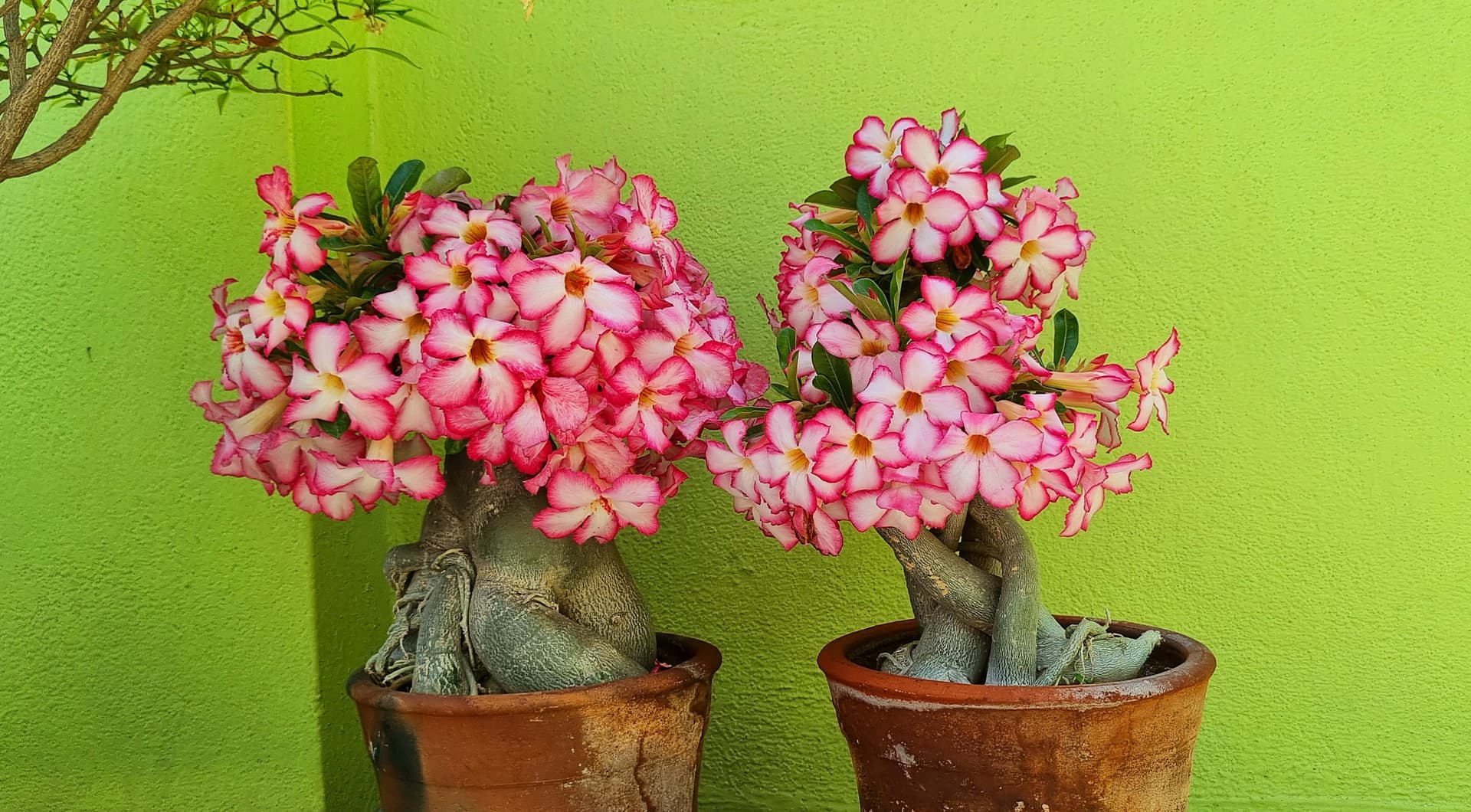
Tropical Hibiscus (Hibiscus rosa-sinensis)
Default: keep it growing, because a hibiscus in a bright warm room earns its keep. Dormant storage is the fallback.
Know which hibiscus you have: Missouri Botanical Garden describes Hibiscus rosa-sinensis as "a frost tender evergreen," winter hardy to USDA Zones 10-11, while hardy hibiscus (Hibiscus moscheutos) is listed at Zone 5 to 9 and stays outside.
Chicago Botanic Garden says tropical hibiscus "should be moved indoors well before the first fall frost" and "overwinter best indoors if provided with bright light and warm temperatures," with "consistent moisture, but do not allow the plant to stand in water." Missouri Botanical Garden's culture notes run cooler — overwinter "in 60 degree F. locations with reduced watering and reduced fertilization." No sunny window? University of Missouri Extension's fallback is to "put hibiscus in a cool location and let leaves drop and go dormant during the winter," roots kept "barely moist." Expect sparse flowers at best; Missouri says plants in a sunny window "often bloom during winter, although flower production is sparse."
Leaf drop on arrival is expected. Chicago Botanic Garden: "Do not be alarmed if your hibiscus loses all of its leaves shortly after moving them indoors; this is normal."
Whitefly is the signature problem. Chicago Botanic Garden states it flatly — "Hibiscus commonly attract whitefly" — and says to "Check the plants for insects prior to moving them indoors." University of Missouri Extension's whitefly publication explains how a few hitchhikers become a January infestation: they "can be found on the undersides of leaves," and "Adult females usually lay between 200 and 400 eggs." Infested leaves "often turn yellow, appear dry and drop prematurely."
Control is slow, because eggs and pupae "are generally not as susceptible to insecticides as are the nymphs and adults." Missouri says eradication "usually requires four to five applications of a registered insecticide at five- to seven-day intervals," applied "to the lower leaf surface." Insecticidal soap and horticultural oil are on its list of over-the-counter options; we don't recommend systemics such as imidacloprid indoors. "Follow label directions carefully," and test any spray on one leaf first.
Two non-spray tactics help: yellow sticky traps — "The adults are attracted to the yellow color and become trapped" — and a hand vacuum, used "in the early morning when the temperature is cool and they are slow-moving." Our whiteflies on indoor plants guide has the protocol.
Mandevilla
Default: cut it back hard and store it cool. It regrows from the base, which is the appeal for a vine that would otherwise need a trellis indoors.
Sources agree on severe and differ on when. University of Missouri Extension: "This vigorous vine needs severe pruning before being moved indoors to a sunny location. Additionally, it may need more pruning during the winter." Missouri Botanical Garden defers the cut: "Prune plant stems back before placing them outside in spring after last frost date." The only hard number we found is Illinois Extension's, for plants stored in a never-freezing garage — in spring, "prune them back to 4 to 6 inches. The Mandevilla can remain longer."
Missouri Botanical Garden lists mandevilla as winter hardy to USDA Zones 10-11 and notes the stems "exude a milky sap when cut," so wear gloves. If a pet chews anything you bring in, call your vet; ASPCA Animal Poison Control is (888) 426-4435.
What goes wrong: trying to keep it in full leaf, on its trellis, in a dim room. Missouri's alternative is "a cool location that does not freeze"; University of Maryland Extension likewise says mandevilla can be "allowed to go dormant."
Fuchsia, Coleus and Begonias, Briefly
Fuchsia: dormant storage. Iowa State's recipe is a cool (40 to 50°F), dimly lit basement or porch, watered "sparingly (about once every 3 or 4 weeks)," out in March for a severe prune. Coleus: cuttings; Penn State Extension groups coleus with geranium for stem-cutting propagation. Tuberous begonias are stored as tubers, which Iowa State lists at 40-50°F. Herbs and citrus are separate projects: see overwintering herbs indoors and overwintering citrus indoors.
Inspect for Pests Before Anything Crosses the Threshold
Illinois Extension's warning is the whole argument: infested plants "will be difficult to overwinter, and you run the risk of the disease or pests spreading to other plants."
University of Maryland Extension's overwintering checklist names the culprits — "scale, mealybugs, aphids, whitefly, and spider mites" — and tells you to look for "webbing, honeydew (a sticky substance found on leaves), stippling (tiny yellow spots), or a white, waxy substance." Missouri Botanical Garden's notes for mandevilla single out "whiteflies, spider mites and mealybugs, particularly on overwintering plants." Maryland also explains why indoors is worse: "Outdoors, pests are kept in check by natural parasites and predators." The full sequence is in our guide to debugging plants before bringing them inside.
What Winter Actually Looks Like
Worse than when the plant came in — normal, not failure, and the main reason people bin living plants in February. Illinois Extension's summary of overwintered annuals is the line to remember: "They will look awful for most of the winter, constantly dropping leaves and getting leggy."
The "is it dead?" test is the one the bare-root instructions already use: scratch a stem and look for firm, green, live tissue. Iowa State's March step is to "Remove all shriveled, dead material. Prune back to firm, green, live stem tissue," and Wisconsin Horticulture cautions that bare-root plants "may take a while before they begin growing again." Green under the skin means alive — don't bin anything before April. If a plant is merely leggy, Wisconsin's fix is to "prune or 'pinch back' stems just above a leaf node." Our winter care guide covers the rest of the shelf.
Spring: Cut Back, Then Feed, Then Acclimate Slowly
The order matters, and it starts earlier than people expect.
Cut back in March. Iowa State prunes potted geraniums "by one-half to two-thirds" and expects growth "within a few days." Bare-root plants get cut to live tissue and potted up.
Then feed — not before. University of Maryland waits until April to "move the plants to a sunny location indoors, increase watering, and fertilize," and on the houseplant route holds fertilizer "until you see new growth in later winter or early spring." For hibiscus, Chicago Botanic Garden pairs the haircut with feeding: "prune back all leggy growth in late winter and begin fertilizing with a well-balanced fertilizer every two weeks."
Then acclimate gradually. A plant that spent four months in a basement can scorch in May sun. Iowa State's fuchsia instruction is the model: after frost danger passes, "Initially, place the plants in a shady, protected location outdoors," where they "should acclimate to their outdoor environment in a few days." Chicago Botanic Garden moves hibiscus into full sun only "after all danger of frost has passed." The schedule is in putting plants back outside in spring.
Frequently Asked Questions
How do I overwinter hibiscus indoors?
Bring it in well before the first fall frost, check it for whitefly, then pick a lane. Chicago Botanic Garden says tropical hibiscus "overwinter best indoors if provided with bright light and warm temperatures." Without that window, University of Missouri Extension's fallback is a cool location where the leaves drop and the plant goes dormant, roots kept "barely moist."
How do I overwinter mandevilla?
Cut it back hard and store it cool. University of Missouri Extension calls for "severe pruning before being moved indoors to a sunny location," and offers a dormant option — "a cool location that does not freeze." Missouri Botanical Garden prunes in spring instead, so the timing is genuinely unsettled; the amount isn't.
Does bare root geranium storage actually work?
Sometimes, and nobody pretends otherwise. The method is well documented — roots shaken clean, plants bagged or hung upside down at 45–55°F, cut back to firm green tissue in March — but Wisconsin Horticulture's own verdict is that "Storing bare-root geraniums can be a challenge." Take cuttings as insurance.
The Short Version
Match the strategy to your house, not to the plant. Real south light means you can keep a hibiscus or a favourite geranium growing. A cool basement or never-freezing garage means dormant storage — almost no effort, and for zonal geraniums Missouri Botanical Garden reckons it gives the most vigorous flowering next season. Neither? Take cuttings in late summer and compost the parent.
Whatever you choose: do it before the hard freeze, inspect for whitefly first, and don't judge these plants by February. For the rest of the move, start at our Indoor Move hub.