This guide contains affiliate links. We may earn a small commission if you purchase through our links, at no extra cost to you.
Your succulent is stretching because it is not getting enough light. The horticultural word for it is etiolation — the plant is elongating the stem between its leaves to push its rosette closer to a light source. It is almost never the watering, the pot or the fertilizer. And here is the part most articles skip: the stretched section never shrinks back.
That changes what "fixing" means. You are not restoring the plant you had — you are stopping the stretch and then deciding whether to live with the tall version or cut it up and restart a compact one. Both are legitimate. Our broader guide on how to care for succulents indoors covers the conditions that prevent this in the first place, and the single most important of them is how much light succulents actually need.
What Etiolation Actually Is
Etiolation is a well-described light response, not a disease. The LibreTexts Botany textbook puts the anatomy plainly: plants grown in the dark "have elongated stems, are white or yellow (due to lack of chlorophyll), and have small leaves," and a dark-grown seedling looks taller because "its internodes are greatly elongated." The same text calls it "a mechanism that increases the chance that the plant will access light."
The trigger is hormonal. In the shade avoidance response, LibreTexts notes, phytochrome-interacting factors "turn on the genes needed for auxin synthesis, and auxin stimulates stem elongation." The plant spends stored energy on reach instead of bulk.
On a succulent it shows up as a specific cluster of symptoms:
- Longer gaps between leaves. A rosette that was a tight spiral becomes a spaced-out spiral climbing a bare stem.
- Smaller, paler, thinner leaves. Less chlorophyll, less stored water.
- A lean toward the window.
- Weaker structure. The New York Botanical Garden's care guide for African milk tree says it directly: "Without extended, direct light, your plant will begin to stretch and may have difficulty supporting itself."
Iowa State University Extension compresses the diagnosis into eight words: "In low light, plants become lanky and pale."
The Honest Bad News: It Does Not Reverse
Move an etiolated succulent into good light and the new growth comes in tight. The stretched growth stays exactly as stretched as it was — there is no cell in a stem that un-elongates.
So the realistic outcome of "just give it more light" is a plant with a long bare stem, a spaced-out middle and a suddenly compact new top. Some like that look; most find it odd, which is why beheading is the standard fix rather than a drastic one.
Fix the light either way. Whether or not you cut, the light has to change first, or you will simply etiolate the new growth too.
Is It Really Etiolation? A Quick Differential
Not every tall succulent is a stretched one. Check these before you reach for the snips.
- Even elongation, pale color, increasing leaf spacing, leaning → etiolation. Fix the light.
- Reaching hard in one direction only, otherwise normal color and spacing → directional light, not a light shortage. Rotate the pot. Iowa State Extension recommends you "rotate plants to prevent lopsided growth."
- Soft, mushy, darkening tissue at the base; translucent squashy leaves → not stretching, but rot, and light will not touch it. See how often to water succulents indoors and healthy roots versus root rot.
- Long stems that were always long → some species are trailing or shrubby by design. String of hearts, string of dolphins and burro's tail grow on long trailing stems, and elephant bush and jade build woody trunks with age. Judge leaf spacing and color, not overall height.
- Stretch that started in November → seasonal. Indoor light collapses in winter and rebounds in spring; our winter care guide covers the cold-season adjustment.
If the plant is pale but the spacing looks normal, something else may be going on — yellowing leaves have a longer list of causes than light alone.
Fix the Light — But Move the Plant Slowly
Iowa State University Extension sets the target high: indoor succulents "need ten or more hours of bright, indirect light (indirect light is bright enough to cast a shadow, but not in direct sun)," and though some species tolerate less, "most need at least six to eight hours."
Here is the trap. An etiolated plant has been living in shade, and dropping it straight into an unobstructed south window frequently trades stretching for scorched leaves. Growers commonly recommend acclimating over two to three weeks — start with an hour or two of the brighter light and build up.
If the window cannot deliver, add a lamp instead of arguing with the architecture. Iowa State's advice is to "move them to brighter locations or use supplemental light like high-output, full-spectrum light fluorescent or LED light fixtures." A clip-on fixture like the GooingTop 6000K Full-Spectrum Grow Light (about $20.99 as of August 2026) is the cheapest way to test that. According to GooingTop, it runs 10 red plus 74 white LEDs, draws about 10 watts and has a timer with 4, 8 and 12-hour settings — the timer matters most, because consistency beats intensity here. Our grow lights guide covers placement and run times, and the general light requirements guide explains how to read a window.
If you would rather measure than guess, the TopTes TS-710 light meter (about $28.49 as of August 2026) settles the argument; TopTes states it reads 0.1 to 200,000 lux and 0.1 to 20,000 foot-candles.
How to Fix a Stretched Succulent: Four Options, Ranked
1. Do nothing
Genuinely valid. An etiolated succulent is not sick. Fix the light, let the new growth come in tight, and move on.
2. Behead it — the standard repair
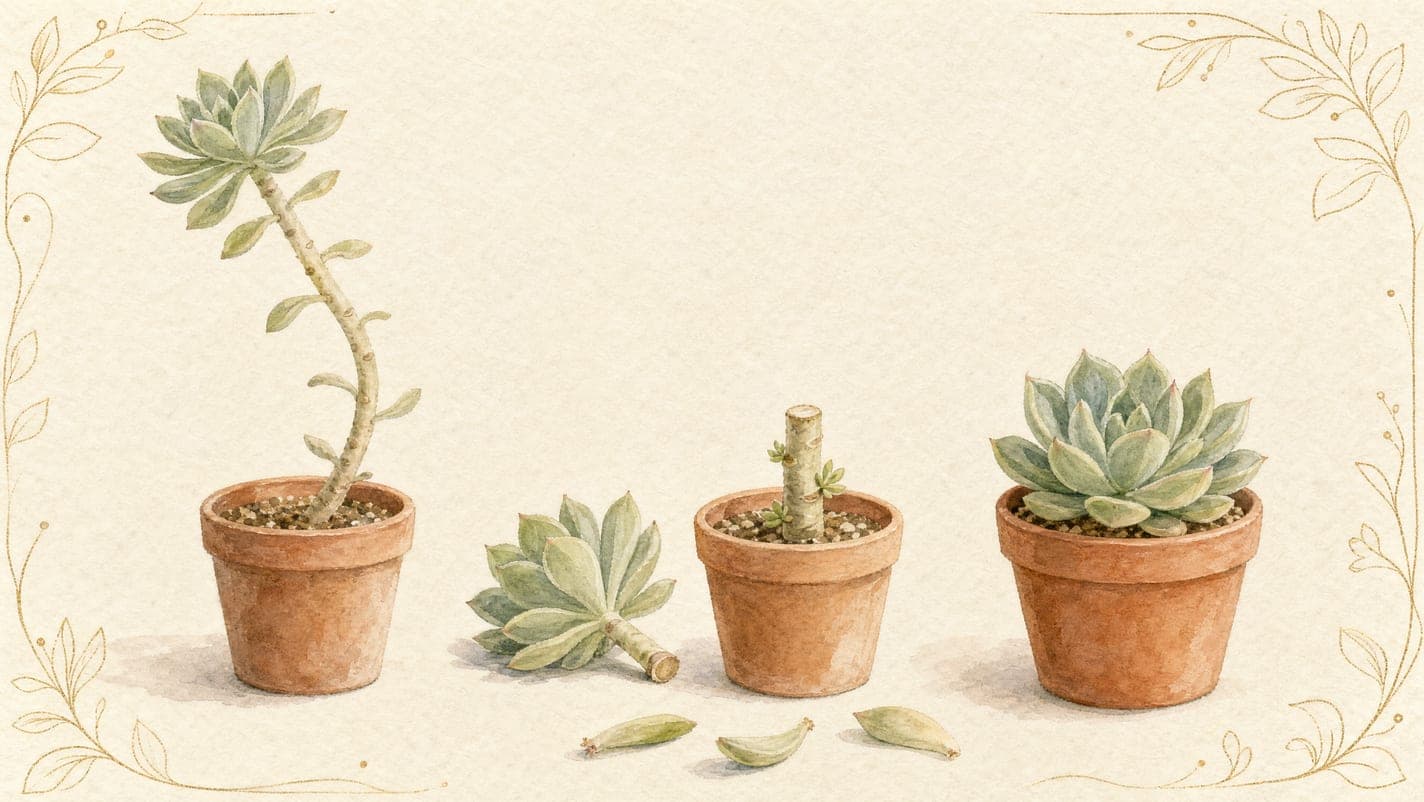
This is the real answer, and it produces more plants, not fewer. Iowa State University Extension describes beheading as a variation on stem cuttings in which "the entire rosette is cut off with an inch or two of stem attached." For a longer bare stem, its stem-cutting instructions call for removing "a section of stem 3 to 6 inches long using clean, sharp pruners or scissors."
- Cut clean. A crushed cut heals slowly and invites rot, so thin sharp blades matter more than expensive ones. The Fiskars 6-Inch Micro-Tip Pruning Snips (about $12.89 as of August 2026) are what we keep on the shelf; according to Fiskars, the micro-tip blades "cut all the way to the tip for clean, healthy cuts," which is the whole point on a half-inch stem. Wipe blades with alcohol between plants.
- Strip the lower leaves. Illinois Extension notes that for rooting you want "at least 1 or 2 sets of nodes (where you removed the leaves from)" in the growing media. Save the leaves — see option 3.
- Let it callus. This is the step people skip, and then the cutting turns to mush. Iowa State says to "allow the cut end to dry and callus over" for several days; Illinois Extension recommends you "let it set on the counter for 4-7 days." Sources differ on the exact window, so treat four to seven days in a dry, shaded spot as the range and go by feel: the cut should be dry and firm, not wet.
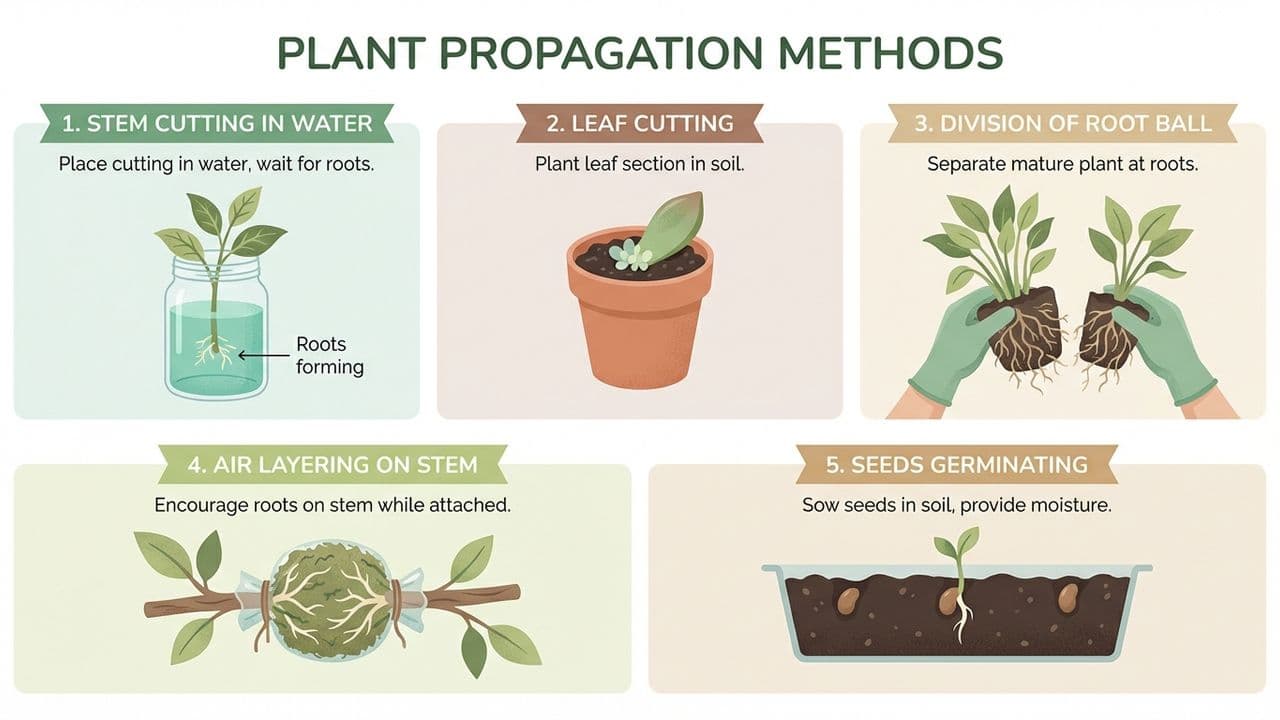
- Plant it in dry, gritty mix and hold off on watering until roots form. Our propagation methods guide covers rooting media, and how often to water succulents indoors explains why a rooting cutting wants far less water than an established plant.
- Keep the stump. Iowa State reports that after beheading, "multiple side rosettes will develop on the stalk left behind," and those can be harvested after several months or grown on as a cluster. One leggy plant becomes a rooted top plus several offsets.
One safety note. If you are cutting a euphorbia — African milk tree is the common leggy offender — wear gloves and eye protection. Poison Control warns that the milky white sap of Euphorbia (spurge) plants "can be very irritating to the skin, eyes, and mouth." The New York Botanical Garden gives the same instruction: "Take care to use gloves and protective eyewear when handling this plant." Wash off any contact promptly and seek medical advice for eye exposure.
3. Leaf pulls from the bare stem
The stripped leaves are free plants, and technique is everything. Iowa State Extension states flatly that "partial pieces of leaves will not root," so you need the whole leaf, cleanly detached at its base — twist gently side to side rather than pulling straight out.
Let them callus, then lay them on slightly moist cactus mix. Iowa State's moisture instruction is the second-most-skipped step: "Keep the soil surface damp, but not wet. A spray bottle is an effective way to wet the soil surface without getting the soil too wet." New roots and rosettes form "in several weeks." Success rates vary by genus. Iowa State lists Graptopetalum, Pachyphytum, Sedum, Crassula and Kalanchoe as the genera leaf-cutting propagation "works well for"; growers widely report echeverias are similarly generous, and that aeoniums mostly are not. Our advanced propagation guide goes deeper.
4. Bury the stretch
Repot deeper so the leggy stem sits below the soil line — fast, no cutting, instantly tidier.
The honest caveat: you are putting stem tissue against damp mix, which is how stems rot. We would only do this in a very fast-draining, gritty mix, in a small unglazed pot, on a sparing watering schedule — and not at all on a plant that has already had rot problems. Lowest effort, highest risk.
Timing: When to Cut
Cut in spring or early summer if you can wait: growth is active, cuttings root faster, and the parent has the whole season to push offsets. The New York Botanical Garden recommends taking African milk tree cuttings "in late spring or early summer," and that timing generalizes reasonably well across indoor succulents.
Winter cuttings are not forbidden, just slow. Iowa State's fertilizer advice tracks the same calendar: feed "in the spring and summer months" and "avoid fertilizing in winter when they're not growing." If your plant stretched over winter, fix the light now and schedule the surgery for spring.
Cacti Etiolate Too — It Just Looks Different
On a cactus there are no internodes to count, so etiolation tends to read as a change in width. Growers commonly describe an under-lit globular cactus such as sand dollar cactus producing a narrower, paler cone of new growth on top of its original fat body — the "carrot top" look, with columnar cacti going thin and pale at the growing tip. We have not found an extension-service source that documents the cactus version specifically, so treat the description as grower consensus rather than published guidance.
The rules are identical: permanent, fixed by light, cosmetically repaired only by cutting. Cutting a spined plant is more awkward, so start with our indoor cactus care guide.
Preventing the Next One
- Light first. Match the plant to the window, not the decor. Aloe vera and jade want a genuinely bright spot; snake plant is one of the few that tolerates real shade without turning into a stick.
- Rotate the pot a quarter turn whenever you water. Iowa State recommends rotating "to prevent lopsided growth," and it costs nothing.
- Do not fertilize your way out of it. Feeding a plant that has too little light pushes soft growth it cannot support. Iowa State recommends succulent fertilizer only in spring and summer, at "one-half to one-quarter the rate listed on the label," and none in winter. See our fertilizing guide.
- Re-check every October. Most indoor stretching starts when the sun angle drops and nobody notices for two months. A plant that stretched last winter will stretch again unless something changes.
- Prune as you go. Iowa State's maintenance line is short: "Cut back leggy stems and remove crowded offsets for propagation."
The Short Version
Stretching is etiolation, etiolation is a light shortage, and the stretched stem is permanent. Fix the light gradually so you do not trade a stretch for a burn. Then choose: live with it, behead it and get more plants out of the deal, propagate the stripped leaves, or bury the stem and accept some rot risk.
Beheading is not a last resort — it is how experienced growers keep collections compact on purpose. Start there, and read our complete indoor succulent and cactus care guide for the conditions that keep the replacement growth tight.