This guide contains affiliate links. We may earn a small commission if you purchase through our links, at no extra cost to you.
The short answer to how to care for succulents indoors: put them in the brightest window you own, ideally south- or west-facing, in a gritty mix inside a pot with a drainage hole, and water thoroughly only when the soil has gone completely dry — usually every two to three weeks. Everything else is detail.
Here is the part the care tag never says. Succulents are sold as beginner plants, and they are not beginner plants. They are low-effort plants with high-light requirements, which is a different thing entirely. Almost every indoor succulent that dies died of the same mismatch: a plant adapted to open desert sun, put on a bookshelf six feet from a window, in water-retentive potting mix, in a decorative pot with no drainage hole, watered every Sunday because Sunday is watering day.
Fix the light and the drainage and succulents genuinely do become the easiest plants in the house. Skip those two and no amount of careful watering will save them.
What Counts as a Succulent?
"Succulent" is not a taxonomic group. It is a growth habit — what a plant does, not what family it belongs to. Any plant that stores water in thickened leaves, stems or roots gets the label, and that habit evolved independently in dozens of unrelated families.
Which produces the sentence everyone repeats and almost nobody explains: all cacti are succulents, but not all succulents are cacti.
Cacti are one family, Cactaceae, identifiable by one structure. According to the New York Botanical Garden, "areoles are the well-defined, small, fuzzy bumps on a cactus," and the spines and tufts emerge from them. No areoles, no cactus. That is the whole test.
It is a more useful test than it sounds. The African milk tree is a tall, ribbed, spiny green column that every garden centre shelves next to the cacti — and it is not a cactus. It is a Euphorbia. Its spines sit on the ridges with no areole underneath, and if you cut it, it bleeds white latex instead of clear sap. That matters practically: euphorbia sap is an irritant (see the pet note below).
The other thing most succulents share is a metabolism built for drought. Plants using crassulacean acid metabolism — CAM, named for the Crassulaceae, the jade and echeveria family, where it was first described — open their stomata at night to take in carbon dioxide and keep them closed through the heat of the day; Arizona State University's Ask A Biologist describes the captured carbon being converted to malate, then "turned into malic acid and stored" in the cell's vacuole. It is a spectacular water-saving trick, and it is also why succulents are so slow: fixing carbon on the night shift is not high-throughput. A plant that seems to be "doing nothing" for two months is often just being a succulent.
How Often to Water Succulents Indoors
The honest answer to how often to water succulents indoors is that you should stop asking about frequency and start asking about dryness. But since you need a number to start from, here is a real one: Illinois Extension advises that "generally, succulents need water every two to three weeks."
Then throw the calendar away, because that interval assumes a lot. A 3-inch terracotta pot in a hot south window might dry in five days. A 6-inch glazed pot in a cool north room can stay damp for six weeks. The New York Botanical Garden puts the range plainly for desert cacti: water thoroughly once the top inch of mix has dried, which "could be as often as once a week in hot, dry home or only every few weeks in a more humid, cool house."
The method that works indoors is soak-and-dry:
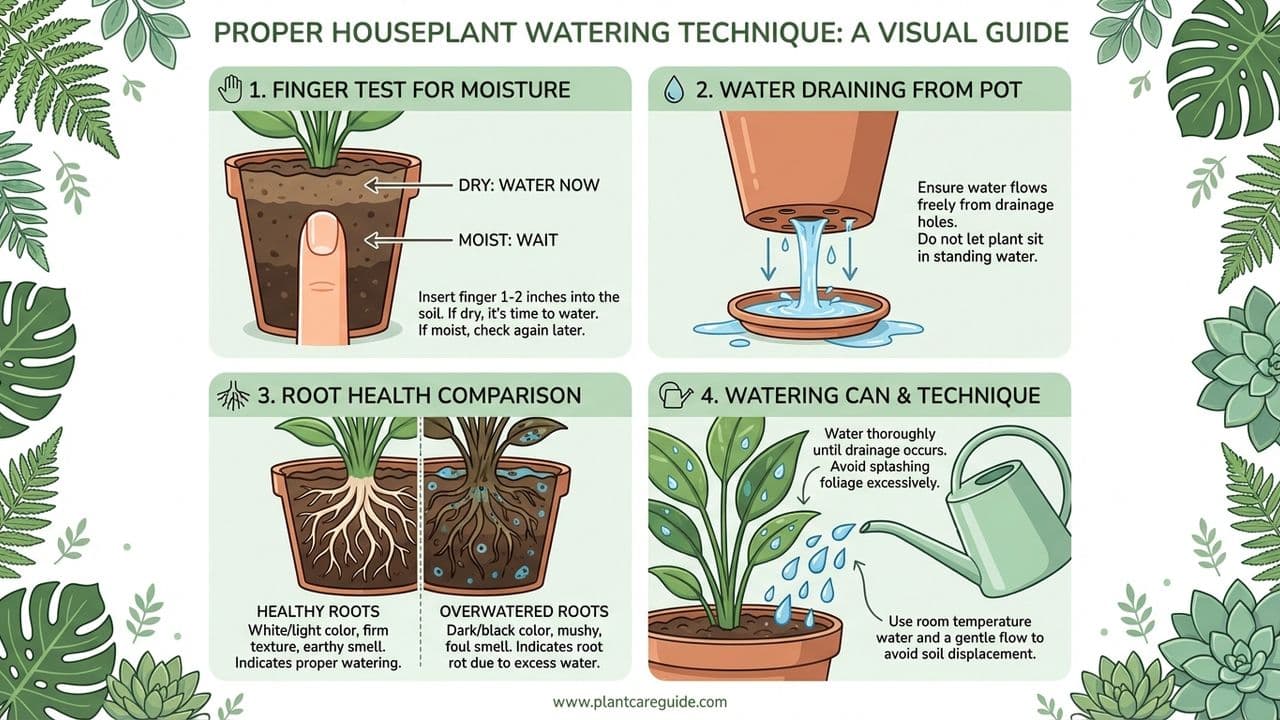
- Wait until the soil is dry all the way through — not dry on top. Push a wooden skewer to the bottom of the pot and pull it out. Clean and dry, water. Soil sticking to it, wait.
- Water thoroughly until it runs out of the drainage hole. University of Minnesota Extension is specific: "When watering, do it thoroughly. Water should flow through the drain holes."
- Tip out the saucer. Clemson's Home and Garden Information Center is blunt: "The plant must never be permitted to stand in water."
- Do not touch it again until step 1 is true.
Half-measures are their own failure mode. Minnesota Extension warns that "a series of repeated shallow sprinklings often results in distorted growth" — the top inch stays wet enough to rot surface roots while the bottom of the root ball never gets a drink.
The check we actually use is the leaf, not the soil. A hydrated succulent leaf is firm and resists a gentle squeeze. A thirsty one gives slightly, like a deflating balloon, and the lowest leaves wrinkle first. Wrinkling is a good signal — the plant telling you it has emptied reserves it is built to empty. Mushy translucent leaves are the bad signal, and by then the damage is a week old.
If your instincts come from watering tropical houseplants, our watering fundamentals guide covers the general principles. Succulents are the extreme case at one end of that spectrum.
Indoor Cactus Care: Where Cacti Differ From Succulents
Most of indoor cactus care is identical to succulent care. The differences are worth knowing because they are the ones that cause bloom failure and winter rot.
Cacti want more light, and will take more heat. Clemson recommends "windows facing south or west where they will receive direct sunlight for several hours each day." The New York Botanical Garden's guidance is that "cacti need strong, extended light exposure," which "usually means giving your cactus the sunniest possible place in your home." There is no low-light desert cactus. There are only desert cacti that take a long time to die in low light.
Cacti want a real winter. Clemson gives the growing-season range as 65 to 85°F and the winter dormancy range as 45 to 55°F. Most leaf succulents coast through winter at room temperature and are fine. Many desert cacti will not flower without that cool rest — an unheated spare room does more for cactus bloom than any fertilizer.
Cacti are fertilized less, and with less nitrogen. Clemson suggests a low-nitrogen fertilizer such as 5-10-5 once a month from June through September, and specifically says not to fertilize arid-climate cacti or freshly repotted plants during winter. High-nitrogen feed on a cactus produces soft, pale, easily-rotted growth.
Not all cacti are desert cacti. The forest and rainforest epiphytes — holiday cactus, orchid cactus — break every rule above, and get their own section at the end of this guide.
Soil and Drainage: The Two Things That Kill Most Succulents
If you only change one thing after reading this guide, change what is in the pot.
Standard potting mix is engineered to hold water. That is exactly wrong for a plant whose roots evolved in coarse grit that drains in seconds. Minnesota Extension puts the consequence in unusually strong terms: grow these plants in pots with drainage holes, "because excess water trapped in the soil will result in rotting and decay in a very short time."
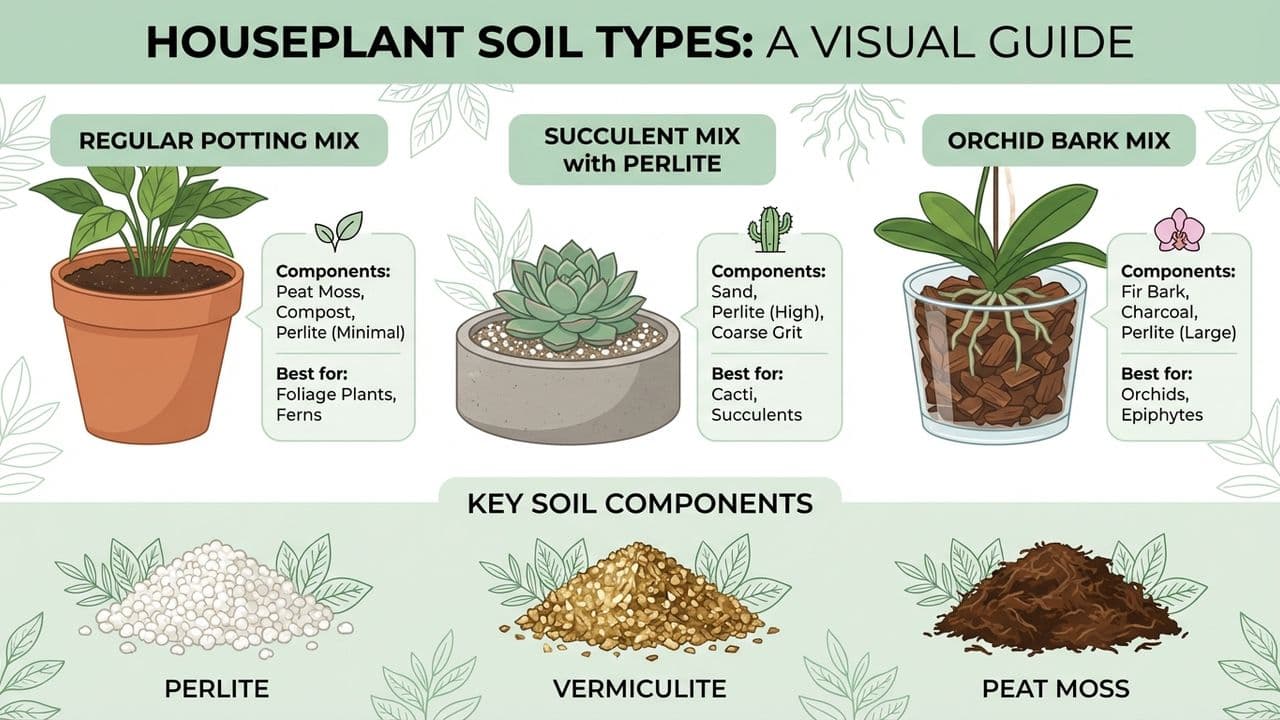
The right succulent soil mix is mostly not soil. Illinois Extension recommends roughly "one-part organic matter, such as potting soil or coir, and two-parts mineral, such as coarse sand, perlite, or pumice." Minnesota Extension's simpler version is one part potting soil to one part coarse sand. Clemson's is equal volumes of peat-based potting soil and very coarse sand or grit.
Every one of those recipes is at least half mineral. Now go read the bag of any commercial cactus soil.
Be honest about bagged mixes: most are still too rich. Miracle-Gro Indoor Potting Mix for Cactus & Succulent runs about $12.99 for a 2-pack as of August 2026; Miracle-Gro states it contains forest products, sphagnum peat moss, sand and perlite to promote fast drainage, with each 8-quart bag filling five 6-inch containers. It is a reasonable base. But peat holds a lot of water, and a mix that drains acceptably in an open nursery greenhouse behaves very differently in a still apartment with the windows shut.
The fix is cheap: add pumice. We cut any bagged cactus mix with roughly 50 percent mineral by volume. Sukh Horticultural Pumice is about $6.99 as of August 2026 for 410 grams at a 5 to 10 mm particle size; Sukh describes it as pre-washed and sifted, with a porous structure that increases soil porosity and resists compaction. That last part is the argument for pumice over perlite — perlite crushes and floats to the top, while pumice stays put and stays angular. Coarse sand or granite grit work too. Play sand and vermiculite do not; they fill air gaps instead of creating them. Our potting soil guide has more on the ingredients.
The pot matters as much as the mix. Three rules, in order:
- A drainage hole is non-negotiable. No watering technique compensates for its absence. If you love a hole-less ceramic pot, use it as a cachepot with the plant in a nursery pot inside.
- Unglazed terracotta beats glazed and plastic. Illinois Extension notes that clay and terracotta pots "work well because they are porous, and the soil dries quicker."
- Shallow and snug beats deep and roomy. Most succulents are shallow-rooted, and the extra soil in an oversized pot is just a reservoir of wet mix nowhere near a root.
A 6-inch terracotta shallow planter with saucer from Yishang runs about $22.99 as of August 2026 and hits all three: the maker lists it as 6 x 6 x 3.6 inches in unglazed clay, with a drain hole and matching saucer, and states that the walls draw water out of the soil so it dries faster. The 3.6-inch depth is the spec that matters — it is a bowl, not a bucket.
Light: How Much Your Succulents Actually Need
This is the section that decides whether you succeed, so we are going to be direct about how much light succulents need.
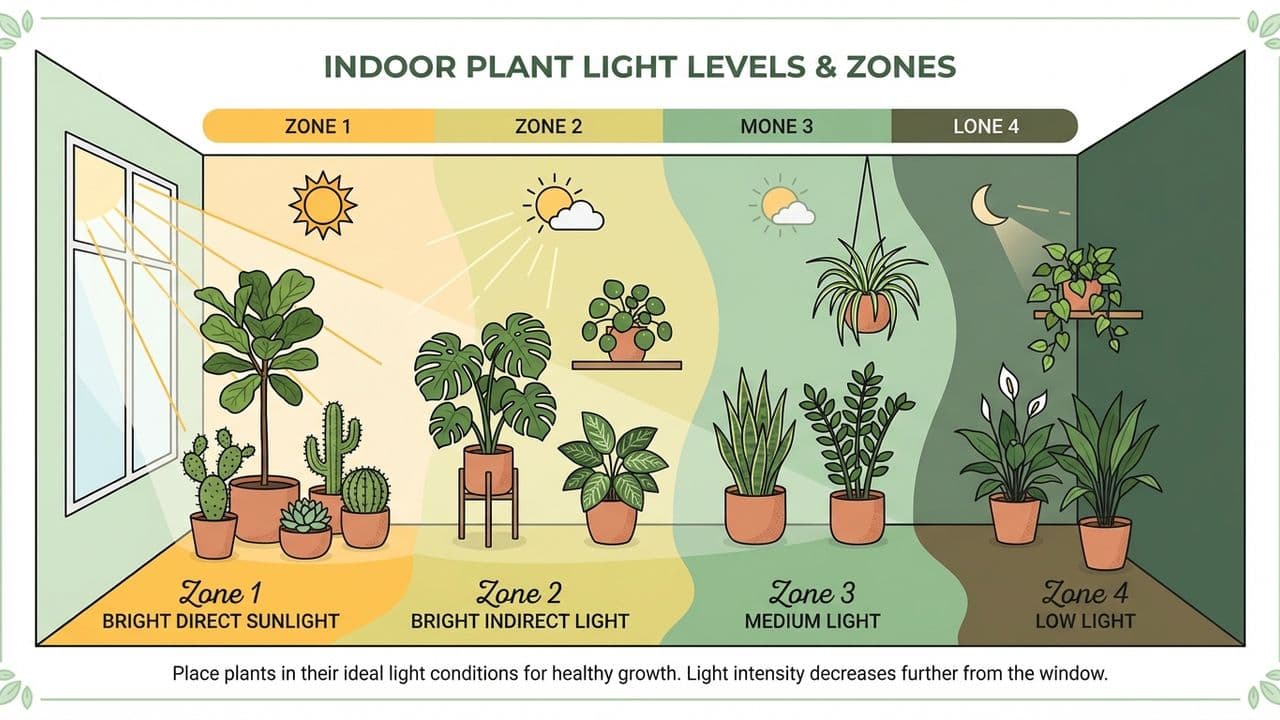
Six to eight hours of bright, direct sun. Illinois Extension states that "it is best to provide at least six to eight hours of bright sunlight." Clemson's south- or west-facing window with "direct sunlight for several hours each day" is the same recommendation phrased as a location. Not bright indirect. Not "near a window." Direct sun falling on the leaves.
Here is what that rules out, plainly, because the retail industry will not print it on a care tag:
- A north-facing window will not grow most succulents. It can keep a snake plant or a ZZ plant alive indefinitely, because those tolerate shade in the wild. It will slowly stretch and pale an echeveria, a sedum or any string-of-something.
- A windowless room, a frosted bathroom pane, an office cubicle or a shelf across the room from a window is not a location for a succulent. It is a location for a succulent-shaped object that will look acceptable for four months.
- Distance costs more than you think. Three feet back from a bright window is a fraction of the light at the sill, even though your eyes insist the room is "bright."
If you do not have the window, buy the light. This is not a compromise — under a decent LED, succulents often grow better than on a real windowsill, because you control the duration. Minnesota Extension's guidance for supplemental lighting on cacti and succulents is to position the fixture "6 to 12 inches above the plants, and keep them on for 14 to 16 hours each day." That is closer and longer than people expect, and it is the most common reason a grow light "doesn't work." Our grow light guide covers fixtures and placement; the light requirements guide explains how to read the light you already have.
One caution on moving plants into stronger light. Succulents sunburn. A plant that has spent six months in a dim corner will scorch if you move it straight into a south window in July. Step it closer over two to three weeks.
Stretched, Leggy Growth and What It Means
Leggy, stretching succulents are the most common problem we get asked about, and the cause is almost always the same: the plant is not getting enough light.
The technical name is etiolation. A light-starved succulent elongates the stem between leaves, spaces those leaves further apart, tilts hard toward the window, and fades from a tight coloured rosette into a pale green cone. Reaching is what a shaded plant can do about being shaded.
Read the growth like a chart recorder. The spacing on the stem is a physical record of the light that plant received while each segment was forming. Tight growth means the light was adequate; a long bare stretch means it was not. If your plant is tight at the base and stretched at the top, the problem started when you brought it home.
Two things are worth knowing, and the second is the one people don't want to hear:
- Fixing the light stops it. New growth typically comes in compact within a few weeks.
- The stretched part never recovers. An elongated stem does not shorten or thicken back up. There is no fertilizer, hormone or technique that reverses it.
So the repair is surgical, not cultural. Behead the rosette with a clean blade a couple of inches below the leaves, callus the cut end for several days in dry air, and set it on dry mix to root. You get a compact plant back, and the stump usually pushes several new heads from the leaf nodes below the cut — which is how one leggy string of dolphins or Curio 'Trident Blue' becomes three good ones. Etiolation is annoying. It is not fatal, and it is not a moral failing.
The Best Succulents for Indoor Growing
The best succulents for indoors are the ones that were not grown under full desert sun for a colour they cannot hold in your apartment. Those pink-and-purple rosettes in the checkout display are showing stress colour, and they will revert to green in any normal home. That is not you failing; that is the plant relaxing.
Genuinely forgiving of ordinary indoor light:
- Snake plant — the most shade-tolerant plant here by a wide margin, and very hard to kill if you err on the side of underwatering.
- ZZ plant — stores water in potato-like rhizomes, tolerates dim corners and long absences.
- Baby rubber plant — a semi-succulent peperomia, happy in medium light where a desert succulent would stretch.
- Hoya bella — thick waxy leaves, wants bright indirect rather than blazing sun, and flowers indoors.
Want a bright window, and will reward you for it:
- Jade plant — slow, structural, and capable of becoming a genuine small tree over a decade. Give it the sunniest spot you have or it goes floppy.
- Silver jade — same care, blue-grey leaves with red margins in strong light.
- Burro's tail — a spectacular trailing sedum for a bright hanging spot. The leaves detach if you look at it wrong; hang it where nobody brushes past.
- Aloe vera — wants more direct sun than people give it, and offsets freely once established.
- Mother of thousands — genuinely easy, and a great propagation demo. Be warned that it seeds plantlets into every neighbouring pot.
A note on pets, because succulents are not a uniformly safe category. The ASPCA lists Kalanchoe as toxic to both cats and dogs, giving the toxic principle as bufadienolides — a class of cardiac glycosides — with clinical signs of "vomiting, diarrhea, abnormal heart rhythm (rare)"; that covers mother of thousands and Kalanchoe pinnata. The ASPCA has no entry for the African milk tree itself, but lists the related pencil cactus (Euphorbia tirucalli) as toxic to dogs and cats on the strength of its irritant latex sap, which its succulent write-up says "causes vomiting and drooling" plus "concern for eye irritation." So the African milk tree, which bleeds the same latex, is one we keep out of reach. Aloe is on the toxic list too ("saponins, anthraquinones"; "vomiting (not horses), lethargy, diarrhea"), as is jade, whose toxic principle the ASPCA records as "unknown," with vomiting, depression and incoordination as signs. On the other side, the ASPCA lists burro's tail as "Non-Toxic to Dogs, Non-Toxic to Cats." If you live with a chewer, read our toxic houseplants and pets guide before you shop, keep the ASPCA Animal Poison Control number (888) 426-4435 somewhere findable, and call your vet rather than us if something gets eaten.
Diagnosing a Sick Succulent
Diagnosing common succulent problems is mostly a matter of separating too-much-water from not-enough-light. Those two account for the overwhelming majority of cases, and they present very differently.
Mushy, translucent, yellowing leaves — usually starting at the base. Most often overwatering, and by the time it is visible the roots have usually been rotting for a while. Unpot and look: healthy succulent roots are firm and pale, rotten ones are brown, slimy and pull off in your fingers. Cut back to clean tissue, let the wound dry for several days, repot into dry gritty mix, and wait a week before watering. If the rot has reached the stem, take a top cutting and write the parent off.
Wrinkled, leathery, deflating leaves. Underwatering — the easiest problem on this list. Water thoroughly and it usually plumps back up in a day or two. Wrinkled is firm and dry; rotten is soft and wet.
Pale colour, wide leaf spacing, leaning. Light. See the section above.
Papery white, tan or brown dry patches on the sun-facing side. Sunburn from a move that was too fast. It does not spread and it does not heal; the leaf carries the scar until it is shed.
Black or brown spots that spread. Fungal or bacterial, and almost always downstream of water sitting on the leaves or crown in a still room. Water the soil, not the plant, and improve airflow.
White cottony specks in the leaf axils. Mealybugs, the one pest that genuinely plagues this group. Touch each with a cotton swab dipped in 70 percent isopropyl alcohol and check weekly for a month, because the egg sacs hatch in waves.
Nothing happening for months. Frequently normal. See the note on CAM metabolism above, and check whether it is winter before you intervene.
Propagating Succulents From Leaves and Offsets
Propagating succulents is the closest thing houseplant keeping has to a free lunch, and it works because these plants evolved to survive being knocked apart by animals and weather.
From a single leaf. Minnesota Extension describes the mechanism directly: "many succulents will form new plants from leaves which have been broken off," and the crucial instruction is to "allow the cutting wound to air dry." Twist a healthy leaf off cleanly at the stem — a torn leaf that leaves tissue behind rarely works — then set it on dry mix in bright indirect light and leave it. Do not bury it. Do not water it. Roots and a tiny rosette appear at the broken end in two to six weeks, feeding off the parent leaf as it shrivels. Only start watering lightly once roots have found the soil. Echeveria, sedum, graptopetalum and jade are reliable this way; aeonium and most cacti are not.
From offsets and pups. Aloes, haworthias and many cacti produce clones at the base. Unpot the parent, separate the pup with as much root as you can get, callus any cut surface for a couple of days, and pot it in dry mix. This is the fastest method — you skip straight to a rooted plant.
From stem cuttings. The etiolation fix above is the same procedure. Cut, callus for three to seven days until the wound is dry and sealed, set on dry mix, wait.
From plantlets, if the plant does it for you. Mother of thousands and Kalanchoe pinnata grow entire rooted babies along their leaf margins and drop them. You do not propagate these so much as contain them.
The universal rule across all four methods is callus first, water later. A fresh cut in wet soil is an open wound in a petri dish. Every failed succulent cutting we have seen was watered too early or never allowed to dry.
Winter Dormancy and the Cool-Dry Rest
Succulent care in winter is mostly a matter of doing dramatically less, and the specific instruction is to cut water hard.
Minnesota Extension's guidance is memorable because it sets such a low bar: "during the low-light winter months, water cacti and succulents only enough to prevent shrinking and withering." Clemson says the same thing at more length — in the rest period plants "should be allowed to get very dry between waterings," watered "just enough to keep them from shriveling," which "usually will mean a light watering every few weeks."
The logic is straightforward. Light drops, day length shortens, growth stops, water uptake collapses — but the amount you pour in stays the same, so mix that dried in ten days in July now stays wet for a month. The winter killer is almost always a summer watering habit carried unchanged into December.
What we actually change from roughly November to February:
- Water perhaps a third as often, and only after the skewer test comes out bone dry.
- Stop fertilizing entirely until spring growth resumes.
- Move plants closer to the glass to claw back some of the lost light — but watch for cold draughts on the leaves at night.
- If you can offer a cool rest, do. Clemson's winter dormancy range for cacti is 45 to 55°F, and it is what triggers spring flowering in many desert species. An unheated spare room or enclosed porch that stays above freezing is ideal.
- Expect nothing. No new leaves is the correct winter outcome, not a problem to solve.
As light returns in spring and you see new growth, step watering back up gradually and start feeding again. That is also the right window to repot anything that has outgrown its container.
Holiday Cactus: A Different Plant With Different Rules
Holiday cactus care is where most of this guide stops applying, and it is worth its own section because these are the succulents people receive as gifts and then treat like desert plants.
Schlumbergera is a true cactus. It is not a desert plant. University of Minnesota Extension states it flatly: "although true cacti, these plants are native to rainforests." In the wild they grow as epiphytes in the crooks of trees, rooted in leaf litter, in dappled shade and humid air.
What that changes:
- More water, not less. Clemson notes that rainforest cacti "need substantially more water" than desert types and "prefer at least 50 percent humidity." Let the top inch dry, then water. Never let one dry to bone.
- Filtered light, not direct sun. Clemson recommends "bright but filtered light" to avoid sunburn. Minnesota Extension's summer guidance is part shade, 3 to 6 hours of sun, noting that "filtered sunlight, such as under a tree, is ideal as it mimics the plant's natural habitat."
- A richer mix. Minnesota Extension's recipe is 1 part sterile potting soil, 2 parts peat moss, 1 part sharp sand or perlite — a near-inversion of a desert mix. But they still "won't grow well in heavy, wet soils."
Getting it to bloom is a photoperiod problem, not a care problem. Minnesota Extension gives two routes: "if the night temperature is 60 to 65 degrees Fahrenheit, these plants must have at least 12 hours of complete darkness every night for about 6 weeks to bloom." Or drop the temperature — at "cooler night temperatures of 55 degrees Fahrenheit, they will bloom in approximately 5 to 6 weeks, sometimes regardless of the day length." Complete darkness means complete; a lamp switched on in the evening resets the clock.
Once buds form, stop fiddling. Minnesota Extension attributes bud drop to "drafts or sudden changes in temperature or humidity levels," and notes the direction and amount of sunlight can cause it too. Do not rotate a budded holiday cactus, do not move it to show it off, do not repot it.
The same rules broadly cover the other epiphytic cacti sold as houseplants — the German empress is a Disocactus with the same forest ancestry and the same preference for filtered light and a mix that never dries to dust.
Frequently Asked Questions
Can I grow succulents in a north-facing window? A few, badly. Snake plant and ZZ plant will hold on because they tolerate shade in habitat. Echeverias, sedums, most cacti and the trailing Curio species will stretch, pale and eventually collapse. If north is your only window, buy a grow light rather than a different succulent.
How do I know when a succulent needs water without guessing? Two checks together. Push a wooden skewer to the bottom of the pot and confirm it comes out dry, then squeeze a lower leaf — firm means wait, slightly yielding or faintly wrinkled means water. Lifting the pot works too once you learn its dry weight. What does not work is a schedule.
My succulent's bottom leaves are shrivelling. Is it dying? Usually not. Succulents consume their oldest leaves as a normal part of growth, so one or two papery lower leaves that pull away cleanly are fine. Widespread wrinkling means it is thirsty. Mushy, translucent lower leaves are the one to worry about — that is rot.
Should I mist my succulents? No. Misting wets the leaves and crown without meaningfully reaching the roots, and water sitting in a rosette in still indoor air invites fungal and bacterial spotting. Established plants get soaked at the soil, or nothing.
Do succulents need fertilizer? Very little. Minnesota Extension recommends a houseplant food higher in phosphorus than nitrogen, "diluted to half the recommended rate," applied once or twice a year during active growth for cacti. Clemson suggests a low-nitrogen formula such as 5-10-5 monthly from June through September, and says not to feed arid-climate cacti or recently repotted plants in winter. Overfeeding produces soft, stretched, rot-prone growth.
Why did my succulent lose its bright pink and purple colour? Because it is happier. Those colours are stress pigments produced under intense light, drought and temperature swings — nursery conditions, not living-room conditions. Reverting to green indoors is normal and not a sign of poor health. If you want the colour, you need the stress, which means much stronger light.
What to Do This Week
Three things, in this order, worth more than any amount of technique.
- Move your succulents to the brightest window in the house. If that window faces north, order a grow light instead and plan on 14 to 16 hours a day at 6 to 12 inches.
- Check for a drainage hole. No hole means repot today, or drop the nursery pot inside the pretty one.
- Repot into something at least half mineral, then leave the plant alone until the soil is dry to the bottom of the pot.
Do those three and succulents become what they were sold to you as: plants that ask for almost nothing. Skip them and you will keep buying replacements every spring, which is a business model, not a care routine.
Explore the full series
- How Often to Water Succulents Indoors (and Why Most People Get It Wrong) — The soak-and-dry method, why a schedule fails, and how to read the plant instead of the calendar.
- How to Care for an Indoor Cactus: Light, Water and the Winter Rest — Why desert cacti need a cool, dry winter rest — and what that unlocks.
- The Best Soil for Indoor Succulents (and Why Potting Mix Kills Them) — Pumice, perlite and grit ratios, plus the no-drainage-pot problem.
- How Much Light Do Succulents Need Indoors? (And Why Most Windows Fall Short) — Window direction, distance, foot-candles and when a grow light is the honest answer.
- Why Is My Succulent Stretching? Fixing Leggy, Etiolated Growth — Etiolation explained, why it never reverses, and how to behead and restart.
- Best Succulents for Indoors: 12 That Actually Survive Low Light — Which species tolerate a real apartment window — and which ones are sold to fail.
- Why Is My Succulent Dying? A Symptom-by-Symptom Diagnosis Guide — Mushy vs shrivelled vs scorched — reading the symptom back to the cause.
- How to Propagate Succulents From Leaves, Offsets and Cuttings — Leaf pulls, offsets and beheading, plus why callusing is the step people skip.
- Succulent Care in Winter: Dormancy, Watering and Weak Light — Summer- vs winter-dormant genera, and how far to cut water back.
- Holiday Cactus Care: Christmas, Thanksgiving and Easter Cactus Explained — A jungle epiphyte, not a desert cactus — and how to trigger rebloom.