This guide contains affiliate links. We may earn a small commission if you purchase through our links, at no extra cost to you.
Most indoor succulents need six to eight hours of bright light a day, and in the northern hemisphere an unobstructed south-facing window is the only common indoor spot that reliably supplies it. Iowa State University Extension sets the bar higher still: succulents "need ten or more hours of bright, indirect light," and while "some species tolerate lower light levels," Iowa State notes that "most need at least six to eight hours."
Iowa State names the real problem outright: "Light is often one of the most limiting factors when growing succulents indoors." Succulents are also the plants least able to hide a shortfall — a pothos in a dim corner just grows slowly, while a jade plant stretches into a pale caricature of itself in one season.
This guide replaces "bright indirect" with numbers you can check. It sits inside our larger guide to indoor succulent and cactus care; our houseplant light requirements guide covers the same physics for tropicals.
Why Your "Bright" Room Is Much Darker Than It Looks
Your eyes fail here in a predictable direction. University of Missouri Extension puts it plainly: "The human eye is a poor judge of light intensity because it automatically adjusts to different light levels." A room that reads as "nice and bright" can be a rounding error to a plant.
The magnitudes explain why. A peer-reviewed review of lighting and circadian health indexed in PubMed Central reports that "outdoor levels of sunlight extend beyond 100,000 lux at midday and remain above 3000 lux when it rains." Indoors, says Illinois Extension, "the amount of light that enters the room is only a small amount" of that.
Colorado State University Extension is blunter: "light levels in most homes are below that required for all but low light house plants." Succulents sit at the opposite end of that range.
Foot-candles and lux, briefly
Missouri Extension defines a foot-candle as "the amount of light received by a 1-square-foot surface that is 1 foot away from a light source equivalent to one candle of a certain type." Because a lux is one lumen per square metre instead, one foot-candle is roughly 10.76 lux. Extension literature uses foot-candles; phone apps default to lux.
Be careful with published figures, though: they disagree wildly. Illinois Extension puts a plant directly in front of a south window at about 1,500 foot-candles; UGA Extension, describing the same spot, says "the sun at noon on a summer day may measure 10,000 ft-c." Both are defensible — they measure different things. Use them for ranking, not for absolutes. What matters is that UGA files succulent-grade conditions under a separate "sunny" category — at least four hours of direct sun — above its "high light" band of 200-plus foot-candles.
Window Direction, Ranked (Northern Hemisphere)
Northern hemisphere throughout — southern-hemisphere readers, swap south and north.
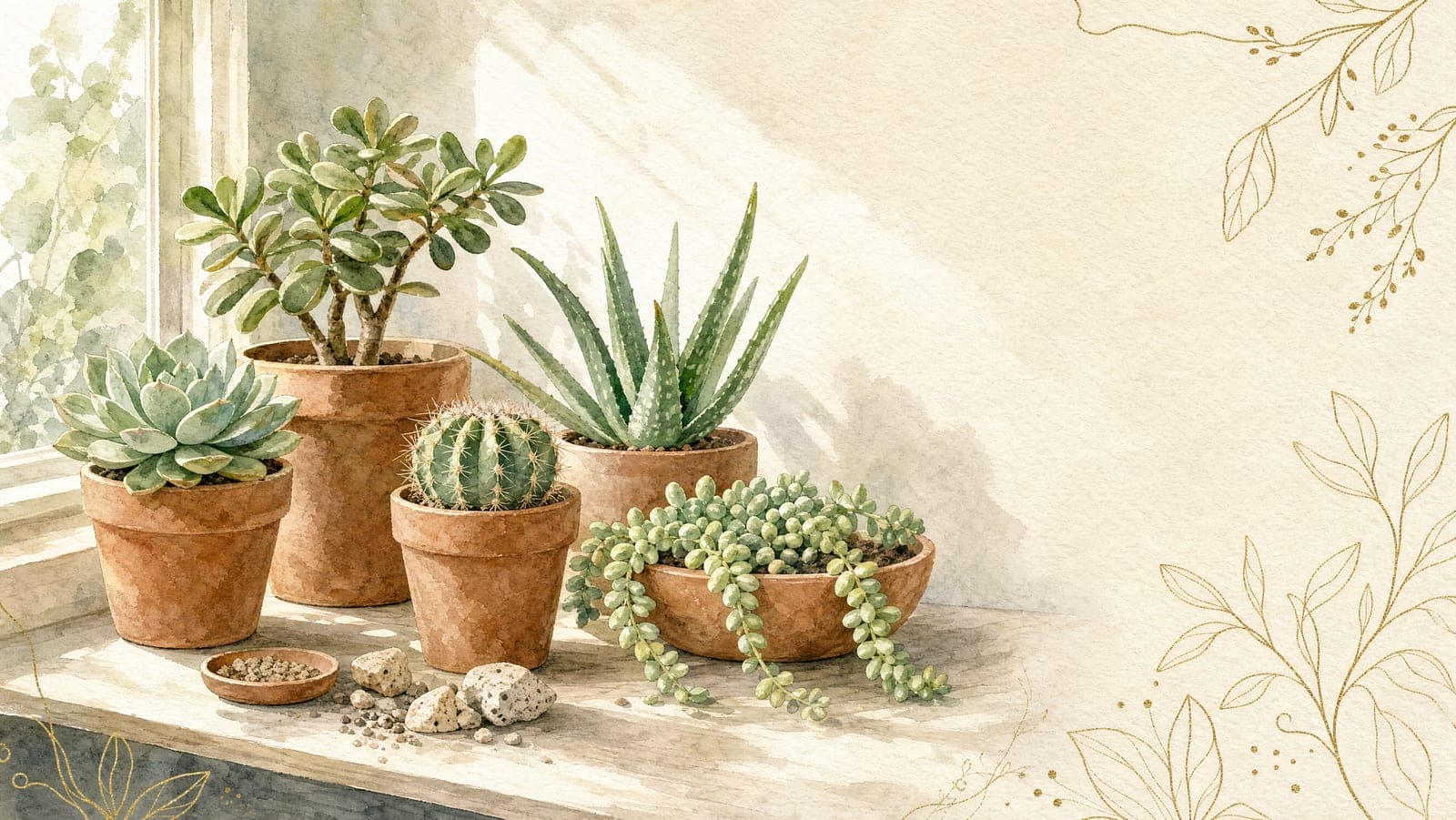
1. South — the only reliably sufficient window. Missouri Extension: "Windows facing south provide the brightest light conditions for the longest duration." This is where the jade plant, the aloe vera, the African milk tree and the desert rose go.
2. West — usually enough. Fewer hours, but the hottest ones. Clemson calls south or west windows "where they will receive direct sunlight for several hours each day" ideal for arid-climate cacti. The caveat is thermal: growers commonly report scorching on leaves pressed against hot afternoon glass, so leave an air gap.
3. East — good for the tolerant half of the group. UGA describes eastern exposures as receiving "direct morning light from sunrise until nearly midday," with readings that "can reach 5,000-8,000" foot-candles.
4. North — not enough, and optimism will not change that. Missouri Extension: "north windows are satisfactory only for plants requiring the lower light levels." UGA measured "a northern windowsill" at "as low as 200 ft-c on a clear winter day" — and that is the best spot in the room.
Distance from the glass matters as much as direction
Illinois Extension's light chart is really a distance chart: directly in front of a south window is direct light, three to ten feet back from that same window is medium, fifteen to twenty feet back is low. A few feet into the room can drop a plant a category or two — Illinois puts a spot up to five feet from a south window at about 300 foot-candles, a fifth of the reading directly in front of the glass. Missouri Extension draws the boundary — "even low-light plants usually do not receive enough light at distances greater than 10 feet from an average window."
So the rule is unglamorous: on the sill, or within a foot or two of it.
How to Actually Measure the Light in Your Room
The shadow test (free, surprisingly good). Hold your hand a few inches above where the plant sits, mid-morning and mid-afternoon. A hard, crisp-edged shadow means direct sun; a fuzzy edge means diffuse light; no shadow means the spot will not support a succulent. Iowa State defines bright indirect light the same way — "bright enough to cast a shadow, but not in direct sun."
A phone lux app (free, and only good for comparing). Phone sensors are not calibrated photometers, so treat the absolute numbers as unreliable. They are useful for ranking two spots in your own home: hold the phone flat at leaf height in each and trust the ratio, not the reading.
A real light meter (about $30, and it ends the argument). Colorado State Extension notes that "inexpensive light meters are available in many garden supply stores," with the caveat that they "do not distinguish among wavelengths, so cannot guarantee satisfactory plant growth" — a meter reports intensity, not spectrum. The TopTes TS-710 Light Meter (about $28.49 as of August 2026) is the one we reach for, because it reads in both units; according to TopTes it covers 0.1 to 200,000 lux and 0.1 to 20,000 foot-candles. Walk it away from a window and watch the number collapse.
Whichever method you use, measure at leaf height, not at the glass, at three times of day. Our foot-candle calculator estimates a spot from window direction and distance.
Read the Plant Instead: A Symptom Table
Your succulent has been measuring the light all along. It reports in morphology.
| What you see | What it means | What to do |
|---|---|---|
| Stem elongating, wide gaps between leaves, plant leaning at the window | Too little light (etiolation) | Move closer to the glass or add a lamp |
| Compact growth, tight rosettes, red / purple / orange blush | Ample light | Nothing |
| White or tan bleached patches on the sun-facing side | Sunburn from a too-fast increase | Shade it and increase light gradually |
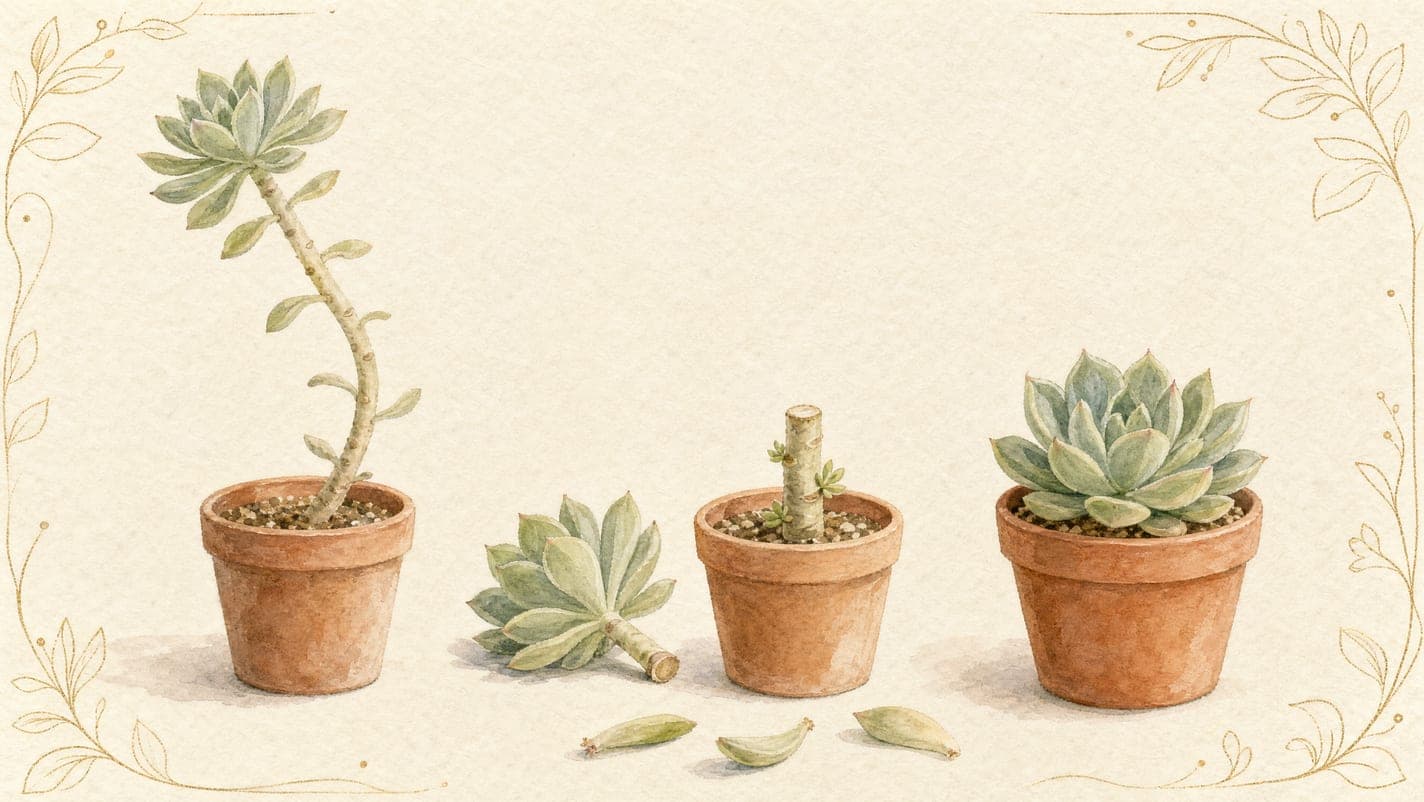
Act on the stretching signs fastest. Iowa State: "In low light, plants become lanky and pale." Wisconsin Extension says the same of haworthias — "in insufficient light, leaves will elongate and plants will lose the richness of their colors." In our experience the elongated section never shrinks back; the remedy is to behead the compact top and re-root it, as our leggy, stretching succulents guide explains. Rotate pots regularly, too — Iowa State advises it "to prevent lopsided growth."
The colour signs are real physiology. The UC Master Gardener Program of Contra Costa County explains that succulents "become more pigmented in the presence of strong sunshine," while plants "housed in lower light levels could turn back to green." That blush is a light meter you already own.
Light also drives how fast a pot dries, so a plant moved to a brighter window needs water sooner — the scenario our succulent watering guide is built around.
Sunburn and the Two-Week Acclimation Rule
Here is the trap: you act on all of the above, and two days later the plant has bleached white patches.
Colorado State Extension explains why. "Leaves of plants growing in low light readily sunburn when moved to a bright location. Over time, as the plant acclimates, it will become more sun tolerant." The plant is not fragile — it is unacclimated, having spent months under shadecloth or retail fluorescents. Clemson advises placing cacti moved outdoors "in partial shade for the first few weeks."
Our indoor version takes two weeks. Week one, bright room but out of the direct beam. Week two, one to two hours of direct beam a day — morning if you can choose — increasing by about an hour every second day. Week three, full position.
In our experience sunburn scarring does not grow out, so two weeks is cheap insurance. Thin-leaved trailers like burro's tail and string of hearts are the ones we acclimate most cautiously. Desert cacti such as the sand dollar cactus sit at the high-light end; our indoor cactus care guide covers where they diverge.
Grow Lights: When They Are the Honest Answer
A grow light is not a consolation prize. For three situations it is the right tool: a north-facing-only apartment, an interior room with no usable window, and winter at high latitude.
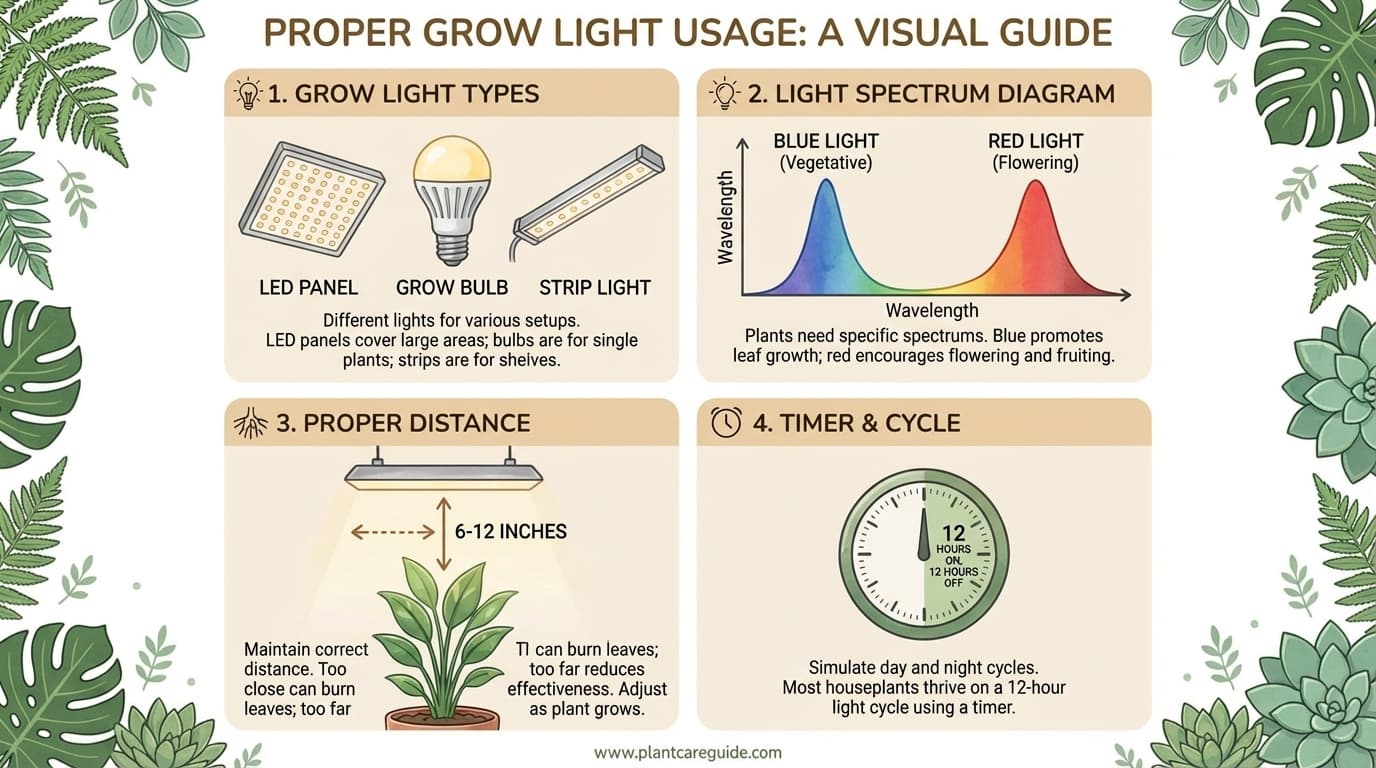
- Duration: 12 to 16 hours. Iowa State: "For most species, 12 to 14 hours is a good length of time for the light to be on." Minnesota Extension, on cacti and succulents specifically, recommends "14 to 16 hours each day." Illinois Extension explains the ceiling: plants "need a rest period too."
- Distance. Iowa State: "Fluorescent fixtures should be 6 to 12 inches from the foliage. LED can be 12 to 24 inches away in most cases."
- Spectrum and timer. Iowa State recommends "full-spectrum (also called 'daylight') light," and to "plug all supplemental lights into a timer." No purple panel required.
For one plant or a small windowsill group, a clip light does the job. The GooingTop 6000K Full-Spectrum Clip Grow Light (about $20.99 as of August 2026) is the cheap default: according to GooingTop it runs 10 red plus 74 white LEDs at 6000K, draws about 10 watts, and has a timer offering 4, 8 or 12-hour cycles. Note that ceiling — 12 hours is the bottom of Iowa State's range, so add an outlet timer if you want more.
The SANSI 10W Pot Clip-On Grow Light (about $23.96 as of August 2026) is the higher-output alternative in the same format: SANSI states 10 watts of output power with "169.7 umol/s/m2 @ 6 inches growing power," a 3/6/12-hour timer and four brightness levels. SANSI also claims the light "will prevent your plants from leggy growth" — marketing copy, not a tested result. A well-positioned light reduces stretching; hung too far away it produces the etiolation it claims to prevent.
Our honest read: a clip light keeps a succulent alive and reasonably compact, but will not reproduce a south window. The dense, blushing, tight-rosette look needs intensity these fixtures cannot deliver at a sensible distance — expect green and healthy, not red and photogenic. For fixture types and multi-plant setups, see our grow lights guide.
"Low-Light Succulents" Are a Myth Worth Killing
Searches for low light succulents for indoors return confident lists. The accurate version: there is no true low-light succulent — only lower-light-tolerant ones, and tolerating is not thriving.
Haworthia and gasteria are the tolerant genera. Wisconsin Extension calls haworthias "more tolerant of modest lighting than many succulent plants" — but still recommends an east or west window with "a few hours of direct light daily." The Huntington's International Succulent Introductions describes Gasteria batesiana as "tolerant of low light and neglect."
The snake plant and the ZZ plant genuinely cope — Iowa State says flatly that "ZZ plants do exceptionally well in low light." Penn State Extension notes the snake plant "has a well-known reputation as a low-light plant" and measured one at "as low as 25-foot candles in mid-morning" — then delivers the lesson in a clause: in medium light their plant grew from about 9 inches to 17 inches, and "in brighter light, it would grow much taller." Elephant bush is more forgiving than an echeveria, though Wisconsin Extension is clear that it "needs bright light and very well-drained soil to thrive" and names a south-facing window as its ideal indoor location.
None of that is low-light in the sense people mean when buying a succulent for a bathroom shelf. If your only window faces north, our low-light apartment plants list will serve you better than a tray of elongating echeverias — and our best indoor succulents for beginners guide sorts the genus by how much light it demands.
Your Perfect Summer Spot May Underlight in Winter
The sun moves; your plant does not. UGA Extension describes the geometry: "in the summer, when the sun is farther north than it is in the winter, the sun rises at a sharp angle in the morning and is high in the sky by noon," whereas "the low winter sun shines across the room for most of the daylight hours."
The effects are counterintuitive. Winter light reaches further into the room — UGA notes sunlight penetrates farther indoors in winter — but there is far less of it. A spot that was perfect in July can be quietly starving a plant by January, and the stretch you notice in February started in November. Missouri Extension's advice is hard to improve on: "In winter, any houseplant benefits from the light of a south window."
So each autumn we re-measure, move everything closer to the glass, clean the windows and the leaves, and cut water back hard. Our winter plant care guide covers the rest.
What to Do This Week
- Find your brightest window and confirm which way it faces.
- Do the shadow test at 10am and 3pm where your succulents sit now.
- Move them to the sill, acclimating over two weeks if the jump is large.
- Watch for stretch — widening gaps between new leaves mean you are still short.
- Add a timed clip light if your best window faces north.
The correction that matters: the light in your home is a small fraction of what it feels like, and succulents will tell you so first and loudest. Measure once, move the pot two feet, and most "mystery" succulent problems solve themselves.
For watering, soil, potting and placement in one place, our complete succulent care guide puts the system together.