This guide contains affiliate links. We may earn a small commission if you purchase through our links, at no extra cost to you.
Most indoor succulents want water somewhere between every 7 and 21 days. That is the honest range, and on its own nearly useless — the interval is set by how fast your pot dries, not by your plant. Learning how often to water succulents indoors means learning to read the pot instead of the calendar.
Iowa State University Extension hedges its own number the same way: "Typically once every two or three weeks works well, but it will depend on soil type, light level, humidity, and container type." SDSU Extension lands somewhere else entirely — "A succulent can be watered once a week or less, depending upon how quickly the soil dries out in the pot."
Two extension services, two intervals, one identical qualifier. That qualifier is the whole article. What follows replaces the schedule with a decision procedure. Our broader guide on how to care for succulents indoors covers light, potting and placement alongside it.
Why There Is No Correct Succulent Watering Schedule
A pot loses water two ways: evaporation from the surface and sides, and the plant pulling it up through the roots. Both are governed by things that have nothing to do with the species on the label.
- Pot size. A 2.5-inch pot holds well under a cup of mix. A 6-inch pot holds a couple of quarts. Same plant, many times the reservoir — and far longer to dry.
- Pot material. Nebraska Extension describes clay pots as porous, allowing "air and moisture to penetrate the sides of the pot" and acting "like a wick to remove excess moisture from the potting soil." Glazed ceramic and plastic do not.
- Soil mix. A gritty mix drains in seconds. Peat-heavy bagged "houseplant" soil can stay damp in the middle for two weeks.
- Light. A plant in a south window is photosynthesizing and transpiring. The same plant on a north sill is idling.
- Temperature. A 62°F January room dries a pot far slower than an 80°F July one.
Run the extremes. A jade plant in a 2.5-inch terracotta pot in a July south window can genuinely need water every five days. The same jade in a 6-inch glazed pot on a January north sill might go six weeks — and still rot, because six weeks was not long enough for that much soil to dry in that little light.
Anyone who gives you a number without asking about your pot is guessing.
How to Water Succulents Indoors: The Soak and Dry Method
Soak and dry is not complicated, but almost everyone does the "soak" half wrong. Iowa State Extension describes the cycle plainly: "water thoroughly, wetting the entire root ball until it drains, then let the soil dry completely before watering again."
Three rules:
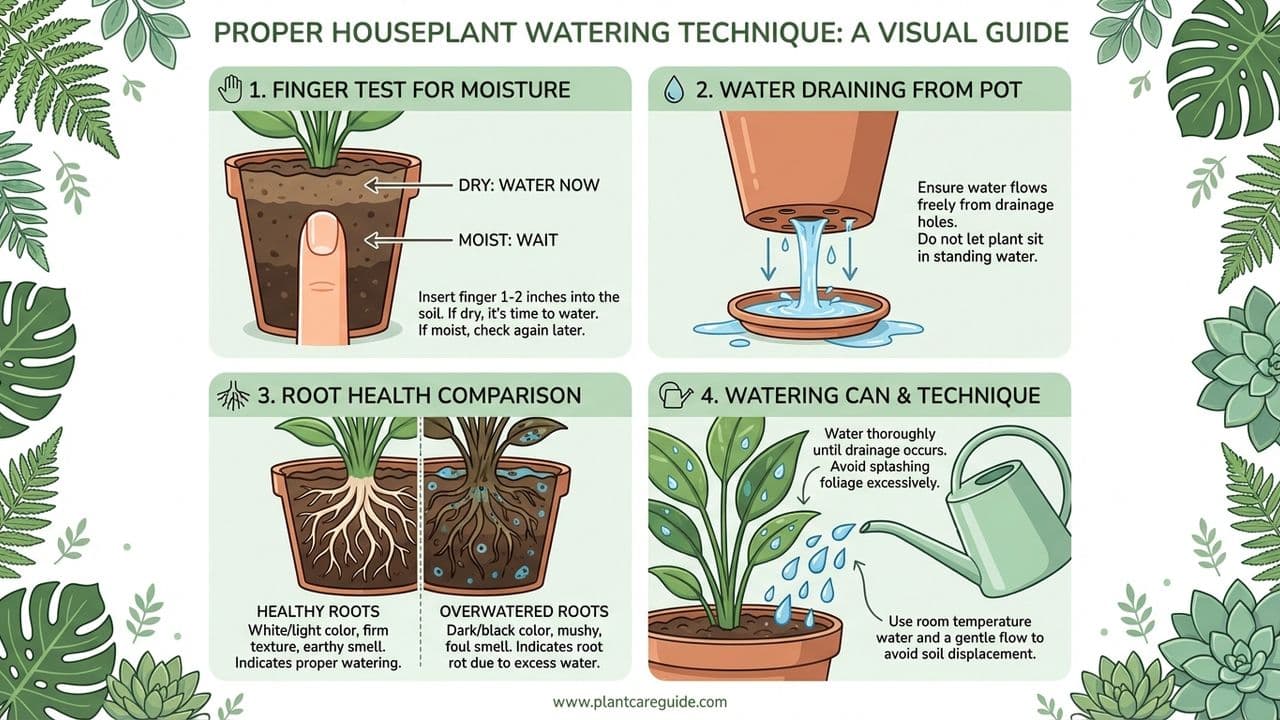
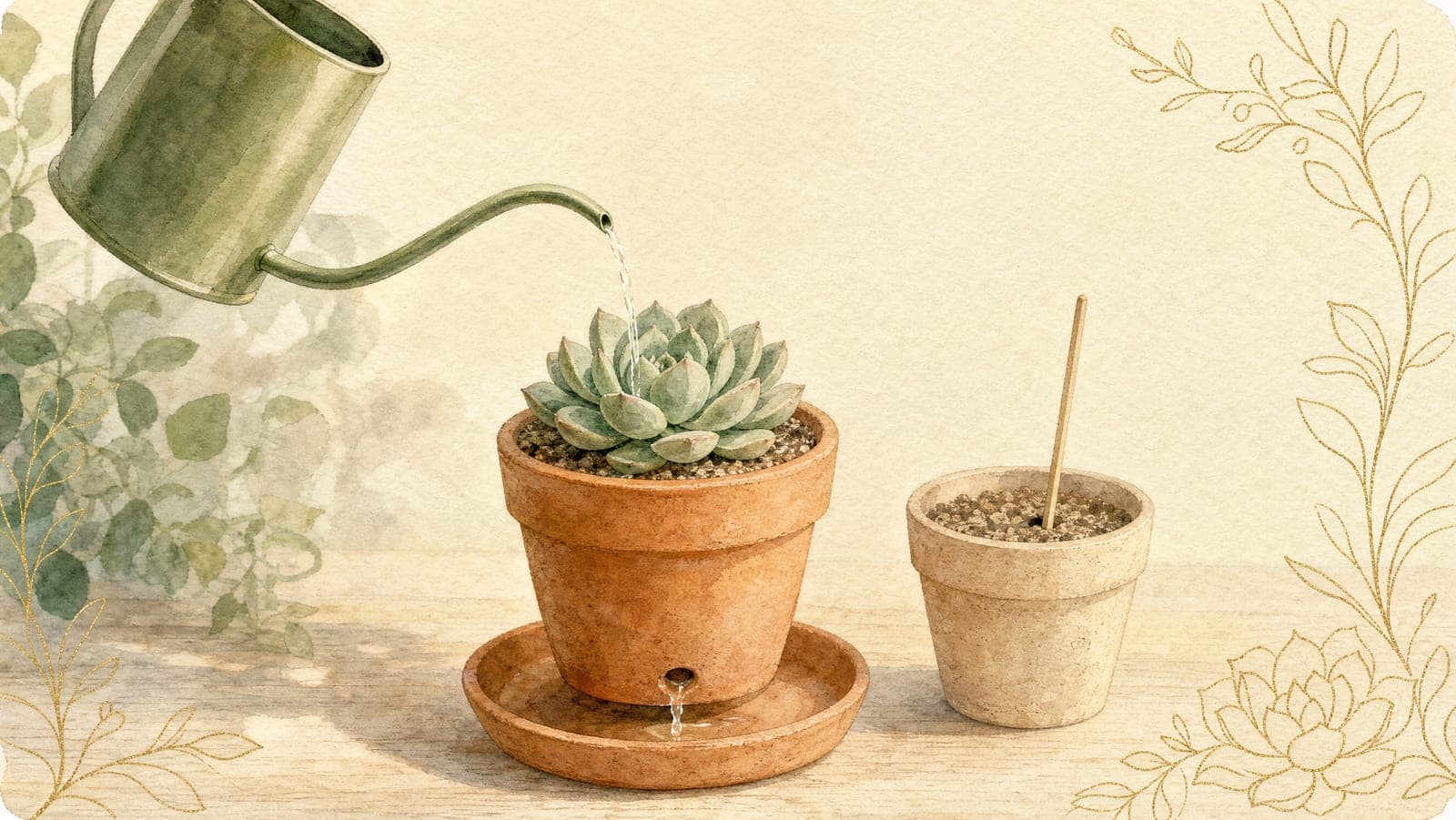
- Water until it runs out of the drainage hole. Not a splash. Not a quarter cup. SDSU Extension gives the benchmark: "Start by making sure the pot has a drainage hole, and you should notice water draining out the bottom."
- Empty the saucer within thirty minutes. A pot standing in runoff has not drained; it is soaking. Iowa State Extension is explicit on this point: "Never allow water to sit in saucers or outer sleeves."
- Then leave it alone. The dry half of the cycle is where the roots get oxygen.
Small, frequent sips are the failure mode. They wet the top inch, leave dry pockets deeper down where the roots actually are, and train roots to stay shallow — chronically dry at the root, chronically damp at the surface.
Aim the water at the soil, not the plant. Rosette-formers like echeverias and tight clumps like burro's tail hold water in their centers, and indoors that puddle dries slowly. A long spout gets you under the foliage: the Fiskars Indoor Watering Can, 40 oz (about $12.97 as of August 2026) is what we reach for — according to Fiskars, the slender spout is designed to reach through foliage and deliver water to the soil rather than the leaves. The Tennedriv Small Watering Can, 34 oz (about $12.97 as of August 2026) is the same idea in a smaller body. A measuring cup with a spout works too.
Three Ways to Tell When the Soil Is Actually Dry
"Dry" means dry at depth, not dry on top. Use at least two of these:
1. The finger or skewer test. SDSU Extension's version is the simplest: "Test the soil with a finger to see if the soil is dry. If it feels dry, water the soil directly." For pots deeper than about four inches, a bamboo skewer pushed to the bottom works better — damp mix darkens the wood and clings to it.
2. Pot weight. Lift the pot right after you water, then again a week later. The difference is dramatic, and you will calibrate to it within two cycles.
3. Leaf feel. Squeeze a lower leaf gently between finger and thumb. A hydrated succulent leaf is firm and resists; a thirsty one gives slightly, days before any visible wrinkling. Iowa State notes that underwatered succulents eventually show stems and leaves that "become wrinkled and mottled" — by then you have waited longer than you needed to.
If the mix is still damp at depth and the leaves are still firm, the answer is always wait. Almost nothing indoors dies from one extra dry week.
Your Soil and Pot Set the Clock
The mix determines how many days "dry" takes, so changing the mix changes your schedule more than changing your habits will.
SDSU Extension suggests roughly "one-part potting soil to one-part coarse sand, pumice or perlite." If you would rather buy it done, Hoffman Organic Cactus and Succulent Soil Mix (about $11.49 as of August 2026) is a reasonable ready-to-use starting point — Hoffman describes it as pH balanced and formulated for both jungle and desert cacti. We still cut bagged cactus mixes with extra pumice for anything in a glazed pot, because most of them are peatier than the name suggests. Getting the right succulent soil mix deserves more attention than it usually gets; our soil selection guide walks through the components.
On pots: if you have killed things, small unglazed terracotta is the most forgiving container there is. It dries fast, it dries evenly, and it quietly forgives the overwatering that kills succulents in glazed pots. A 12-pack of Yishang 2.5-Inch Terracotta Pots with drainage holes runs about $8.99 as of August 2026 — Yishang states every pot has a drain hole and that the unglazed clay allows air and water movement through the sides. Roughly 75 cents per pot to make your mistakes survivable.
The No-Drainage-Hole Problem (and the Gravel Layer Myth)
Iowa State Extension is unambiguous that succulent containers "must have drainage holes." That decorative pot with a sealed base is not a planter; it is a cachepot. Keep the plant in a plastic nursery pot, drop it inside, and lift it out to water.
And no, a layer of gravel at the bottom does not create drainage. Illinois Extension: "Instead of extra water draining immediately into the gravel, the water 'perches' or gathers in the soil just above the gravel." Water does not move readily from fine soil into a coarse layer, so it accumulates at the boundary until the soil above is saturated. Their conclusion is blunt — "gravel in the bottom does little to keep soil above it from being saturated by overwatering." All you have done is raise the waterlogged zone closer to the roots.
Iowa State notes that "root rot typically develops from too much water in the soil," through low oxygen levels in saturated soil. Our guide to healthy roots versus root rot covers what recovery looks like.
Overwatered or Underwatered? Both Plants Look Limp
This is where most succulents die: the symptoms overlap, the owner guesses wrong, and adds water to a drowning plant. Iowa State Extension separates them clearly.
Too much water shows as yellowing plus "soft and mushy leaves and stems," and Iowa State adds that "over time, leaves will drop off." Affected leaves typically go translucent and squash between your fingers. The soil surface stays damp, and you may see mold or fungus gnats.
Too little water shows as leaves that "turn yellow, shrivel, and brown before dropping off," with stems and leaves that "become wrinkled and mottled." The plant is thin and papery, but the base of the stem is still firm.
The test is the squeeze. Mushy and translucent means stop watering. Wrinkled, thin and firm at the base means water it. A mildly underwatered succulent usually plumps back up within days of a proper soak, though Iowa State cautions that a plant left dry long enough to lose roots "may not recover well" either. An overwatered one often does not recover, because the roots are already gone — Iowa State notes that roots lost to rot cause the same shriveling and leaf drop as drought, which is exactly why the misdiagnosis is so common. Diagnosing common succulent problems is a subject of its own, and yellowing has more causes than water alone; see our guide to yellow leaves.
Why Succulents Work the Night Shift
Succulents and cacti run a different photosynthetic schedule. Arizona State University's Ask A Biologist puts it this way: "Cacti lose less water by only opening their stomata at night. Night is cooler and not as dry which means that less water will evaporate." The stored carbon dioxide is held overnight as an acid — hence the name, crassulacean acid metabolism.
Two things follow. First, these plants use water slowly by design, so much of a pot's water loss indoors is evaporation rather than uptake by the plant — which is why a big pot of damp mix stays damp so long. Second, dry indoor air is not the enemy here that it is for tropicals; you do not need to offset low humidity with extra water. Aloe vera, snake plant and the water-storing rhizomes of a ZZ plant are built for exactly the conditions most people apologize for.
One contrast worth knowing: a baby rubber plant looks succulent and gets treated like one, but it is only semi-succulent and wants water sooner. Group by appearance instead of drying speed and that is the plant that suffers.
When to Water Less
Light and temperature drive everything, and both collapse in winter. Iowa State Extension recommends ten or more hours of bright, indirect light for indoor succulents — a north-facing sill in December delivers a fraction of that.
Cut back hard when light drops. A plant that took water every ten days in July may want it every four to six weeks in January, same pot, same spot. SDSU Extension is direct that "in the fall and winter months the need for water declines," and that "overwatering of succulents is one of the most common causes of death."
Do not change the method — soak and dry still applies, and a winter watering should still run out of the drainage hole. Change only the trigger; let the skewer tell you when. Trailing types like string of pearls and stem-storing columns like African milk tree are especially unforgiving of winter watering on a summer rhythm.
The same logic applies to cacti, only harder: they want a much deeper cold-season cutback than leafy succulents do. Our indoor cactus care guide covers where the two diverge, and watering 101 covers the general principles.
Bottom Watering: Useful, Not Magic
Setting a pot in a tray of water and letting it wick up from below does one thing well: it wets the entire root ball evenly, which helps when a mix has gone hydrophobic and top water just runs down the sides.
It has one real cost. The University of Maryland Extension notes that salts may form a white accumulation on the soil surface when plants are watered regularly from the bottom, because bottom watering never flushes fertilizer and mineral residue out of the pot. The fix: top water thoroughly every third or fourth cycle so the runoff carries the salts out. Pull the pot from the tray as soon as the surface darkens, usually 10 to 20 minutes.
Skip the Moisture Meter (and Don't Panic About Tap Water)
We are not going to recommend a moisture meter, and we would rather explain why than sell you one. The cheap two-prong probes generally infer moisture from how easily electricity passes between the tips, which depends on dissolved salts and probe contact as much as on water. In the gritty, low-salt mixes succulents actually want, that is exactly where the reading is least trustworthy. We have watched one meter read "dry" and "wet" an inch apart in the same pot. A wooden skewer is more accurate and costs nothing.
Tap water is fine for the overwhelming majority of indoor succulents. Very hard water may leave a mineral crust on terracotta and on the soil surface. Nebraska Extension notes the deposits on the outside of a clay pot "can be scrubbed off," but do not write the crust off as purely cosmetic: the University of Maryland Extension warns that mineral and fertilizer salt deposits "can cause harm to plants by competing for the available moisture and causing desiccation or 'burning' of tissues," and recommends flushing the mix from the top with several volumes of water. Absent a specific, diagnosed problem, that periodic flush matters more than switching to distilled water.
Your First Month, In Practice
- Get it into the right container. Drainage hole, a gritty mix, and a pot no more than an inch wider than the root ball.
- Soak it once, properly — until water leaves the bottom — then empty the saucer.
- Note the date and the pot weight. That is your baseline.
- Check with a skewer every four days. Do not water. Just check.
- When the skewer comes out clean and dry to the bottom, water again and note how many days it took.
That number is your interval — for that plant, in that pot, in that window, in that season. It changes when any of those change, and now you know how to find the new one. For the full picture on light, potting and placement, our complete guide to indoor succulent and cactus care puts it all together.
When in doubt, wait. Mildly underwatered succulents usually recover within days. Overwatered ones frequently do not recover at all.