This guide contains affiliate links. We may earn a small commission if you purchase through our links, at no extra cost to you.
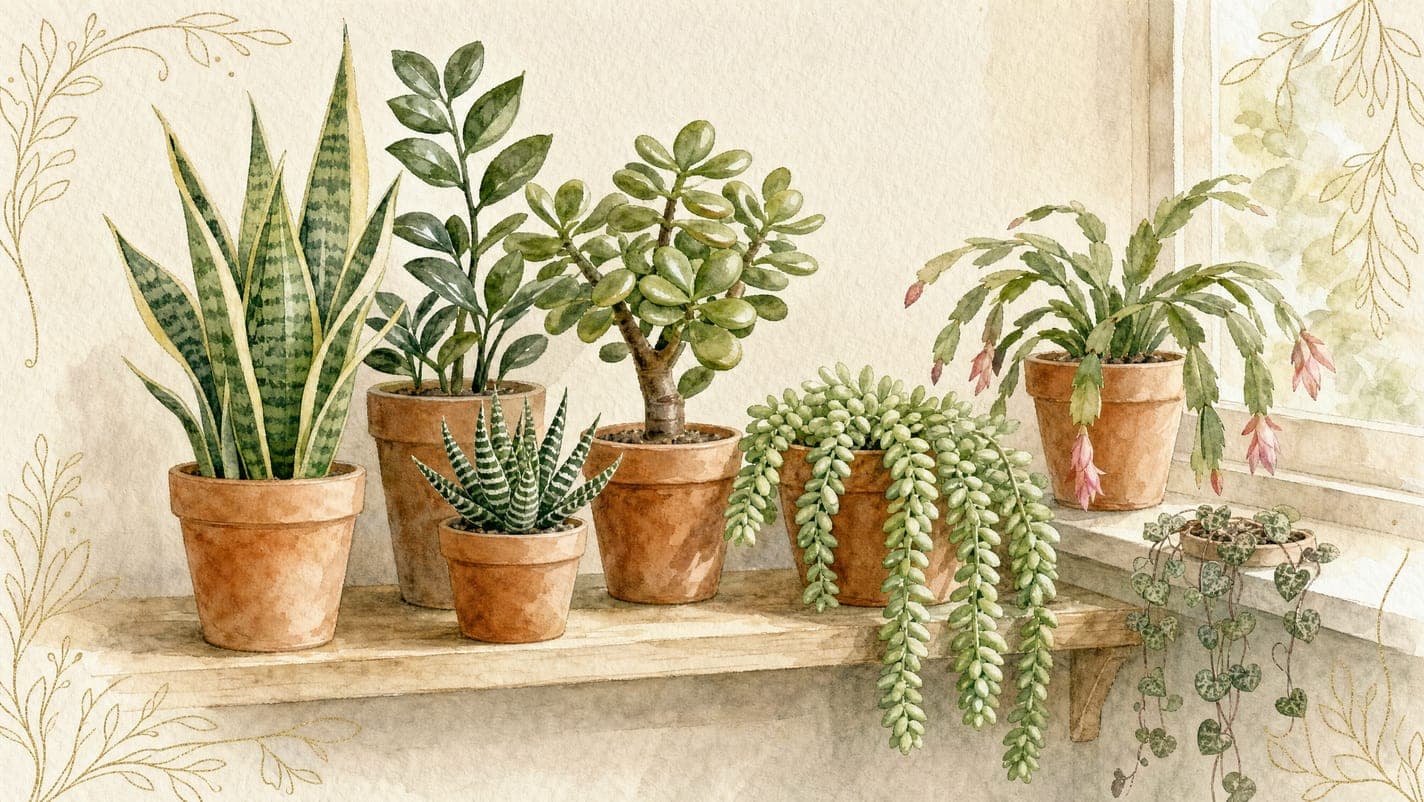
The best succulents for indoors start with the snake plant: nothing else holds its shape for years in a room every other succulent would sulk in. Below it are eleven more, ranked by how much dimness they tolerate, not by how good they look in a shop photo.
First, the part most roundups skip. No succulent thrives in genuinely low light. Not one. Every plant here is a compromise between what it wants and what your apartment has, and "tolerates" means survives and holds its shape for months without a south window — not thrives. Several will still stretch in a north room, and we say which. For the full picture on caring for succulents indoors, start there and use this page to pick the plant.
What "Low Light" Actually Means Indoors
Illinois Extension puts numbers on categories plant labels leave vague. It defines low light as roughly 75 foot-candles — "North window: a few feet away," "East/West window: 3-10 feet away." Bright light is about 300, and direct light, a south window straight in front of you, around 1,500 — twenty times the first number.
Hold that against what succulents ask for. Iowa State University Extension's guidance for growing them indoors is "ten or more hours of bright, indirect light," conceding only that "some species tolerate lower light levels, but most need at least six to eight hours." When they don't get it, Iowa State is blunt: "In low light, plants become lanky and pale."
A stretched rosette does not go back when you move it. So this is not a list of succulents that love the dark: it is the twelve most forgiving of an average apartment window, ranked by dimness tolerance, then forgiveness of watering error, then availability. Our succulent light requirements guide covers reading your own room, and the light level calculator estimates foot-candles from window direction.
The 12, Ranked by How Much Dimness They Tolerate
1. Snake Plant (Dracaena trifasciata)
The snake plant wins by a wide margin. NC State Extension says to give it "direct sunlight only part of the day, 2 to 6 hours, as it will tolerate very low light," and Penn State Extension agrees: "Snake plant enjoys bright indirect light but tolerates low-light areas very well." A few feet from a north window it grows slowly and generally holds its shape.
Penn State's watering rule is "water only when it is dry," adding that "you can kill it by overwatering, but you can neglect to water it for a month or so." NC State goes further for winter: "only water every one to two months." The failure mode is watering it on the same rota as your tropicals. Pets: the ASPCA lists it as toxic to dogs and cats, with saponins as the toxic principle.
Cultivars vary hugely: Penn State says the straight species "can grow up to 4 feet tall," while the dwarf 'Hahnii' grows "to only 6 inches." See also Sansevieria, Dracaena angolensis and the whale fin.
2. ZZ Plant (Zamioculcas zamiifolia)
Let's be accurate: the ZZ plant is not a classic succulent. It is an aroid with a fat water-storing rhizome — a caudex succulent by function, not by family. It behaves like one indoors, though, and shrugs at a dim room: growth there approaches zero, which is why it keeps looking right. Treat the rhizome as a reservoir — fully dry, then a proper soak, in gritty mix with a drainage hole. The failure mode is rot from kindness.
Pets: treat it as a chewing hazard. NC State Extension's plant toolbox lists Zamioculcas zamiifolia as a problem for cats and dogs, poison severity "medium," toxic principle "calcium oxalate," poison part the leaves, with symptoms of "diarrhea, vomiting if leaves are consumed in quantity" — the mechanical irritation typical of the arum family. We could not find a Zamioculcas entry in the ASPCA's own database, so we won't attribute a rating to them we can't locate.
3. Holiday Cactus (Schlumbergera)
The surprise of the list. Christmas and Thanksgiving cacti aren't desert plants: Iowa State Extension describes them as natives of "the humid, tropical, and semi-tropical mountain forests of southeastern Brazil" that "are epiphytes, growing in tree crotches." A plant evolved for filtered canopy light is the best true lower-light performer here, and Iowa State says holiday cacti "prefer bright, indirect light" indoors — an east or north window suits.
Its care rules invert everything else here. Iowa State says "a special cactus mix is not required," and it wants evenly moist soil while budding and flowering, kept "on the dry side" when dormant. The failure mode is drying it out desert-style in bloom, which drops the buds.
Pets: the ASPCA lists Christmas cactus (Schlumbergera bridgesii, Cactaceae) as non-toxic to dogs, cats and horses. For a showier epiphyte on similar light, see the orchid cactus and our indoor cactus care guide.
4. Gasteria (Ox Tongue)
Gasteria is the true succulent most often called the shade-tolerant one, and the claim survives checking. NC State Extension's entry for Gasteria gracilis says outright: "Unlike many succulents, they can tolerate some shade. Inside give them bright light." It handles an east window, or a couple of feet back from a north one, without going leggy, and NC State notes it "generally stays 6 inches tall" potted — a genuine desk plant. The failure mode is overwatering: NC State warns that "fungal diseases and root rot can occur if overwatered."
Pets: we found no Gasteria or "ox tongue" entry in the ASPCA database, and absence from a list is not a safety rating.
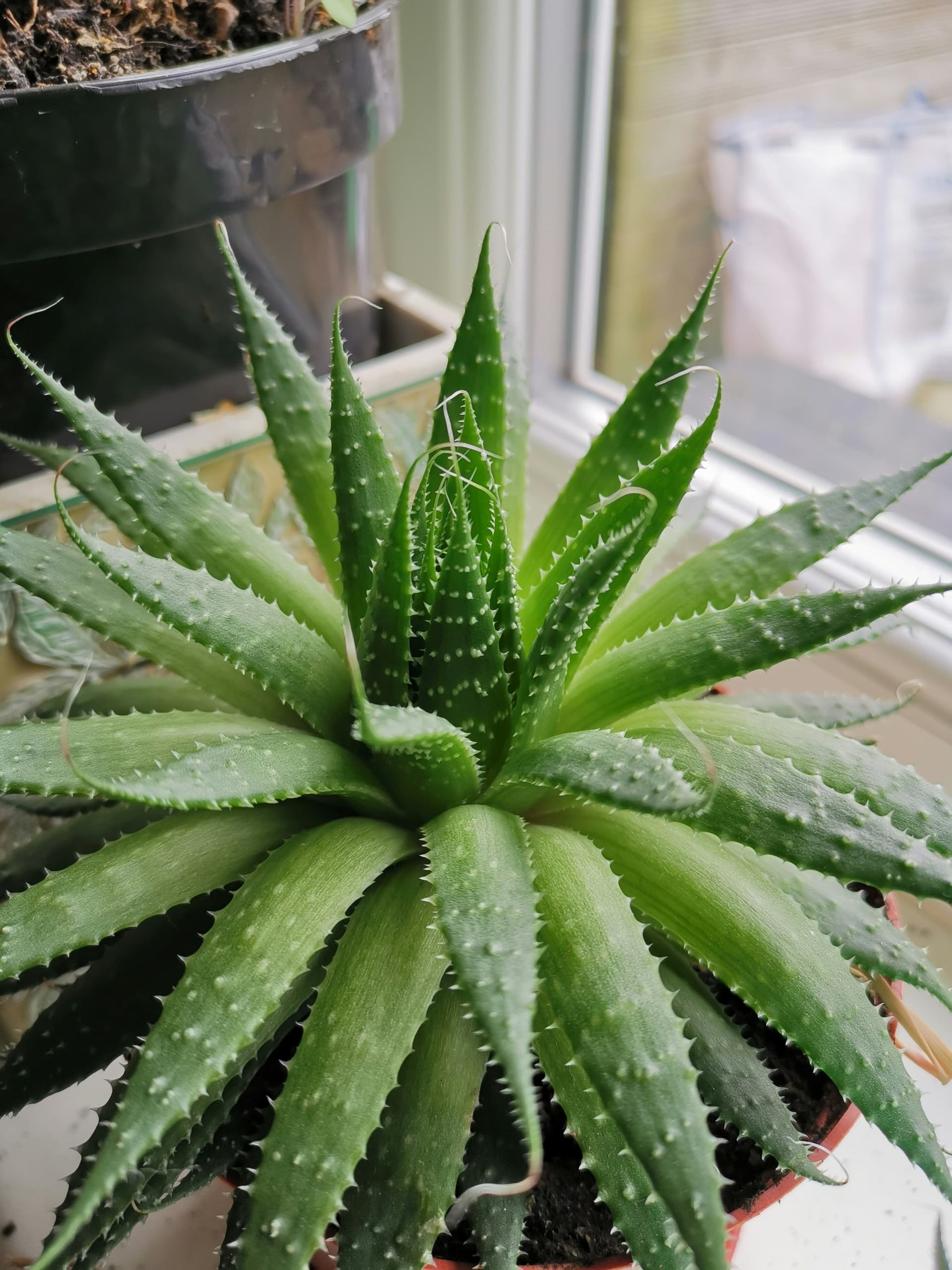
5. Haworthia and Haworthiopsis (Zebra Plant Types)
The white-banded rosettes sold in 2-inch pots everywhere. University of Wisconsin-Madison Horticulture Extension explains why they cope: "Many live in more protected spots and therefore are adapted to thrive in partial shade" — with the caveat that "in insufficient light, leaves will elongate."
Wisconsin's watering rule is practical: "if the soil mix is well drained, Haworthias can be watered weekly in the summer months; less frequently in the winter." Blend potting soil with an equal volume of perlite or pumice. The failure mode is an oversized pot — Wisconsin puts single plants at 1-3 inches across, so a big one holds slow-drying mix around very few roots.
Pets: the ASPCA lists Haworthia species as non-toxic to dogs and cats, and carries separate non-toxic entries for zebra haworthia (Haworthia fasciata) and little zebra plant (Haworthia subfasciata). Dim-tolerant, tiny and off the toxic list makes it our default pick for a dim apartment with a cat. The Shop Succulents Haworthia Collection, 5-Pack (about $15.34 as of August 2026) is an on-topic way to try several; Shop Succulents states plants are hand-selected and "may vary from pictures shown," so expect an assortment, not named species.
6. String of Hearts (Ceropegia woodii)
A trailing semi-succulent, and one of the few vining plants that's genuinely easy. UW-Madison Extension recommends "a west or south facing window" for string of hearts indoors. An east window works at a visible cost: "if not given enough light they will be a light green color," losing the dark marbling. Wisconsin also warns it "is easily killed by overwatering." The failure mode is hanging it in a corner, the darkest spot in the room.
7. Burro's Tail (Sedum morganianum)
Plump, trailing and beautiful, with one glaring weakness: burro's tail sheds leaves when you touch it. That's a handling problem, not a health one — choose its spot once, stop moving it, and let the shed pile root as free cuttings. An east or west window is the floor. Pets: the ASPCA lists it (Sedum morganianum, "burro's tail") as non-toxic to dogs, cats and horses.
8. Elephant Bush (Portulacaria afra)
A South African shrub that reads as jade from across the room, grows faster and takes hard pruning without sulking. Elephant bush wants a bright east window — this is where the list crosses from dimness-tolerant into needs a decent window. Pets: it's often recommended as the non-toxic stand-in for jade, but we could not find an ASPCA entry for Portulacaria afra, so we won't print a rating.
9. Jade Plant (Crassula ovata)
The jade plant is here because it lives for decades, not because it's dim-tolerant. It needs an unobstructed east or west window; in low light it gets leggy and the thick trunk never develops. A jade dropping leaves is usually being watered on a tropical rhythm in a dim spot — both mistakes at once.
Pets: the ASPCA lists the jade plant (Crassula argentea, family Crassulaceae) as toxic to dogs and cats, toxic principles "unknown," clinical signs "vomiting, depression, incoordination," and suggests keeping jades in high spots out of reach. Silver jade carries the same caveats.
10. Aloe Vera
Practical, architectural and hard to kill — but light-hungry. Aloe vera belongs in the brightest window you have; in a north one it goes flat and pale and splays outward. The failure mode is a decorative pot with no drainage hole — aloes rot from the base, and by the time the outer leaves soften the crown is gone. Pets: the ASPCA lists aloe as toxic to dogs and cats, toxic principles "saponins, anthraquinones," clinical signs "vomiting (not horses), lethargy, diarrhea."
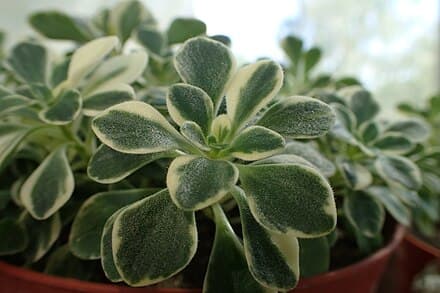
11. Panda Plant and Other Kalanchoes (Kalanchoe tomentosa)
Fuzzy, silver-gray, brown-edged leaves — the most tactile succulent most people will own, and that felt is a real reason to keep water off it. Kalanchoes want a bright window and stretch readily. Pets: this is the one to take seriously. The ASPCA lists Kalanchoe species (family Crassulaceae) as toxic to dogs and cats, toxic principles "bufodienolides," clinical signs "vomiting, diarrhea, abnormal heart rhythm (rare)." Those are cardiac glycosides — a different category of concern from an upset stomach. We would not keep a kalanchoe, including Kalanchoe pinnata, anywhere a determined chewer can reach.
12. Echeveria
Echeveria is here for one reason: it's sold everywhere, and it's probably what you pictured when you searched. It's also the likeliest to disappoint in an average window — rosettes are the shape most punished by weak light, and Iowa State's "lanky and pale" describes an under-lit echeveria exactly. The failure mode is buying the colored one: the pinks and purples are pigments produced under high light, and indoors it tends to fade back toward plain green. If you have a south window, echeverias are wonderful. If you're reading a low-light article, buy a haworthia instead.
Which Succulents Not to Buy for a Dim Room
We'd rather you skip these than replace them in six months:
- Echeveria rosettes in dish gardens. The light demand above, plus a shallow shared container with no drainage hole and several species on different schedules.
- Most desert cacti. A sand dollar cactus needs serious direct sun. In a dim room it won't die quickly — it will just produce a pale, permanently misshapen growth point.
- Lithops (living stones). Extreme light plus a dry rest period most homes can't supply.
- Sempervivum (hens and chicks). Cold-hardy outdoor plants that stretch almost immediately indoors.
- Desert rose and other caudex plants. Sold as houseplants, grown as full-sun specimens.
- African milk tree and other euphorbias, if you have pets or children. The ASPCA's guidance on the related pencil cactus notes the sap "causes vomiting and drooling," with possible eye irritation — "redness, swelling, squinting."
If the room is genuinely dark — no usable window, or a north one blocked by a building — succulents are the wrong family. See low-light apartment plants for what works there, and best first houseplants for the broader beginner roundup.
Pet Safety: Several of These Are Toxic
Checked against the ASPCA's database, the split is roughly even. Toxic to dogs and cats: snake plant, aloe, jade and kalanchoe. Non-toxic: Haworthia species, zebra haworthia, Christmas cactus, burro's tail and echeveria — the ASPCA lists Echeveria elegans ("hens and chickens") as non-toxic to dogs, cats and horses, and names echeveria among the non-toxic succulents in its own pet guidance. For Gasteria, elephant bush, string of hearts and the ZZ plant we could not locate ASPCA entries — which is not the same as a clean rating.
The ASPCA itself notes that "non-toxic" does not mean "no problem," since pets may get mild stomach upset from any plant outside their normal diet. None of this is dosing advice: if a pet has eaten something, call your vet or the ASPCA Animal Poison Control Center at (888) 426-4435. Nothing here is food, for pets or people. See our pet-safe houseplants guide for what to bring home instead, and the pet toxicity checker for individual species.
Buying: What to Look For, and What Multipacks Actually Ship
Three checks, thirty seconds. Compact growth: tight leaf spacing means good light, long gaps mean it already stretched in the greenhouse and won't recover. A firm base: press where the stem meets the soil, because soft or dark means rot, and no care reverses it. Pests: Clemson HGIC's rule is "before buying or bringing a plant indoors, always check it and its container for signs of pests" — look for mealybugs, whose adult females "cover themselves and their eggs with a white, waxy material, making them look cottony," and for spider mite webbing. Clemson also advises isolating anything new "for six weeks."
Buying online, the assortments ship unnamed varieties. You cannot choose species from a mixed pack, so none of these will get you the exact plants ranked above.
- Altman Plants Specialty Live Succulents, 6-Pack, about $16.52 as of August 2026 — six varieties, no duplicates. Altman lists them as "Kalanchoe, Crassula (jade), Portulacaria (elephant bush), Sedum adolphi, Sedeveria, Graptosedum, and more," several from the light-hungry bottom half of our list.
- The Succulent Cult, 5-Pack Assortment, about $9.99 as of August 2026, is the cheapest way to try several; the seller describes it only as a handpicked assortment of starter plants.
- Altman Plants Deluxe, 12-Pack, about $22.99 as of August 2026 — six varieties in sets of two, per Altman.
Our honest advice: buy one named plant from the top of this list for the spot you actually have, and use a mixed pack only if you enjoy a lottery.
The First Week: Get It Out of the Nursery Peat
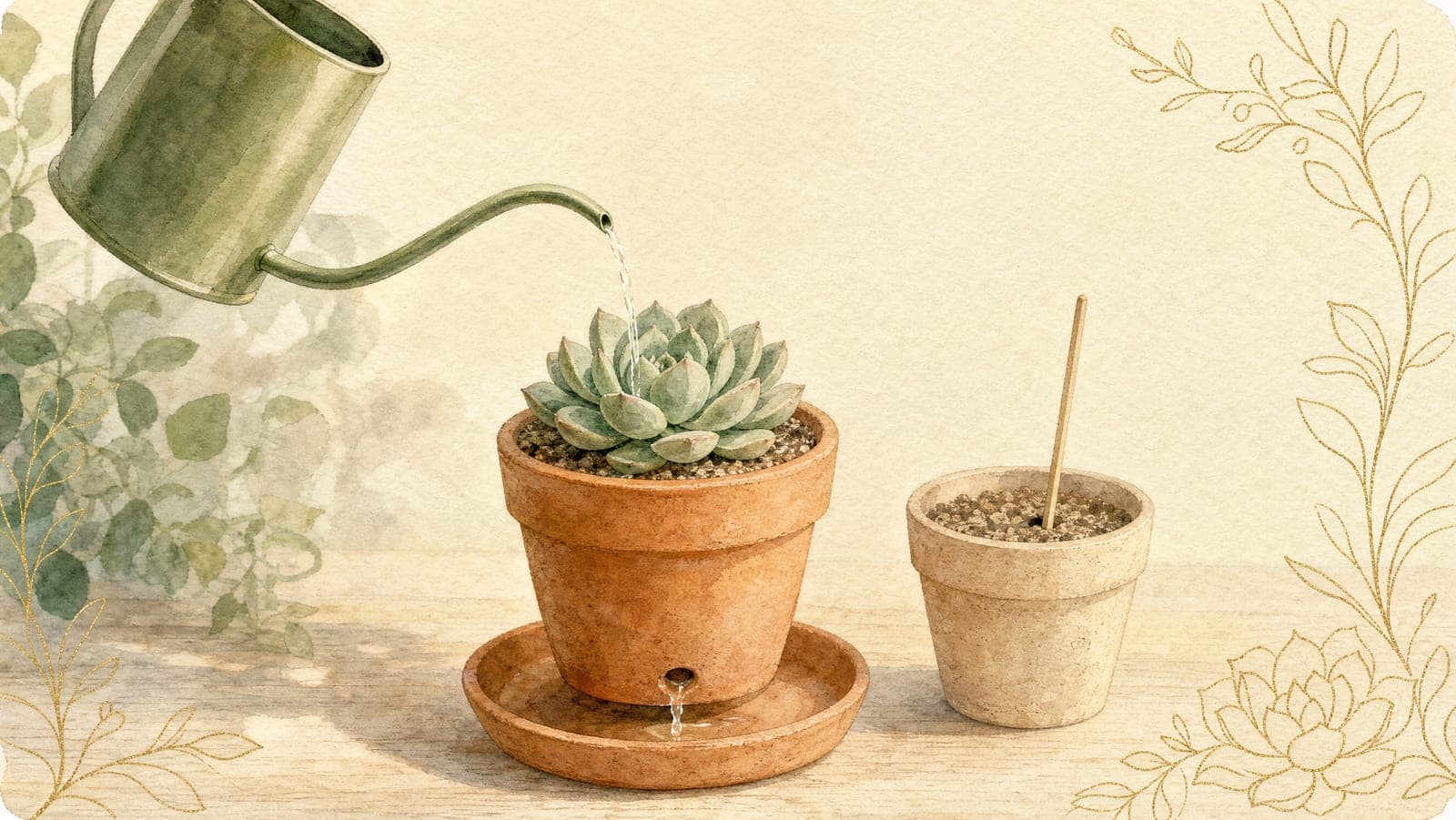
Almost every succulent sold here arrives in a dense, peat-heavy nursery mix built for greenhouse irrigation. Under greenhouse fans it dries quickly; in a still living room it can stay damp far longer, which is how a healthy plant rots soon after you bring it home. Iowa State Extension is unambiguous that succulent containers "must have drainage holes," and that "clay or terracotta pots are ideal since they are porous and allow quicker soil drying."
- Back to the Roots Organic Succulent and Cacti Mix, 6 quart, about $9.99 as of August 2026, saves you blending — Back to the Roots describes it as including perlite and horticultural sand for fast drainage. We still cut bagged mixes with extra pumice for a glazed pot.
- A 6-pack of Orceler 4-Inch Terracotta Pots with saucers runs about $17.58 as of August 2026 — Orceler states each pot has a drainage hole and that the porous walls speed drying.
Then leave it alone: water once after repotting, and not again until the mix is dry to the bottom. Our succulent soil and drainage guide covers mixes, how often to water succulents indoors covers the soak-and-dry cycle, and the repotting guide covers technique. One exception: the holiday cactus is an epiphyte, and Iowa State says ordinary potting soil is fine for it.
The 12 at a Glance
| Plant | Dimmest light tolerated | ASPCA status (dogs and cats) |
|---|---|---|
| Snake plant (Dracaena trifasciata) | Few feet from a north window | Toxic (saponins) |
| ZZ plant (Zamioculcas zamiifolia) | Few feet from a north window | No entry found |
| Holiday cactus (Schlumbergera) | North or east window, bright indirect | Non-toxic |
| Gasteria (ox tongue) | East window, or back from a north one | No entry found |
| Haworthia / Haworthiopsis | Bright east window | Non-toxic |
| String of hearts (Ceropegia woodii) | East window, with paler leaves | No entry found |
| Burro's tail (Sedum morganianum) | East or west window | Non-toxic |
| Elephant bush (Portulacaria afra) | Bright east window | No entry found |
| Jade plant (Crassula ovata) | Unobstructed east or west window | Toxic |
| Aloe vera | South or west window | Toxic (saponins, anthraquinones) |
| Panda plant and kalanchoes | Bright window | Toxic (bufodienolides) |
| Echeveria | South window, realistically | Non-toxic (Echeveria elegans) |
Two semi-succulents for a marginal window: the baby rubber plant takes medium light well, and the trailing string of dolphins suits real light.
The Short Version
Buy for the window you have, not the one you wish you had. Snake plant or ZZ plant for a genuinely dim room. Haworthia or gasteria for a small, brightish desk. Holiday cactus if you want flowers and have an east window. Everything below those wants more light than an average apartment corner supplies, and buying it anyway is how people conclude they have a black thumb.
Then do the two things that decide the outcome: get it out of the nursery peat and into a gritty mix with a drainage hole, and water only when the pot is dry to the bottom. To go deeper, our indoor succulent and cactus care guide is next.