This guide contains affiliate links. We may earn a small commission if you purchase through our links, at no extra cost to you.
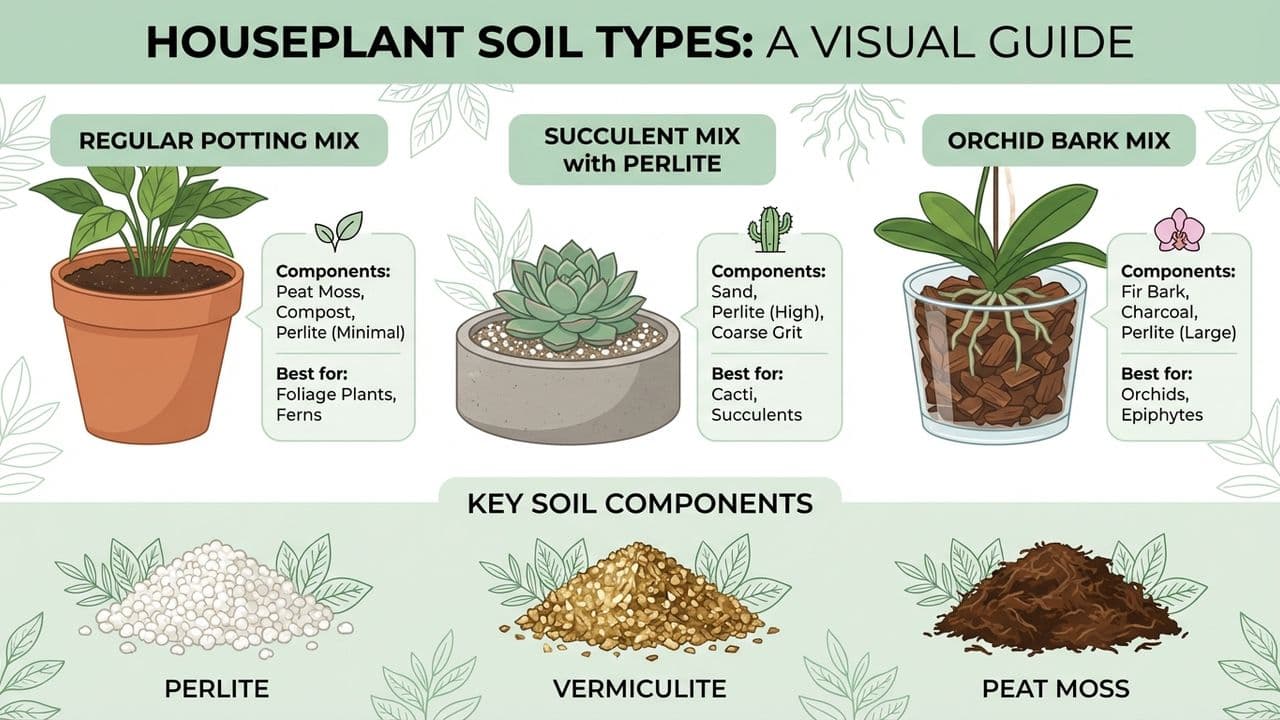
The best soil for succulents indoors is mostly rock. Roughly half to four-fifths of the volume should be coarse mineral — pumice, perlite, crushed lava, coarse sand — with the rest organic. Standard potting mix is not bad soil; it simply does the opposite of what a succulent root wants.
Most "best succulent soil" articles skip this: the soil and the pot are one system, and the pot usually matters more than the bag. The same mix behaves completely differently in a 3-inch terracotta pot and a 7-inch glazed one. Our broader guide to how to care for succulents indoors covers light and placement alongside this.
What follows is not a product list — it is how to judge any bag on the shelf, or fix the one you already own.
Why Standard Potting Mix Kills Succulents
General-purpose potting mix is engineered to hold water. That is the feature, not a defect. According to Virginia Cooperative Extension, "potting soils composed of mostly fine particles or fibrous structures like peat moss and coconut coir will often hold more water and less air, while potting soils composed of more coarse materials like bark or perlite will readily drain after watering."
More water means less air. A succulent root in a fine, fibrous mix is not just wet; it is short of oxygen. Wisconsin Horticulture attributes houseplant root rot to soil-borne fungi — Pythium, Phytophthora, Rhizoctonia solani and Fusarium — noting that "root rot fungi grow and reproduce best in wet soils," so a mix that stays saturated is what sets the rot up.
The second failure is stranger and less discussed. The University of California Master Gardeners of Santa Clara County note that "many potting soils become hydrophobic — tending to repel water — when they dry out, and are difficult to re-wet." The culprit is usually the peat: "paradoxically though, when peat moss dries out it is very difficult to re-wet." So on the next watering, "the water might be running between the side of the pot and the hydrophobic root ball instead, barely wetting the outer surface and leaving the center of the root ball dead dry."
A peat-heavy pot swings between two bad states — saturated and airless, then water-repellent and unevenly dry — and neither is what a desert plant evolved to sit in. Our general houseplant soil guide covers what bagged blends are actually made of.
What "Well-Draining" Actually Means
"Well-draining" is the most abused phrase in houseplant writing. It does not mean water comes out of the hole; water comes out of almost any pot eventually. It means how much air is left in the mix once the dripping stops, and how fast the rest leaves.
You can measure that on your own bench:
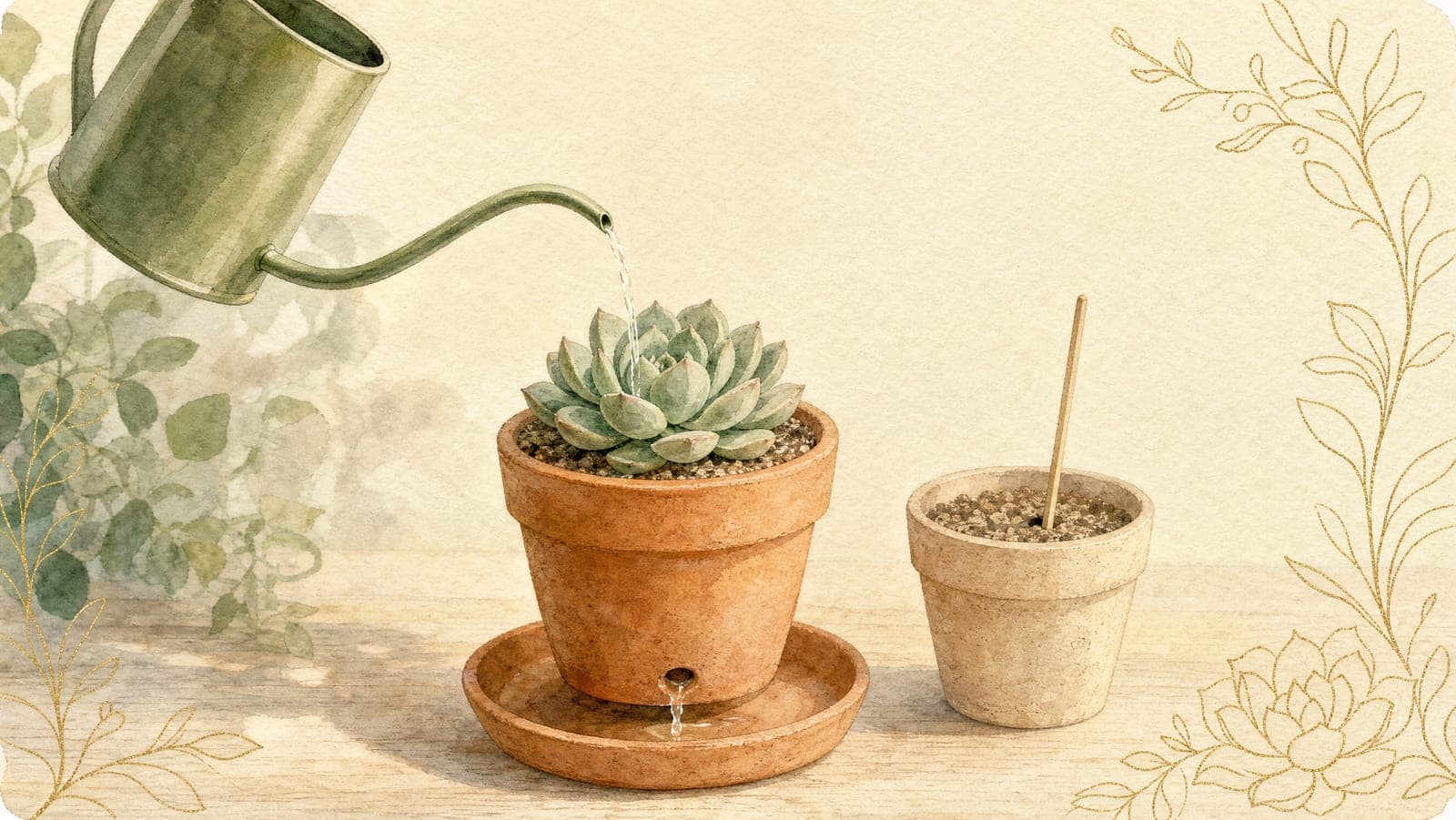
- Water the pot thoroughly until it runs out the bottom, then empty the saucer.
- Wait five to seven days in a normally lit room.
- Push a bamboo skewer to the bottom of the pot and pull it out.
If the skewer comes out dark and damp with mix clinging to it, that pot is too water-retentive for a succulent. In our experience a gritty mix in a small clay pot is dry to the bottom in three to five days; a peat mix in a 6-inch glazed pot can still be wet at two weeks.
Mix and watering schedule cannot be discussed separately: the mix sets the interval. That relationship is the whole subject of our guide to how often to water succulents indoors.
The Mineral-to-Organic Ratio
The honest range growers use is roughly 50 to 80 percent mineral to 20 to 50 percent organic. Nobody agrees on one number, and anyone who quotes one without asking about your light and your pot is guessing.
The conservative floor comes from University of Minnesota Extension, which advises for cacti and succulents that "a mix of one part potting soil and one part coarse sand is usually porous enough," with a field test we like: moisten the mixture and squeeze it in your hand, and "on release, the soil should fall apart." If it holds a shape like clay, add more grit.
More mineral is safer but thirstier. An 80 percent mineral mix is very hard to overwater, and it will also want water more often and lose nutrients faster. A 50 percent mix forgives a forgetful waterer and punishes an enthusiastic one.
Recipe 1: The cheap one (amend a bag)
One part bagged cactus and succulent mix to one part pumice. Bagged "cactus" soil is often peatier than the name suggests, so cutting it 50/50 should land roughly in the 65 to 75 percent mineral range, depending on how much grit the bag already contains.
For the base, Back to the Roots Organic Succulent and Cacti Mix, 6 Quart runs about $9.99 as of August 2026. According to Back to the Roots, the blend includes aged bark plus perlite and horticultural sand for drainage. We still would not plant into it straight from the bag.
Recipe 2: The gritty one (buy it done)
At the high-mineral end, a true gritty mix is mostly hard particles with barely any peat. Bonsai Jack Gritty Mix, 2 Quarts is about $15.80 as of August 2026. Bonsai Jack states the blend contains Bonsai Block, Monto Clay and pine fines, optimized to a pH of 5.5 for plants that require drier feet between waterings. It is expensive per quart, so we treat it as the mix for plants you actually care about — an old jade plant, a desert rose with a fat caudex — not for potting thirty cuttings.
Desert cacti belong at the top of this range. University of Minnesota Extension's 1:1 soil-to-sand blend is a floor rather than a target for something like a sand dollar cactus, which in our experience does better with noticeably more grit than that; see our indoor cactus care guide for where cacti and leafy succulents diverge.
The Amendments, Compared Honestly
Pumice is our default. A 1992 study in Communications in Soil Science and Plant Analysis evaluating pumice as a perlite substitute reported that the physiochemical properties relevant to container soil amendment were similar between the two. The practical difference is density: growers commonly report that pumice stays mixed in while perlite floats to the surface with repeated watering and crushes under a thumbnail. Sumloty Horticultural Pumice, 3 Quarts in the 1/4-inch grade is about $15.29 as of August 2026; Sumloty describes it as naturally mined, sterile and pH-neutral.
Perlite is cheaper, lighter and everywhere, and it works. It just migrates upward over time and crumbles to dust, which matters more in a pot you will not repot for three years than in a seed tray.
Coarse sand has to actually be coarse — builder's or horticultural grade, gritty between the fingers. University of Minnesota Extension specifies coarse sand rather than sand generally, and growers and mix formulators commonly report the reason: fine sand and play sand tend to fill pore space rather than open it, so mixed into organic matter they can pack down denser than what you started with.
Calcined clay (Turface and similar fired-clay products) is a real option and a genuine disagreement among growers. The particles are porous, holding some water internally while keeping the mix open. Whether that helps depends on your climate and habits — we will not claim it beats pumice, because we do not think anyone knows.
For the organic fraction, bark fines or coir may behave better than straight peat: coir is widely reported in the container-media literature to be less hydrophobic than peat and easier to re-wet once it has dried.
The Perched Water Table (Read This Part)
Here is the fact that reframes everything, and almost nobody selling soil mentions it.
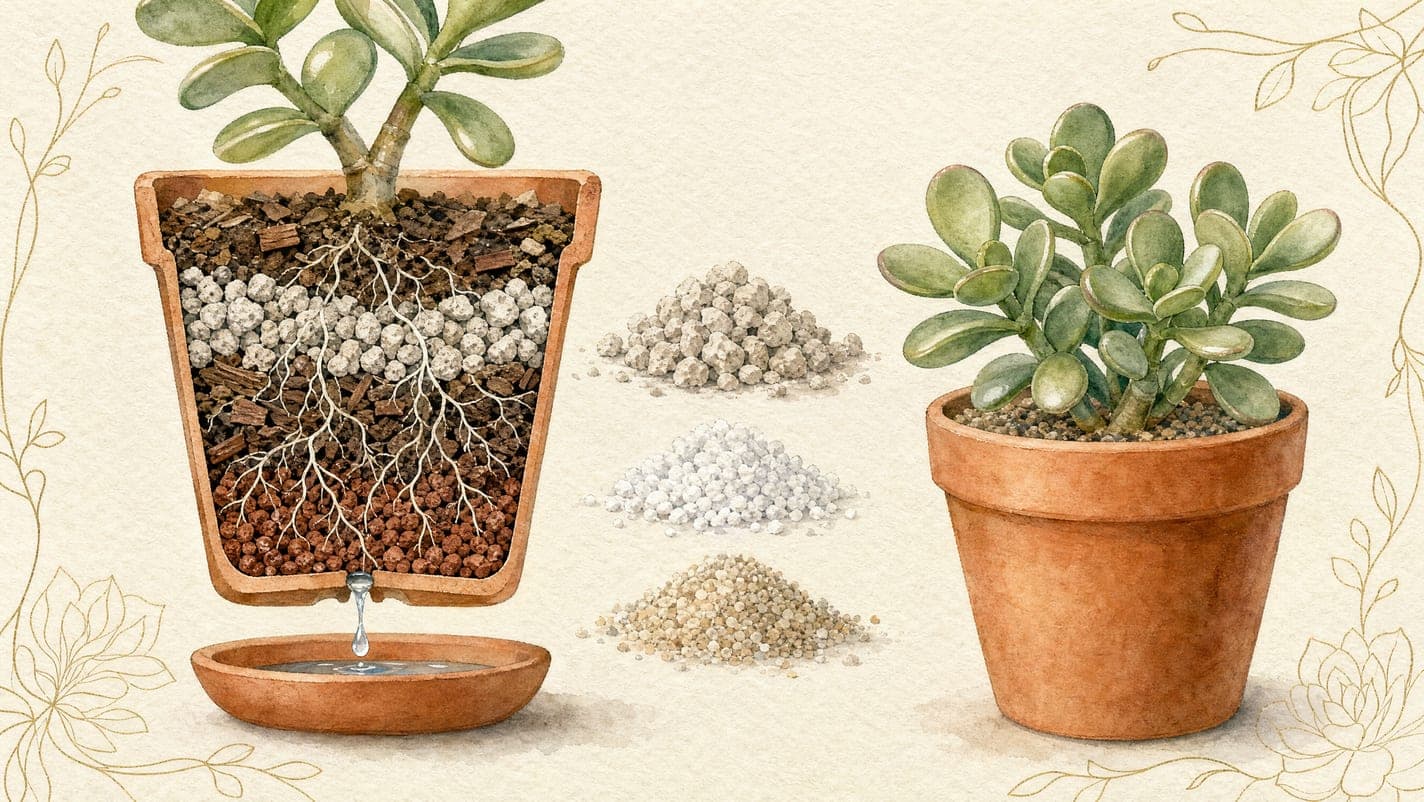
Every pot holds a saturated layer at the bottom. Not "a badly drained pot" — every pot, including yours, including one with a hole. The UC Master Gardeners of Santa Clara County state it plainly: "a well-watered container of potting mix always has a saturated layer at the bottom." That zone is called the perched water table, and its depth is set by the particle size of the mix, not by how tall the pot is. Fine particles hold water higher. Coarse particles hold it lower and thinner.
Which is why the most common piece of drainage advice online is backwards. Water does not cross from fine material into coarse material until the fine material is already soaked. Per the same UC source, "water does not move easily from a layer of fine-textured material to a layer of coarse-textured material," and "if a layer of such material is in the bottom of a pot, the downward movement of water (i.e., drainage) will stop when the water encounters the coarse layer."
Illinois Extension describes the result: the water "perches" or gathers in the soil just above the gravel until no air space is left, so gravel in the bottom "does little to keep soil above it from being saturated by overwatering." Washington State University's Linda Chalker-Scott, who calls this "one of those myths that refuses to die," gives the bottom line: "Drainage material added to containers will only hinder water movement."
So a gravel layer does not create drainage. It raises the saturated zone closer to the roots. Same for pot shards over the hole — Chalker-Scott singles them out. A decorative pebble layer on top works by a different mechanism and is a matter of taste: it does not move the perched water table, but it does slow evaporation from the surface, so the mix underneath stays damp longer than it otherwise would.
The actual fix is to change the particle size of the whole mix. UC's Master Gardeners give the two real options — "amend the potting mix by adding coarse materials such as perlite, crushed lava, or pumice, or choose a deeper container." A taller pot does not shrink the saturated layer; it just puts more unsaturated mix above it. For what happens when that zone stays wet, see our guide on healthy roots versus root rot.
Pots: The Half of the System Nobody Shops Carefully
A drainage hole is not negotiable. University of Minnesota Extension is blunt about this group of plants specifically: grow them "in pots with drainage holes because excess water trapped in the soil will result in rotting and decay in a very short time."
Material changes the drying speed as much as a soil amendment does:
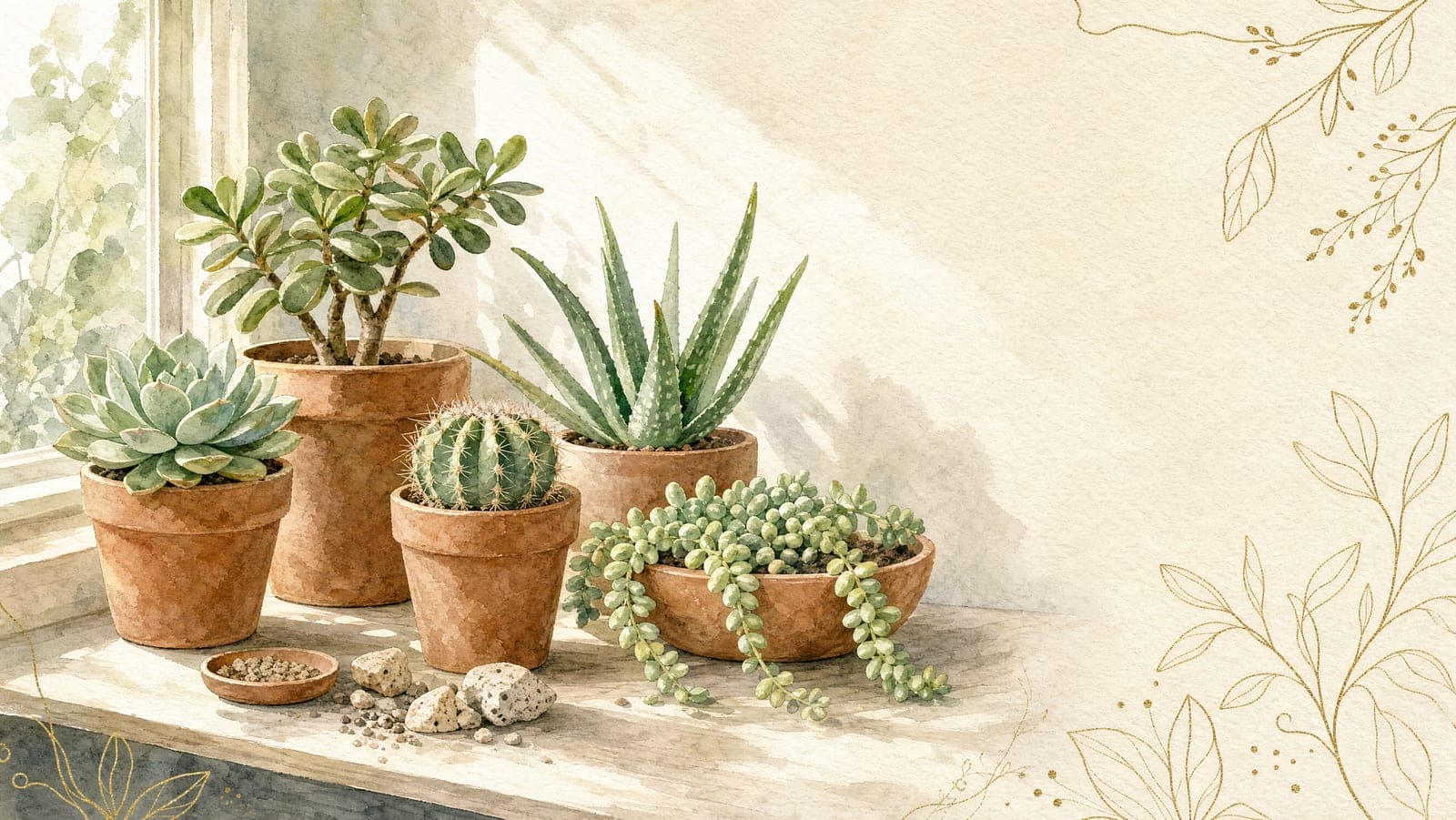
- Unglazed terracotta is porous. Virginia Cooperative Extension notes that terracotta pots "will tend to dry out the rootzone more quickly," and Penn State Extension is direct: "Terracotta is ideal for succulents." It is the most forgiving container there is for anyone who overwaters. A 6-pack of Orceler 4-Inch Terracotta Pots with Saucers runs about $17.58 as of August 2026 — Orceler states each pot has a bottom drainage hole and that the clay walls let air and water move through, helping soil dry faster.
- Glazed ceramic is sealed. Virginia Cooperative Extension notes potting soil in glazed clay pots "holds water longer." Beautiful, and it demands a grittier mix.
- Plastic is "nonporous, so they only lose water from the drainage holes and the surface of the potting soil," per the same source. Fine for succulents if the mix is right.
Over-potting is a drainage problem before it is a growth problem. Virginia Cooperative Extension observes that large containers "can usually store greater volumes of water than small containers," while in small ones "the smaller volume of potting soil does not have the capacity to store water for long periods of time." A small plant in a big pot is surrounded by wet mix no root can reach. Penn State's default is sound: the new container should be only "slightly larger than the current one."
Empty the saucer — Virginia Cooperative Extension advises not keeping a container in a drainage tray for more than 60 minutes. And for a no-hole decorative pot, use it as a cachepot: keep the plant in a plastic nursery pot, drop it inside, and lift it out to water over the sink. A trailing burro's tail looks better in a nice cachepot than it would ever look rotting in one.
Repotting Into the New Mix
Nursery plants almost always arrive in dense, peat-heavy production mix, kept water-retentive so a grower can irrigate a whole bench on one schedule. At home, swapping it is the single highest-value change you can make.
Work dry, not wet. Let the plant go dry for several days, tip it out, and crumble the old mix off the roots. Prune anything black, hollow or mushy. Repot at the same depth in a pot barely wider than the root mass, then hold off on water so torn roots can callus. Arizona Cooperative Extension is more specific for cacti: replant into dry soil, and "wait a week for any roots damaged during transplant to dry" before irrigating. Our repotting guide covers the mechanics.
An aloe vera is about as tolerant a test subject as exists; our roundup of the easiest succulents for beginners covers which species forgive a new mix while you calibrate.
When the Soil Is Not the Problem
Honesty section, because this article could easily oversell itself. A perfect gritty mix will not save a succulent in a north-facing corner — etiolation, the stretched pale growth people blame on soil, is a light problem, full stop. Nor will it save a plant watered every Sunday regardless of what the pot weighs.
We rank the interventions light first, pot second, mix third, with watering habit running through all of them. Soil is the easiest of the four to buy your way out of, which is exactly why it gets more attention than it deserves. Our guide to common houseplant mistakes covers the rest.
The Short Version
- Aim for 50 to 80 percent coarse mineral — higher for cacti, lower if you tend to underwater.
- Squeeze test it. Moist mix should crumble apart, not hold a shape.
- Skewer test it after a week. Still damp at the bottom means still too heavy.
- Never put gravel in the bottom. It raises the saturated layer instead of draining it.
- Drainage hole, or use a cachepot. There is no third option.
- Buy the pot small, and terracotta if you tend to overwater.
Get the mix and the pot right once and most succulent care collapses into a single question: is it dry yet. For light levels, propagation, seasonal changes and everything that sits on top of this, start with our full indoor succulent care guide.