Your dog or cat ate part of a houseplant. Do these things, in this order. Get the animal away from the plant. Photograph the plant and keep a piece of it. Do not try to make your pet vomit. Then call someone — your own vet, the nearest emergency clinic, or a 24/7 animal poison control line:
- ASPCA Animal Poison Control Center: (888) 426-4435. The ASPCA lists this number as available any day, any time, and notes that a consultation fee may apply.
- Pet Poison Helpline: (855) 764-7661. Also 24/7. Its website states an 89 USD per-incident fee, with follow-up consultations included.
That is what to do if your dog ate a houseplant, and it is the same first move if your cat ate a houseplant — with one exception covered below, because a cat and a true lily does not wait.
We are plant people, not veterinarians, and this page is not a diagnosis. Its only job is to get you to a professional faster and better informed. Every symptom and timeline below is attributed to a veterinary source. Once the crisis has passed, the long-term fix is choosing pet-safe houseplants — but that is tomorrow's problem.
What to Do Right Now: 5 Steps
1. Separate the pet from the plant. Move the animal to another room, or the plant out of reach. This stops the exposure getting larger.
2. Clear the mouth if you can do it safely. The Merck Veterinary Manual describes supportive care for insoluble calcium oxalate plant exposure — the aroids, below — as including removal of the plant material and rinsing or wiping out the mouth to remove remaining crystals. Do not fight an animal in pain, and do not put fingers into a mouth that might bite. If it does not come out easily, say so when you call.
3. Photograph everything and save a sample. The plant, the pot, the nursery tag, the chewed part. Bag a leaf or piece of stem — at a clinic it is the most useful thing you can bring.
4. Work out the three numbers they will ask for. Roughly how much, roughly when, and which part — leaf, stem, flower, bulb, tuber or berry. "Two bites, about ten minutes ago, from a leaf" beats nothing.
5. Call, and start a written timeline. Note the time of every symptom and the time you called. Vets and poison lines both work from that timeline, and it is easy to lose track of when something started.
What Not to Do
Do not induce vomiting on your own. ASPCA Pro tells veterinary professionals that emesis is wrong when the substance "is going to cause more harm coming back up than it did going down" — its examples include strong acids or bases and substances that can be aspirated — and when the animal is already symptomatic or already vomiting. Cornell University's College of Veterinary Medicine puts it to owners plainly: induction of vomiting is sometimes contraindicated, so consult a veterinarian or a poison control center, who can tell you whether it is safe at home, and how.
No home remedies, no doses of anything. If a treatment is appropriate, the person on the phone will tell you what and how much.
Do not force milk, food or water in as a "neutraliser." Merck does note that supportive care for insoluble oxalate exposure sometimes includes milk or other calcium-containing dairy, because the oxalates bind to it and that helps clear the mouth. But that is a measure chosen once someone knows what the plant was, not an antidote — and pushing liquid into a drooling, distressed animal carries its own risk.
Do not wait and see if you have a cat and any true lily. It is the one scenario where a pet who looks completely fine can still be in serious trouble.
Do not crowdsource the plant ID on social media instead of calling. Identification threads get answers wrong constantly, and the wait is time on a clock you cannot see.
Identify the Plant — The Single Highest-Value Thing You Can Do
Everything else depends on it, and Merck is blunt about why: "Many plants that share the same common name are in different families and have different levels of toxicity. Therefore, it is important to identify not only the common name of the plant ingested, but also the scientific name."
Three ways to get there quickly, in order of speed:
- The nursery tag. Most plants ship with the botanical name on a plastic stake. Check the pot, then the drawer where you throw those tags.
- Our pet toxicity checker. A searchable database with separate cat and dog entries, symptom notes and severity ratings. Search the common name you know, read the scientific name back to the vet.
- A photo. Pet Poison Helpline staff will ask for the plant's name and may request photos to help identify it. Take one shot of the whole plant, one of a single leaf.
If you want severity ranked rather than looked up one plant at a time, our companion guide to the toxic houseplants to avoid sorts them by how bad the exposure tends to be.
The peace lily confusion, which cuts both ways
This confusion sends people to the ER unnecessarily and, far worse, causes others to shrug off genuinely urgent exposures.
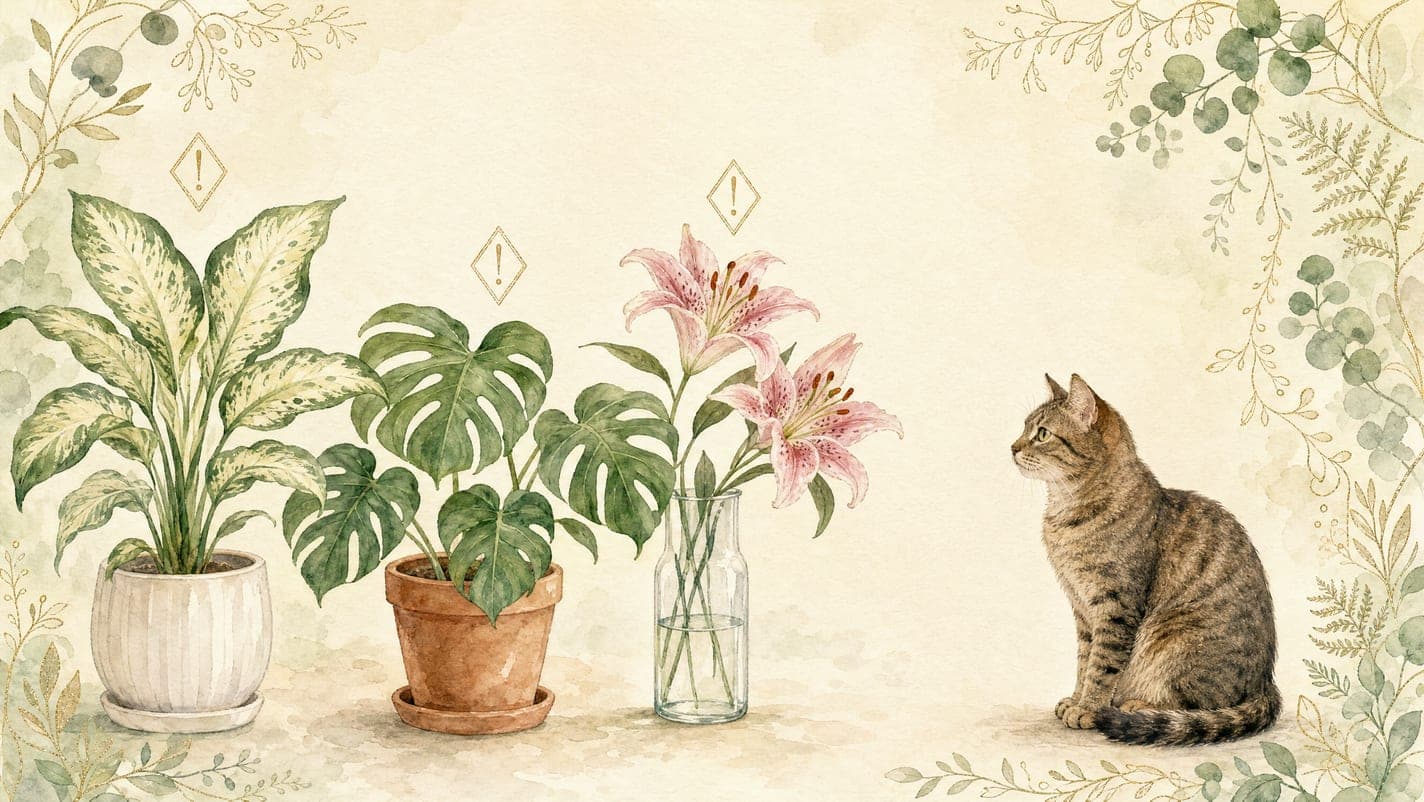
According to ASPCA Pro, the two genera that damage a cat's kidneys are Lilium (the Asiatic, Easter, tiger and stargazer types) and Hemerocallis (daylilies). Peace lily (Spathiphyllum) and calla lily are in neither genus and are not nephrotoxic. ASPCA Pro describes peace lily as containing insoluble calcium oxalate crystals that cause immediate oral pain, drooling and possible swelling of the mouth and tongue; the ASPCA's own calla lily entry lists the same toxic principle and the same kind of oral signs. Different plants, different mechanisms, wildly different stakes.
So: a florist bouquet, or big trumpet flowers and long strap leaves, plus a cat — urgent. The glossy-leaved houseplant with the white spathe — tell the vet it is Spathiphyllum and they will know exactly what you mean.
The thing people forget to mention
Anything sprayed onto the plant is a separate exposure. If you treated it with an insecticide, horticultural oil or soap spray recently, say so — insecticides were the ninth most common toxin category the ASPCA Animal Poison Control Center handled in 2025, at 3.8% of exposures. Our pest control guide covers treating plants around animals; tonight, just report the residue.
Plant Poisoning Symptoms in Pets: What the Timeline Actually Looks Like
These are signs that warrant a call, not a diagnosis. Symptoms overlap heavily between plants, and with things that have nothing to do with plants.
Minutes: the mouth-pain plants
Many of the most widely kept houseplants are aroids — pothos, heartleaf philodendron, monstera, dieffenbachia, peace lily — all of which contain insoluble calcium oxalate crystals. Pet Poison Helpline explains the mechanism: chewing releases the crystals, which irritate the lips, mouth and throat.
The Merck Veterinary Manual lists the resulting signs as immediate pain, irritation, redness, excessive drooling, pawing at the mouth, swelling, lethargy and loss of appetite. Because the pain is immediate, these exposures announce themselves.
Merck also notes that most exposures to insoluble oxalate plants have a good to excellent prognosis, with full recovery expected and often without veterinary intervention. That is genuinely reassuring, and it has a hard edge: Pet Poison Helpline notes that in rare instances the throat can swell enough to cause difficulty breathing. Any change in breathing, or swelling you can see, is an in-person emergency rather than a phone call.
Hours: stomach signs, and the plants that go after organs
Some plants open more quietly. Kalanchoe contains cardenolides and bufadienolides — cardiac glycosides related to digitalis — which is why veterinary toxicology briefs treat kalanchoe exposure as a potential heart-rhythm problem rather than simple stomach upset. Cyclamen contains terpenoid saponins, and Pet Poison Helpline notes that large ingestions of the tubers can lead to heart rhythm abnormalities, seizures and death — and the tuber of a potted cyclamen sits at the soil surface, where a digging dog reaches it first.
Sago palm earns its reputation. Veterinary sources describe gastrointestinal signs typically appearing within about 15 minutes but sometimes delayed by hours, severe liver failure possible two to three days after ingestion, and a single seed being enough to poison a dog. A calm pet at hour three does not rule a sago palm out.
Exposures with milder listed signs exist too — the ASPCA lists aloe vera as toxic to cats and dogs, with saponins and anthraquinones as the toxic principles and vomiting, lethargy and diarrhoea as the signs. But "milder" is the phone line's call, not yours.
12 to 48 hours: the cat who looks fine and is not
This is the scenario the article is built around. MSPCA-Angell describes the initial vomiting in feline lily toxicity as typically self-limiting, resolving within two to six hours — and warns readers not to be fooled into thinking the cat is getting better. It puts the rest of the progression at excessive thirst and urination within 12 to 30 hours as kidney damage advances, and the kidneys potentially shutting down entirely within 24 to 48 hours.
The number that matters most: ASPCA Pro states that if treatment is started more than 18 hours post-exposure, the renal damage might be irreversible, and that any cat exposed to any part of a true lily should be on intravenous fluid diuresis for 48 hours to prevent acute kidney injury.
Put those two facts side by side: the window in which treatment works best is the window in which the cat looks like it is getting better. That is why "wait and see" is the wrong instinct here specifically.
Is This an Emergency, or Is It a Phone Call?
Honestly, it is a call either way, and the call is what tells you which. Plants and fungi accounted for 7.5% of the more than 376,000 exposures the ASPCA Animal Poison Control Center handled in 2025. These lines take this exact call constantly.
What tends to move a case from "phone call" to "go now":
- Anything involving breathing — noisy breathing, or visible swelling of the face, mouth or throat.
- Collapse, seizures, tremors or an unsteady walk.
- A cat and any Lilium or Hemerocallis exposure, symptomatic or not, given the 18-hour window above.
- Bulbs, tubers, seeds and sap rather than a nibbled leaf edge — often the concentrated part.
- A small animal and a large amount. Dose is relative to body weight, which is why they ask.
- A pet with existing kidney, liver or heart disease, or one already on medication.
What makes a case less urgent — never zero, just less — is a large dog, a tiny amount, a non-toxic plant and a normally behaving animal. Even then, the call is what confirms it.
What the Vet or Poison Line Will Ask You
Have this ready before you dial. It takes 60 seconds and it noticeably shortens the call.
- The animal: species, breed, age, weight and health history. The ASPCA notes it asks because some breeds are prone to conditions that change its recommendations.
- The plant: common and scientific name if you have them, plus the sample or photos. The ASPCA says having the product close at hand is always a plus.
- The exposure: how much, when, which part.
- Anything sprayed on it recently — pesticides, leaf shines, fertilisers.
- What you are seeing: the ASPCA specifically asks about clinical signs such as vomiting, reduced appetite and lethargy. Give times.
- Anything you have already done at home, stated plainly, even if you now think it was a mistake.
- Your regular vet's details, and a pen. The ASPCA gives you a case number and a call-back number your clinic can use to coordinate treatment.
Preventing the Next One
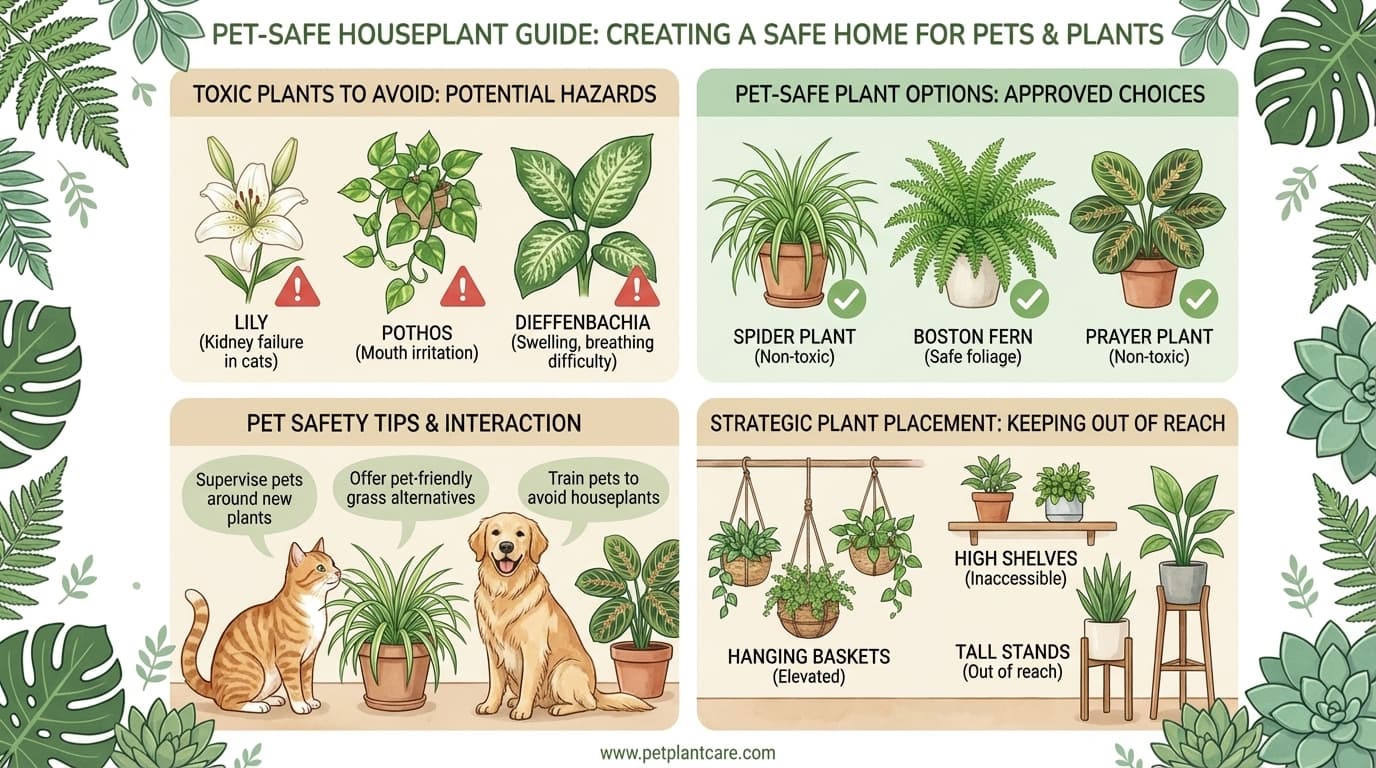
Repeat incidents come down to two fixable things: a plant that should not be in the house, and an animal with an unmet chewing habit. For the first, our lists of cat-safe houseplants and dog-safe houseplants are the swap list. For the second — the cat who will chew something regardless — the deterrent and redirection tactics in our guide to how to stop cats from eating your plants do more good than moving a pot up one shelf. For the reasoning rather than the lists, our broader pet safety and plant toxicity guide covers why "toxic" is a spectrum rather than a switch.
The Short Version
Get the pet away from the plant. Save a piece and take photos. Do not induce vomiting. Call your own vet, the ASPCA Animal Poison Control Center at (888) 426-4435, or the Pet Poison Helpline at (855) 764-7661 — and if you have a cat and a true lily, go now rather than watch.
Merck's assessment of the aroids, the group most common houseplants belong to, is genuinely encouraging. Call anyway, because you cannot tell from the outside which category you are in — and the two exposures where waiting costs most, a true lily in a cat and a sago palm in a dog, are both ones where the animal can look fine for hours.
When the adrenaline drains and you are looking at that chewed pothos wondering whether to keep it, start with Better Indoor Houseplants' pet-safe plant guide. The version of this house where tonight cannot repeat is mostly a matter of which plants are in it.