This guide contains affiliate links. We may earn a small commission if you purchase through our links, at no extra cost to you.
Fungus gnats after bringing plants inside are not a new infestation. They came in with the pots as eggs and larvae, and your house is a warm, rain-free incubator that the patio never was. Let the top inch of soil dry out, trap the adults, treat the larvae with Bti if you need to, and expect three to four weeks.
The delay is what nobody warns you about. Nothing happens for three weeks after you finish bringing plants inside for the winter, and then one evening there is a slow grey cloud over the sink. That is not failure. It is a generation clock finishing its first lap.
Everything below rests on one idea: fungus gnats are a moisture problem wearing an insect costume. You cannot spray your way out of one. Dry the top layer of soil and the population collapses. Products help you count and accelerate; they are not the fix.
The Life-Cycle Arithmetic Behind the Three-Week Delay
According to University of Wisconsin-Madison horticulture extension, "Under optimal conditions, fungus gnats can develop from egg to adult in three to four weeks." Behind that number: females "lay up to 200 eggs (in clusters) in cracks and crevices on the surface of the moist soil of potted plants," those eggs "typically hatch within three to six days," larvae feed for one to two weeks before pupating, adults emerge "approximately four to five days after pupae form," and are then "short-lived, surviving approximately one week." Colorado State University Extension puts the adult female life span slightly longer, at seven to 10 days.
Do the arithmetic on your own pot. Say twenty females are in the soil in mid-September, each laying at the top of Wisconsin's range, and only a quarter of those eggs survive: that is still on the order of a thousand adults emerging three to four weeks later, all within days of one another, because the move roughly synchronised the generations. The survival fraction there is our own guess rather than a published figure — the order of magnitude is the point. Nothing for three weeks and then everything at once is not bad luck. It is the only shape this curve can take.
It sets your expectations for control, too. Indoors, Wisconsin says, these gnats "tend to have overlapping generations" — eggs, larvae, pupae and adults are all in the pot on the day you start. Killing every adult tonight does nothing about Thursday's pupae.
Colorado State names the trigger outright: houseplants kept outdoors over summer "will commonly be colonized by fungus gnats, and when these plants are brought indoors, populations may subsequently increase in response to the warmer temperatures encountered in homes." That is why our debugging plants before bringing inside routine works on the pot, not the leaves.
Make Sure They Are Fungus Gnats and Not Fruit Flies
Wisconsin notes that fungus gnats "are often mistakenly identified as fruit flies." The mistake costs weeks, because nothing that works on one works on the other.
- Fungus gnats are dark brown or black, about 1/8 inch long, with long legs and antennae. Colorado State describes them as "weak fliers, typically flying in short, erratic patterns"; they walk across the soil and rest on it.
- Fruit flies are a kitchen insect, rounder-bodied, and Wisconsin's fruit fly publication notes that some common species "have bright red eyes." It places them around ripe fruit, drink containers and bins, not pots.
- Shore flies also breed in damp media, but per UMass Extension they "have more robust bodies than fungus gnats and their antennae are very short."
The test is where the insect comes off, not what it looks like. Cover the fruit bowl, empty the bin, then nudge a pot: if flies rise off the soil, they are gnats. Our pest identification guide has the small-fly descriptions side by side.
The potato test for larvae
Adults tell you there is a problem somewhere. Potato tells you which pot. According to Colorado State, "An effective means of detecting the presence of fungus gnat larvae is to insert 1/4 inch slices or wedges of potato into the growing medium. The larvae will migrate to the potato and start feeding within a few days." Turn the slices over to check the underside; Wisconsin, which lays them on the surface instead, says to "Check the slices for maggots after three to four days." You want pale, worm-like larvae with a black head capsule.
Are Fungus Gnats Actually Damaging Your Plant?
For most readers, honestly, no. Wisconsin is direct: "In most situations, fungus gnats are a cosmetic problem." Adults "do not feed on or damage plants," and larvae "typically feed on decaying organic matter and fungi in the soil." The caveat is narrow — "if larval numbers are high, they may damage roots by feeding on root hairs or tunneling into the roots themselves," Wisconsin says, then adds: "This sort of damage is rare in home settings."
One exception is genuinely urgent. According to UC IPM, "Larvae, however, when present in large numbers, can damage roots and stunt plant growth, particularly in seedlings and young plants." A mature peace lily with a gnat cloud is annoyed; a tray of two-week-old seedlings or fresh cuttings is at risk.
So for an established collection this is a nuisance plus a watering habit, not an emergency — worth holding onto, because panic sends people to the systemic insecticides we tell them to skip.
How to Get Rid of Fungus Gnats on Indoor Plants, in Order of Leverage
Ranked by leverage. The first is worth more than the other five combined.
1. Dry the top inch and water from below
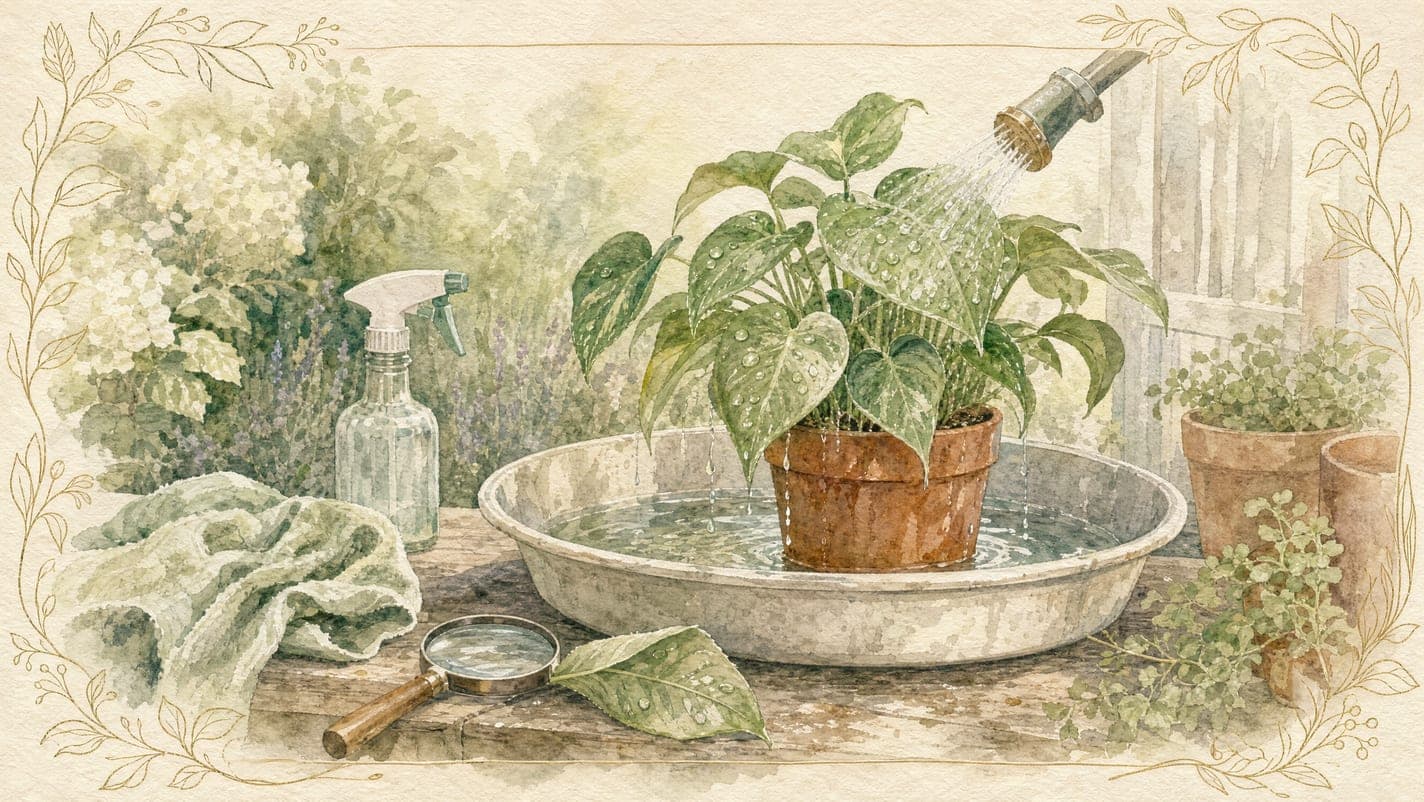
Colorado State calls it "The most important strategy to minimize fungus gnat problems associated with houseplants": "allow the growing medium to dry between watering, especially the top 1 to 2 inches." Wisconsin keeps the surface dry "to eliminate favorable egg-laying sites" by "allowing the top inch of the soil to dry out before you water," or else "you can water from the bottom to provide moisture for the roots while keeping the soil surface dry." Bottom watering is the move for anything that sulks the moment its surface dries, a Boston fern included: you dry one inch, not the root ball.
Note the limit: Colorado State places larvae "usually in the top 2 to 3 inches of the growing medium," so a dry inch does not reach them all. It stops the next round of eggs, which is the link that breaks the cycle. Our watering guide covers checking moisture by finger rather than calendar.
2. Cap the surface with sand or grit
Wisconsin recommends you "cover the soil with a ½ to one inch layer of coarse sand or fine gravel, which will help keep the surface drier and make the soil less attractive for egg-laying." Coarse is the operative word: fine play sand tends to pack down and hold water.
3. Trap the adults, then count them
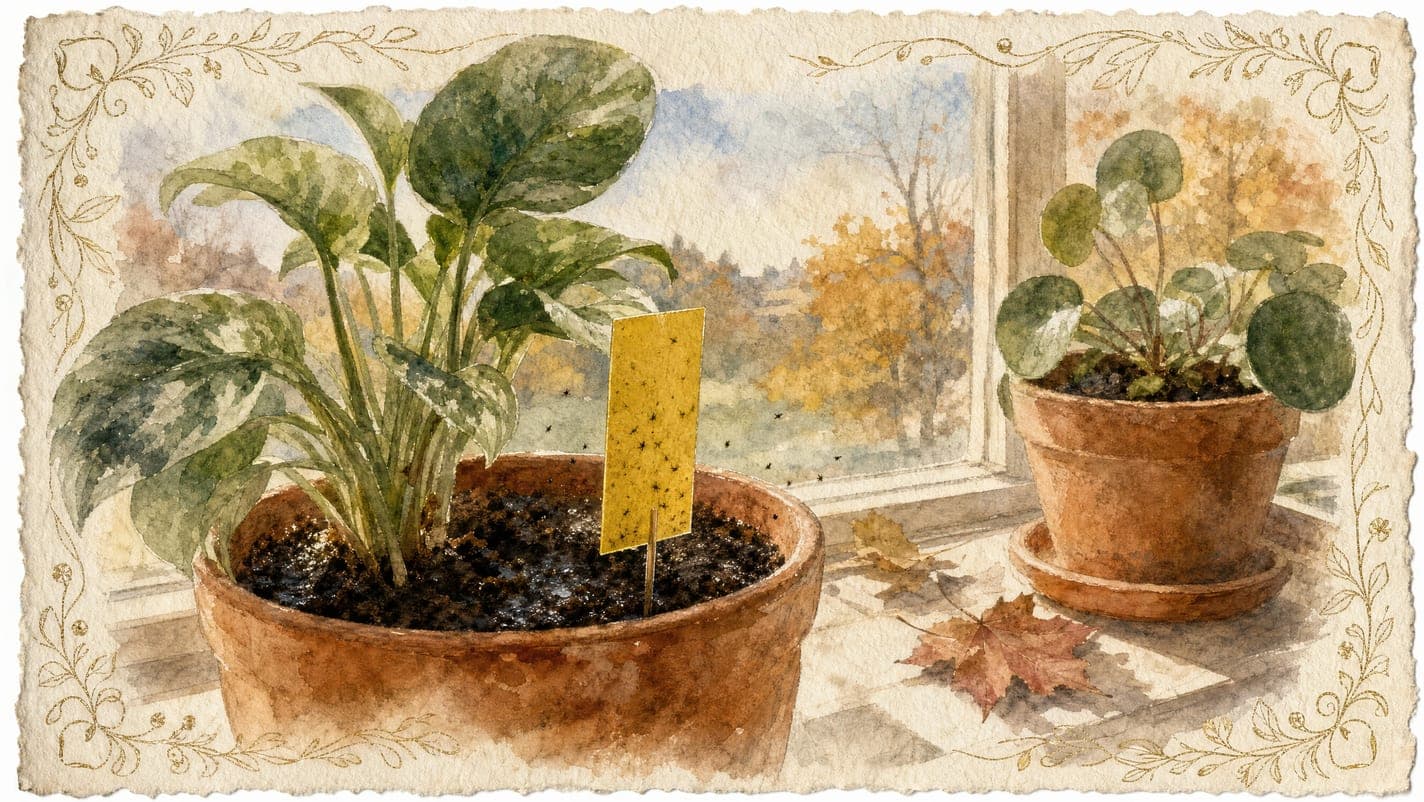
Colorado State advises placing yellow sticky cards "underneath the plant canopy or on the edge of containers," and says doing so "may be helpful in mass-trapping adult females, thus reducing the number of larvae in the next generation." Wisconsin adds the part most people miss: traps "can help you keep track of the number of fungus gnats (and other insects) over time."
That monitoring role is the real reason to buy them. A cloud looks identical on day 3 and day 18; a card does not. Count what stuck this week against last week and you know the population is falling weeks before your eyes can tell.
Safer Brand's houseplant sticky stakes are about $8.97 as of September 2026 for 16 traps. The stake form is the point: it sits at soil level where adults emerge, not up in the canopy.
For a whole collection, a 48-pack of yellow sticky traps runs about $5.29 as of September 2026 — roughly 11 cents a trap. At that price you put one in every pot, which turns traps from a control into a diagnostic. When one card out of fourteen is black and the rest are clean, you have found the pot breeding them.
4. Treat the larvae with Bti
Bti is Bacillus thuringiensis subsp. israelensis, a bacterial larvicide applied as a soil drench rather than a spray. Wisconsin is specific: "Apply these products with adequate water to help the Bti filter through the soil to reach the larvae," and "Use several applications spaced five to seven days apart to control newly hatched larvae until the infestation is under control."
Read that alongside Wisconsin's other line: "These treatments do not affect eggs, pupae or adult fungus gnats." One drench is not a treatment. It kills the larvae present that day; the eggs already in the surface crevices hatch days later into an untreated population.
We are sending you to a category search for Bti fungus gnat products rather than naming one, for an unglamorous reason: every Bti listing we pulled in September 2026 was bulk-sized or badly priced for somebody with six pots. Buy the smallest granular product labelled for fungus gnats in containers and follow its label rather than us.
5. Repot when the mix is the problem
Colorado State recommends repotting when the growing medium has broken down and is retaining too much moisture, and notes that moist media high in peat moss are particularly attractive to egg-laying females. That describes a lot of three-year-old houseplant soil. If one pot keeps reinfecting the room after a month of correct watering, change the mix — our soil guide covers building something that drains.
6. Look for the overwatered plant underneath
Sometimes the gnats are the symptom that finally made you look. Colorado State: "If watering practices are not altered, particularly during fall and winter when plants consume less water, the growing medium will remain moist, which improves conditions for fungus gnat development." Keep the August schedule for a plant now in dimmer light and the pot stays wet for a fortnight. If you find one that has been permanently damp, check the roots — our root health guide covers what rot looks and smells like.
What Does Not Work, or Is Oversold
- Vinegar traps. Wisconsin is blunt: "Vinegar traps and other methods commonly used to monitor for fruit flies do not work for monitoring for fungus gnats."
- Hydrogen peroxide drenches. A partial measure, not a cure. One extension source does publish a dilution: Cornell Cooperative Extension of Allegany County writes that "A mild hydrogen peroxide solution can help kill fungus gnat larvae without harming your plants. Mix one part 3% hydrogen peroxide with four parts water and pour it over the soil." Read the rest of that entry too — "Be sure to let the soil dry out afterward to prevent the gnats from returning" — because the drying is the part that ends it. On its own a drench does not persist, misses the eggs that hatch days later, and does nothing about the wet surface. A knockdown gets mistaken for a cure.
- Cinnamon on the soil. Thinner still: no extension source we found tests it against fungus gnats, and it appears in none of the Wisconsin, Colorado State or UC IPM control lists. Do not count it as treatment.
- Dish soap drenches. According to Colorado State, short-persisting contact insecticides containing pyrethrins, soaps, oils and neem "do not provide sufficient long-term control of fungus gnat adults."
- Spraying adults, and one-off applications of anything. Colorado State notes that "The larvae in the growing medium will not be directly affected by any insecticides applied to kill adults." With four life stages in the pot at once, one treatment always leaves a stage untouched.
- Treating before you change the watering. Colorado State frames insecticides as worth considering only if problems "persist several weeks after watering practices have been adjusted."
We do not recommend systemic insecticides here. Some extension publications, Colorado State's included, list imidacloprid as a soil-applied larvicide. But UC IPM holds that "Insecticides are rarely warranted to control these flies in and around homes," and Wisconsin that "Unless a fungus gnat infestation is severe, chemical controls are not warranted." For a cosmetic pest, in a home with pets, that is a trade we will not make — our pet-safe pest control guide covers the alternatives.
A Realistic Timeline to Zero
Wisconsin puts a number on it: "It may take three to four weeks of modified watering and use of sand/gravel to get fungus gnats in check." Expect it to look worse before it looks better.
- Week 1 to 2: flat or rising. Trap counts may climb, because the pupae already in the soil emerge regardless. Dry the top inch, cap the pots, trap every container, judge nothing.
- Week 3 to 4: the turn. The first generation that never found a moist surface to lay on fails to appear, and the old adults die off about a week after emerging.
- Week 5 to 6: residual. Stragglers from the wettest pot. Still real numbers at week six despite dry surfaces? It is one pot, and repotting beats another month of drenching.
The earliest good sign is a falling trap count, not a thinner cloud. Cards register the change roughly a week before your eyes do — exactly the week most people give up and buy something stronger.
Preventing Soil Pests After Bringing Plants Indoors Next Autumn
The problem is created in the fortnight before the pots come in, which is where it is cheapest to fix.
- Switch to bottom watering outdoors in late summer. A dry surface for the last few weeks on the patio means fewer eggs make the trip.
- Inspect the pot, not just the plant — drainage holes, soil surface, underneath the rim. Our debugging plants before bringing inside routine is the full pre-entry pass.
- Quarantine new arrivals three to four weeks — one full generation, which is exactly how long a hidden population takes to declare itself.
- Repot anything in old peat-heavy mix before it comes in, outdoors in September rather than over a bathtub in November.
- Move early enough to do all of this. Our guide on when to bring plants inside sets the date, so you are not inspecting pots by phone torch on a frost-warning evening.
A useful contrast: a snake plant in gritty mix that dries out completely between waterings rarely has a gnat problem, whatever summer it had. The plants that get them are the ones we keep damp.
Traps, Pets and Kids
Sticky traps are a physical glue trap, not a pesticide, so the practical issue is placement: they work best at soil level, which is also cat height, and an animal that brushes one gets glue in its fur. Tuck stakes under the canopy where foliage screens them. For any Bti product, follow the label on rate, interval and cleared plants — it supersedes any figure here.
Frequently Asked Questions
Why do I suddenly have gnats in my house plants?
Because the pots came inside. Colorado State University Extension notes that houseplants kept outdoors over summer are commonly colonised by fungus gnats, and that populations increase indoors in response to warmer temperatures. The "suddenly" is the life cycle: Wisconsin puts egg-to-adult development at three to four weeks, so a September move produces an October cloud.
How do I get rid of fungus gnats on indoor plants fast?
There is no fast. The floor is one generation: Wisconsin estimates three to four weeks of modified watering plus a sand or gravel topping, and says Bti needs several applications five to seven days apart. Traps speed up the adult phase, but the larvae set the schedule.
Are fungus gnats worse on houseplants in winter?
More noticeable, and the conditions are worse. Colorado State notes that nuisance problems tend to peak in late fall and winter, partly because infested plants arrive from outdoors and partly because shorter days and cooler temperatures cut water use, leaving the medium moist.
The One-Line Version
Stop watering the surface and the problem ends itself in about a month. Traps count, Bti accelerates, sand denies the egg-laying site — the dry top inch is what does it.
Gnats are one predictable consequence of the indoor move. The rest are in our complete Indoor Move guide.