5 Houseplant Resolutions That Actually Stick
Skip the vague 'take better care of my plants' resolution. Here are five specific, actionable habits that will make a real difference for your indoor jungle in 2026.
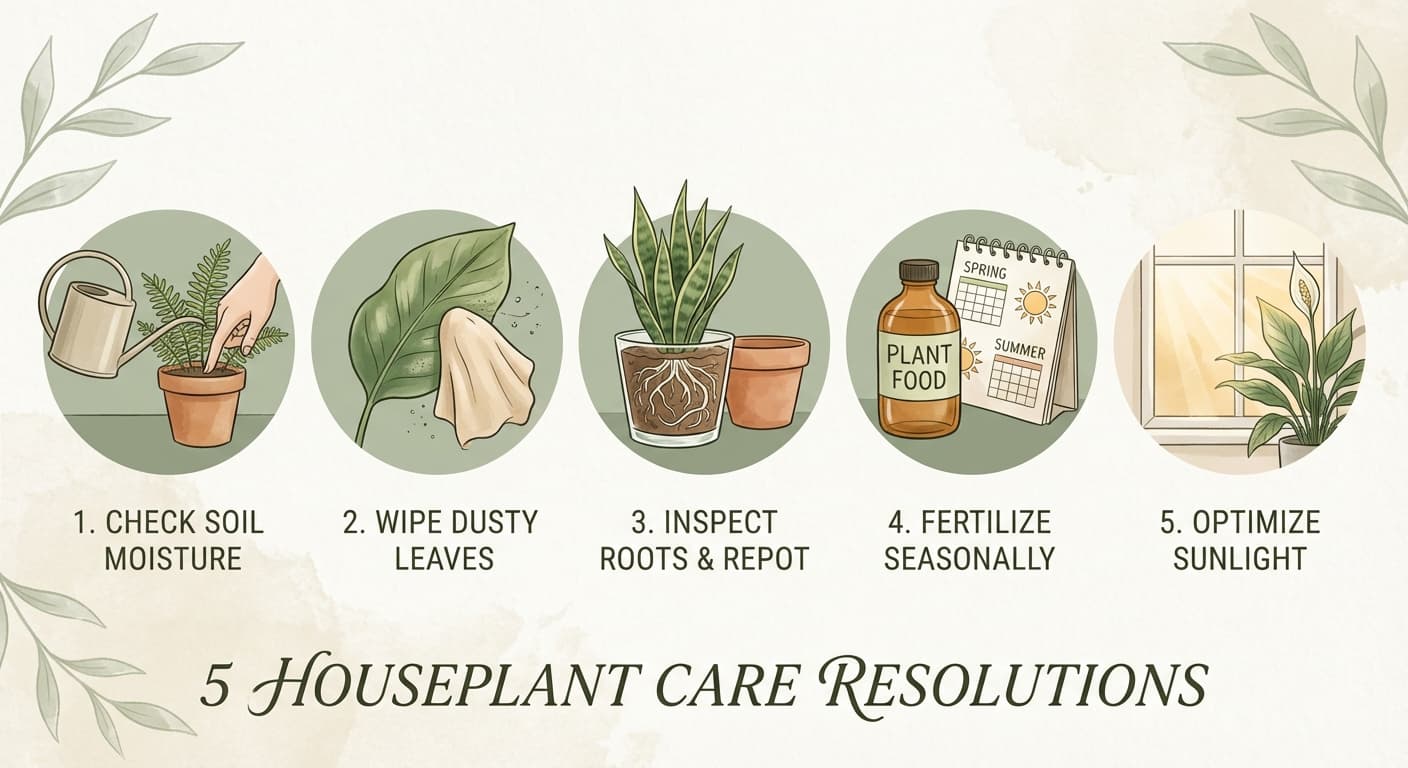
5 Houseplant Resolutions That Actually Stick
New year, new you—but what about your plants?
Every January, we tell ourselves we'll "take better care of our plants." And every February, we're back to the same old habits: overwatering the pothos, forgetting to check on the fern, wondering why the fiddle leaf fig looks so sad.
This year, skip the vague resolutions. Here are five specific, actionable habits that will actually make a difference—and stick.
1. Check Before You Water
The problem: Overwatering kills more houseplants than anything else. It leads to root rot, fungal issues, and a slow, soggy death.
The fix: Before you reach for that watering can, stick your finger 2 inches into the soil. If it's still moist, wait. If it's dry, water.
That's it. This simple test takes 5 seconds and will prevent 90% of watering mistakes.
Level up: Grab a moisture meter for $10-15. They're especially useful for large pots where your finger can't reach deep enough.
Read our complete watering guide →
2. Dust Your Leaves Monthly
The problem: Dust doesn't just look bad—it blocks light and clogs the tiny pores (stomata) your plants use to breathe. A dusty plant is a stressed plant that can't photosynthesize efficiently.
The fix: Once a month, wipe your leaves with a damp microfiber cloth. Support each leaf from underneath and wipe gently from stem to tip. For smaller plants, a quick lukewarm shower works great.
For fuzzy-leaved plants (like African Violets or Rex Begonias): Use a soft, dry brush instead. These plants don't like wet leaves.
3. Repot When Needed (Not on a Schedule)
The problem: Some people never repot. Others repot every spring "because that's what you're supposed to do." Both approaches cause unnecessary stress.
Signs your plant actually needs repotting:
- Roots growing out of drainage holes
- Water runs straight through without soaking in
- Plant is top-heavy and tips over
- Growth has completely stalled despite good care
- You can see more roots than soil
The fix: Check your plants' roots once a year in spring. Only repot if you see the signs above. When you do repot, go up just one pot size (1-2 inches larger in diameter).
4. Feed During Growing Season Only
The problem: Fertilizing in winter is like offering food to someone who's asleep. Your plants are dormant—they can't use those nutrients, and the buildup can actually burn their roots.
The fix: Fertilize monthly from March through September (the growing season). When October hits, stop completely until spring returns.
Organic options: Diluted coffee grounds add nitrogen. Banana peel water provides potassium. But a balanced liquid fertilizer (20-20-20) diluted to half strength works for most houseplants.
5. Learn Your Light (Really)
The problem: Every plant care guide says "bright indirect light," but what does that actually mean in YOUR home? Light varies dramatically by window direction, obstructions, and time of year.
The fix: Spend a day observing where sunlight actually hits in your space. Track it at morning, noon, and afternoon.
- Direct sun: Harsh light that casts sharp shadows
- Bright indirect: Well-lit area where you could comfortably read, no direct sun
- Medium light: A few feet from a window, some ambient brightness
- Low light: Far from windows, or north-facing rooms
Level up: Download a free light meter app on your phone. Aim for 200-500 foot-candles for most tropical houseplants, 1000+ for succulents and cacti.
This Week's Quick Tip
The best time to start? Right now.
Pick ONE resolution from this list and commit to it for January. Just one. Master that habit before adding another.
Trying to change everything at once is how resolutions fail. Build the habit, then build on it.
Plant of the Week: Snake Plant
If you're working on your plant care resolutions, the Snake Plant (Sansevieria) is your ideal training partner.
This nearly indestructible plant:
- Tolerates low light to bright light
- Only needs watering every 2-3 weeks
- Forgives neglect like a champ
- Purifies air while you sleep
If you can keep a snake plant alive for three months, you've built the foundation for caring for almost any houseplant.
Get the full Snake Plant care guide →
What's Your Resolution?
We'd love to hear from you. What's your plant care resolution for 2026?
Just reply to this email—we read every response.
Happy growing, The Better Indoor Houseplants Team
You're receiving this because you subscribed at betterindoorhouseplants.com. Browse all plant guides →
More Newsletters
The Pest Season Survival Guide (Your Plants Need This Now)
Spring means new growth — and new pests. Here's how to identify the 4 most common spring invaders, stop them fast, and protect your collection before things get out of hand.
Issue #4Your Plants Are Waking Up — Here's What They Need Right Now
It's the first day of spring and your houseplants can feel it. Here's your 4-step spring care checklist: when to fertilize, how to repot, light adjustments, and pest prevention.
Issue #3The Winter Humidity Crisis (And How to Fix It)
Your heating system is slowly killing your tropical plants. Here's how to spot humidity stress and 5 ways to save your Calathea, ferns, and other humidity-lovers.
Issue #1Welcome to Better Indoor Houseplants
Our first newsletter! Learn what to expect, get a quick winter care tip, and discover our favorite low-light plants for dark winter days.