This guide contains affiliate links. We may earn a small commission if you purchase through our links, at no extra cost to you.
Pothos and philodendron are the most frequently confused houseplants—and for good reason. Both feature heart-shaped leaves on trailing vines, both tolerate low light, and both show up in every "easy houseplant" list you'll ever read.
But they're actually different plants from different families, with distinct characteristics that matter for care and styling.
This guide teaches you how to tell them apart and helps you choose the right one for your space.
Quick Answer: How to Tell Them Apart
The fastest way to identify them:
Look at the leaf texture and shape:
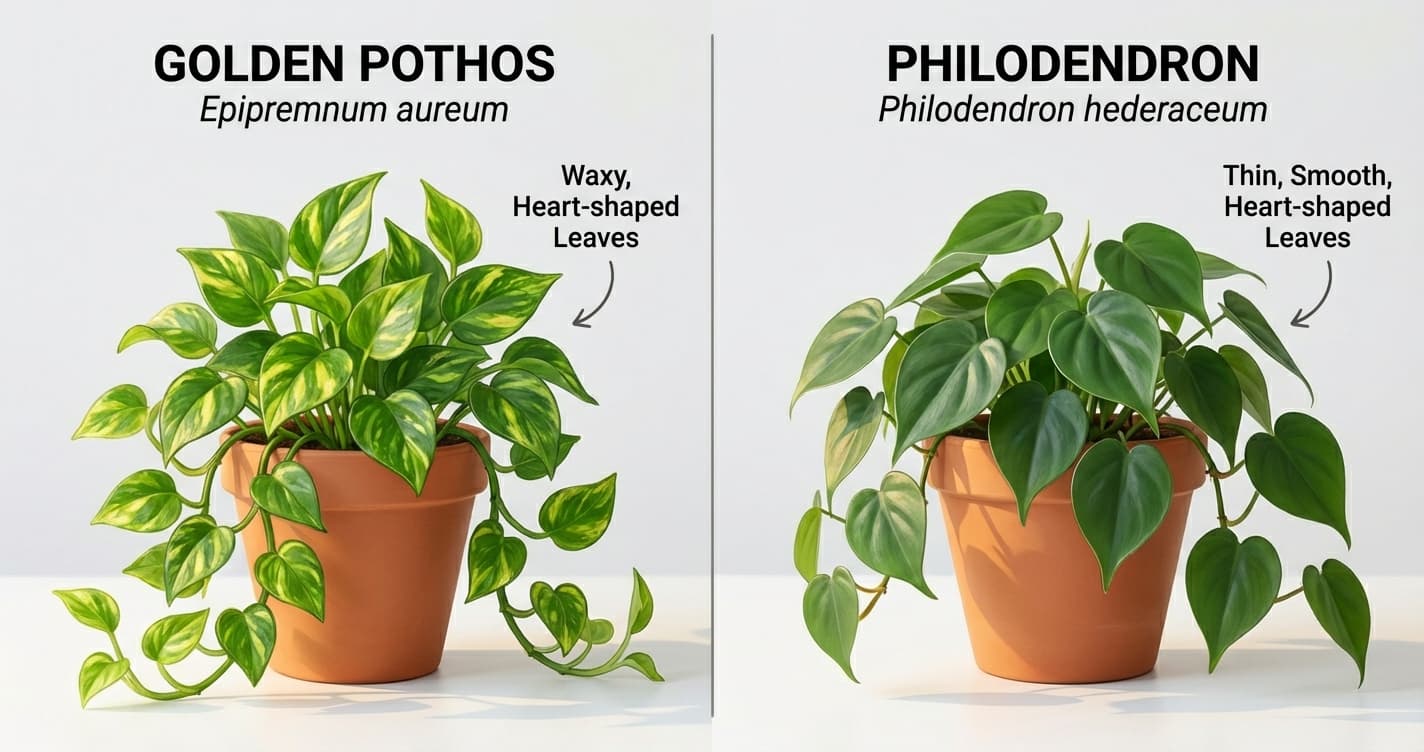
- Pothos leaves are thick, waxy, and slightly bumpy with an asymmetrical heart shape
- Philodendron leaves are thin, smooth, and have a more symmetrical heart shape with a pronounced curve
Look at new growth:
- Pothos new leaves emerge rolled up and gradually unfurl
- Philodendron new leaves emerge from a protective sheath (cataphyll) that later dries and falls off
Look at the petiole (leaf stem):
- Pothos petioles are slightly grooved or indented on top
- Philodendron petioles are round and smooth
Once you know what to look for, you'll never confuse them again.
Quick Answer: Which Should You Choose?
Choose Pothos if you:
- Are a complete beginner
- Want thick, waxy foliage that looks healthy longer
- Prefer plants that communicate their needs clearly (dramatic wilting when thirsty)
- Have slightly lower light conditions
- Want to propagate easily
Choose Philodendron if you:
- Want faster, more vigorous growth
- Prefer a softer, more delicate look
- Have slightly warmer, more humid conditions
- Want more variety in leaf shapes and sizes
- Are comfortable with regular watering
Now let's explore each plant in detail.
Plant Profiles
Pothos (Epipremnum aureum)
Pothos, commonly called Devil's Ivy, is a tropical vine from Southeast Asia. Despite being called "Devil's Ivy" for its near-indestructibility, it's actually a member of the aroid family (Araceae), like philodendrons—which explains the confusion.
Appearance: Thick, waxy leaves with a subtle sheen. The classic golden pothos has green leaves streaked with gold. Many varieties exist, including:
- Golden Pothos – Green with yellow variegation
- Marble Queen – White and green marbled pattern
- Neon Pothos – Solid bright chartreuse
- Jade Pothos – Solid deep green
- Manjula – Wavy leaves with cream, silver, and green
Leaf characteristics: Leaves are asymmetrical—one side of the heart shape is slightly larger than the other. The surface has a waxy, almost plasticky feel with visible texture.
Growth habit: Trailing vine that can grow 10+ feet indoors. Climbs readily with aerial roots if given a support.
Native environment: Tropical forest floors and lower tree canopy in French Polynesia and Southeast Asia.
Philodendron (Philodendron species)
Philodendrons encompass a huge genus of 400+ species, but the ones confused with pothos are the vining types, particularly the Heartleaf Philodendron (Philodendron hederaceum). Native to Central and South America, they're true jungle plants.
Appearance: Thin, velvety-smooth leaves with a matte finish. The classic heartleaf philodendron has deep green, perfectly heart-shaped leaves. Popular varieties include:
- Heartleaf Philodendron – Classic green trailing variety
- Brasil – Green with lime-yellow center stripe
- Micans – Velvety bronze-green leaves
- Lemon Lime – Bright chartreuse (often confused with Neon Pothos)
- Silver Stripe – Green with silver markings
Leaf characteristics: Leaves are symmetrical hearts with a thin, almost papery texture. They feel smooth and soft, not waxy.
Growth habit: Trailing or climbing vine, typically more vigorous than pothos. Can grow 10-20 feet in ideal conditions.
Native environment: Tropical rainforest understory in Central and South America.
Visual Identification Guide
Here's a side-by-side comparison of the key differences:
| Feature | Pothos | Philodendron |
|---|---|---|
| Leaf texture | Thick, waxy, slightly bumpy | Thin, smooth, velvety |
| Leaf shape | Asymmetrical heart | Symmetrical heart |
| Leaf surface | Shiny/glossy | Matte/soft |
| Petiole (stem) | Grooved on top | Round, smooth |
| New growth | Rolled leaf unfurls | Emerges from papery sheath |
| Aerial roots | One thick root per node | Multiple thin roots per node |
| Overall feel | Sturdy, substantial | Delicate, graceful |
Pro tip: Hold a leaf up to the light. Pothos leaves are thicker and block more light; philodendron leaves are thinner and more translucent.
Care Comparison
Light Requirements
| Plant | Minimum Light | Ideal Light | Direct Sun |
|---|---|---|---|
| Pothos | Low | Medium to bright indirect | Avoid |
| Philodendron | Low-medium | Medium to bright indirect | Avoid |
Winner for low light: Pothos, by a small margin. Both tolerate low light, but pothos maintains its appearance better and is less likely to become leggy.
Winner for bright light: Tie. Both thrive in bright indirect light but neither tolerates direct sun well—leaves will burn.
Note on variegation: Both plants need more light to maintain variegation. Marble Queen Pothos and Brasil Philodendron will revert toward solid green in low light.
For help assessing your space, try our light level guide.
Water Requirements
| Plant | Frequency | Drought Tolerance | Overwatering Risk |
|---|---|---|---|
| Pothos | Every 1-2 weeks | Moderate-high | Medium |
| Philodendron | Every 1-2 weeks | Moderate | Medium-high |
Winner for forgetful waterers: Pothos. Its thicker leaves and stems store more water, and it wilts dramatically before suffering damage—giving you a clear warning.
Winner for consistent waterers: Philodendron. It prefers more regular moisture and rewards consistent care with faster growth.
Key insight: Both are pretty forgiving, but pothos communicates better. When thirsty, pothos leaves droop visibly. Philodendron tends to show stress through yellowing leaves, which can also indicate overwatering—making it slightly harder to read.
Learn proper technique in our watering 101 guide.
Humidity Requirements
| Plant | Minimum Humidity | Ideal Humidity | Humidity Stress Signs |
|---|---|---|---|
| Pothos | 30% | 50-70% | Brown leaf tips |
| Philodendron | 40% | 60-80% | Brown tips, curling |
Winner for dry homes: Pothos. It tolerates typical household humidity (30-50%) without complaint.
Winner for humid environments: Philodendron. It absolutely thrives in high humidity and shows off with larger, more lush growth.
Practical note: Neither plant requires a humidifier in most homes, but philodendrons look noticeably happier in bathrooms, kitchens, or near humidifiers.
Growth Rate and Habit
| Plant | Speed | Annual Growth | Training Preference |
|---|---|---|---|
| Pothos | Moderate-fast | 12-18 inches | Trailing or climbing |
| Philodendron | Fast | 18-36 inches | Trailing or climbing |
Winner for fast growth: Philodendron. With proper conditions, heartleaf philodendrons grow faster and produce more leaves than pothos.
Winner for controlled growth: Pothos. Its slower pace means less frequent pruning and a more predictable shape.
Both climb readily when given a moss pole or trellis, developing larger leaves as they climb (a phenomenon called morphogenesis).
Pet Safety
| Plant | Toxic to Cats | Toxic to Dogs | Severity |
|---|---|---|---|
| Pothos | Yes | Yes | Mild-moderate |
| Philodendron | Yes | Yes | Mild-moderate |
Both plants are toxic to pets. They contain calcium oxalate crystals that cause oral irritation, drooling, and gastrointestinal upset if chewed.
While rarely life-threatening, keep both away from curious cats and dogs. Consider hanging baskets or high shelves.
For pet-friendly alternatives, see our pet safety guide.
Propagation
| Plant | Difficulty | Method | Time to Root |
|---|---|---|---|
| Pothos | Very easy | Water or soil cuttings | 2-3 weeks |
| Philodendron | Very easy | Water or soil cuttings | 2-4 weeks |
Tie. Both propagate almost identically—cut below a node, place in water, wait for roots. Both are excellent starter plants for learning propagation.
Slight edge to pothos: Its thicker stem cuttings are less prone to rotting in water than philodendron's thinner stems.
Learn more in our propagation guide.
Side-by-Side Summary
| Factor | Pothos | Philodendron |
|---|---|---|
| Light needs | Low to bright indirect | Low-medium to bright indirect |
| Water frequency | Every 1-2 weeks | Every 1-2 weeks |
| Drought tolerance | Moderate-high | Moderate |
| Humidity preference | Tolerates low | Prefers higher |
| Growth rate | Moderate-fast | Fast |
| Leaf texture | Thick, waxy | Thin, smooth |
| Pet-safe | No | No |
| Propagation | Very easy | Very easy |
| Best for | True beginners, low humidity | Slightly more experienced, humid spaces |
Scenarios: Which Plant Wins?
Scenario 1: "I'm a complete beginner"
Winner: Pothos
Pothos is slightly more forgiving of inconsistent care. Its dramatic wilting when thirsty provides clear feedback, and it bounces back from neglect more reliably.
Scenario 2: "I have a dry, air-conditioned apartment"
Winner: Pothos
Pothos tolerates low humidity without complaint. Philodendron may develop brown leaf tips or slow growth in consistently dry air.
Scenario 3: "I want maximum growth and lush vines"
Winner: Philodendron
Given consistent watering and decent humidity, philodendrons grow faster and produce more leaves. If you want your trailing plant to take over a wall, philodendron gets there quicker.
Scenario 4: "My home has good natural humidity" (kitchen, bathroom)
Winner: Philodendron
Philodendrons absolutely thrive in humid conditions. A heartleaf philodendron in a bathroom will reward you with impressive growth.
Scenario 5: "I want a plant with the most variety options"
Winner: Tie (but different types)
Both offer excellent variety. Pothos varieties focus on color variations (golden, neon, marble). Philodendron varieties offer more leaf shape diversity (heartleaf, micans with velvet texture, brasil with stripes).
Scenario 6: "I tend to underwater"
Winner: Pothos
Pothos wilts dramatically when thirsty but recovers quickly when watered. This forgiveness of drought makes it ideal for people who forget.
Scenario 7: "I want to fill hanging baskets fast"
Winner: Philodendron
Its faster growth fills out hanging containers more quickly. You'll have impressive trailing vines sooner.
Common Mistakes to Avoid
Mistake 1: Treating them identically
While similar, their ideal conditions differ. Philodendrons prefer slightly more water and humidity. Treating a philodendron exactly like a pothos may result in slower growth.
Mistake 2: Putting them in direct sun
Both will burn in direct sunlight. Morning sun is usually fine, but avoid hot afternoon rays.
Mistake 3: Letting them dry out completely
While both tolerate some drought, chronic underwatering causes smaller leaves and slower growth. Philodendrons especially prefer consistent moisture.
Mistake 4: Ignoring pest signs
Both are susceptible to mealybugs, spider mites, and thrips. Check undersides of leaves regularly, especially when bringing new plants home.
Frequently Asked Questions
Can pothos and philodendron be planted together?
Yes, they can share a pot and their care requirements are similar enough. However, philodendron may outcompete pothos over time due to faster growth. Monitor and prune as needed.
Why is my pothos/philodendron turning yellow?
The most common causes are overwatering (check if soil is soggy) or underwatering (check if soil is bone dry). Less commonly: too much direct light, root rot, or natural aging of older leaves.
Can I grow them in just water permanently?
Yes, both thrive indefinitely in water (hydroponics). Change water every 1-2 weeks and add a small amount of liquid fertilizer monthly.
How do I make my trailing plant bushier?
Prune the vines regularly. Each cut encourages branching from nodes below. You can propagate the cuttings to create fuller plants.
Our Recommendation
For absolute beginners or low-humidity homes: Start with Pothos. Its resilience, clear communication (the famous "thirsty droop"), and tolerance of varied conditions make it the safer choice.
For those wanting faster growth or with good humidity: Choose Philodendron. Its vigor and lush growth reward consistent care.
Can't decide? Get both. They look beautiful together, their care overlaps significantly, and having both lets you learn the subtle differences firsthand.
Next Steps
Ready to bring one home? Here's your action plan:
- Identify your conditions: Use our light level guide to assess your space
- Find a healthy plant: Visit a local nursery for the best selection
- Get your supplies: Houseplant starter kit guide
- Learn the basics: Complete beginner's guide
- Avoid common errors: 7 mistakes beginners make
Whether you choose pothos, philodendron, or both—you're picking from the most forgiving, rewarding trailing plants available. Either one will teach you plant care while beautifying your space.