This guide contains affiliate links. We may earn a small commission if you purchase through our links, at no extra cost to you.
This guide is part of our comprehensive Tropical Houseplant Guide.
No plant has captured the houseplant zeitgeist quite like the Monstera. Those dramatic split leaves have become the symbol of indoor jungle aesthetics, appearing on everything from throw pillows to wall art. And unlike many trendy plants, Monstera actually deserves its popularity—it's genuinely beautiful and surprisingly manageable for such a statement plant.
But there's a gap between keeping a Monstera alive and helping it thrive. The difference between a sad, small-leaved specimen and a stunning plant with massive fenestrated leaves comes down to understanding what Monstera actually needs.
Let's master Monstera care.
Table of Contents
- Understanding Monstera
- Monstera Varieties
- Light Requirements
- Watering Your Monstera
- Humidity and Temperature
- Soil and Potting
- Encouraging Fenestrations
- Support and Training
- Propagation
- Common Problems
- Growth Timeline
- Frequently Asked Questions
Understanding Monstera
Before diving into care details, understanding Monstera's natural habitat explains why it grows the way it does.
Native Environment
Monstera deliciosa originates from the tropical rainforests of southern Mexico and Central America. In the wild, it's a climbing plant that starts on the forest floor, then scrambles up tree trunks toward the light. Mature specimens can reach 60+ feet in their native habitat.
The famous holes and splits in Monstera leaves (fenestrations) serve a purpose: they allow light to pass through to lower leaves and reduce wind resistance. Young plants growing in shade produce solid leaves; fenestrations develop as plants mature and reach brighter light.
Why This Matters for Care
Understanding Monstera's climbing nature explains several care requirements:
- It wants to climb: Providing support encourages larger leaves
- Aerial roots are normal: These help it attach to trees and absorb moisture
- More light = more splits: Fenestrations are a response to maturity and bright light
- It's surprisingly adaptable: As a plant that grows from forest floor to canopy, it handles a range of conditions
Monstera Varieties
While Monstera deliciosa is the classic, several related plants are commonly sold:
Monstera deliciosa
The iconic Swiss Cheese Plant. Large, heart-shaped leaves that develop splits and holes with maturity. The most common and easiest to grow.
Variants:
- Standard green: Most common, most affordable
- Thai Constellation: Creamy white variegation, stable, more expensive
- Albo Borsigiana: White variegation, less stable, highly sought after
- Aurea: Yellow variegation, rare
Monstera adansonii
Sometimes called "Swiss Cheese Vine." Smaller leaves with proportionally larger holes that extend nearly to the midrib. More vining habit than deliciosa.
- Easier to maintain as a manageable size
- Faster growing
- More demanding of humidity
Monstera peru
Technically Monstera karstenianum. Thick, textured, puckered leaves without holes. Climbing or trailing habit. Less common but increasingly popular.
Monstera siltepecana
Silver-marked leaves when juvenile. Develops fenestrations at maturity. Beautiful understated variety.
Light Requirements
Light is the most important factor for Monstera growth and fenestration development.
Ideal Light
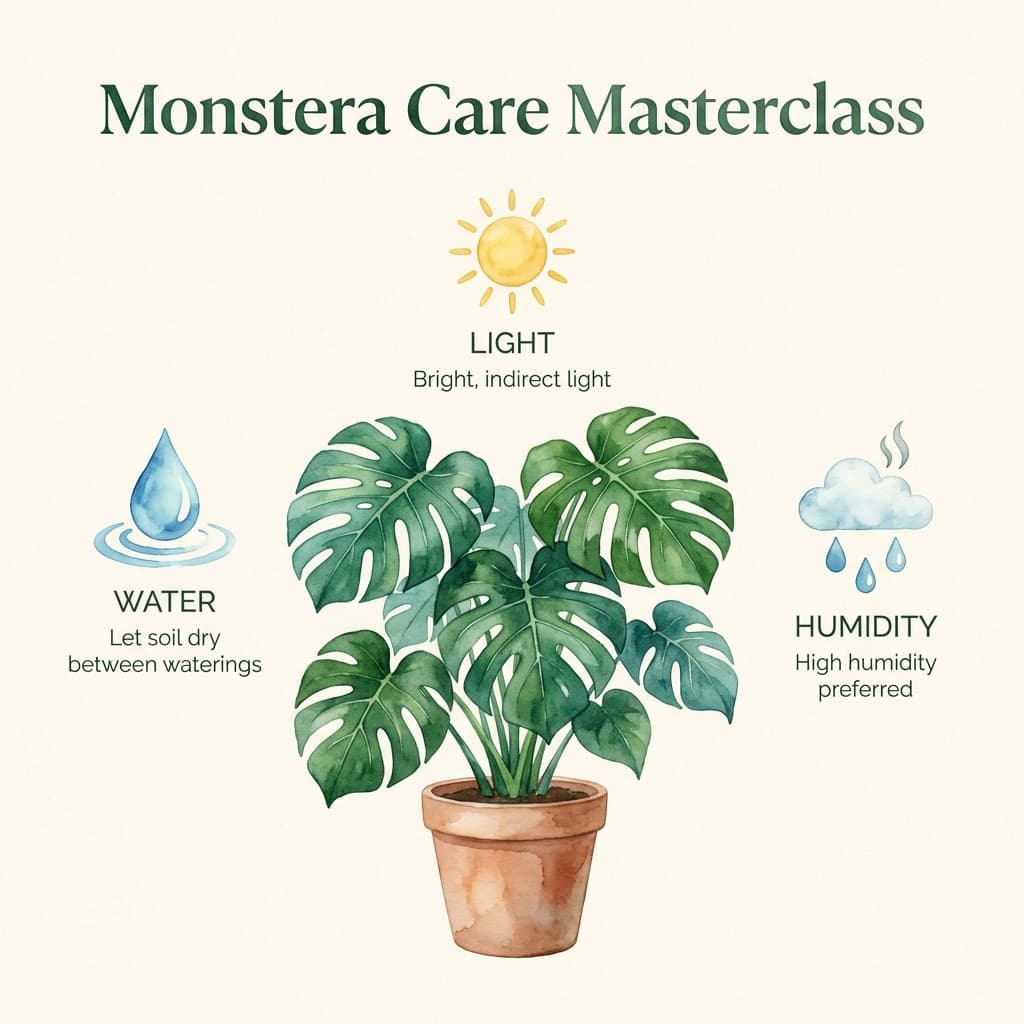
Bright indirect light is optimal—the kind of light 3-5 feet from a bright window, or directly at an east-facing window. Aim for 200-500 foot-candles as measured by a light meter app.
At this light level:
- Growth is vigorous
- Leaves grow large
- Fenestrations develop on mature leaves
- Colors stay deep green and healthy
Tolerable Light
Monstera tolerates medium light (further from windows, north-facing rooms) but with trade-offs:
- Slower growth
- Smaller leaves
- Fewer or no fenestrations
- Plants may become leggy
This is "surviving" rather than "thriving" light.
Too Much Light
Direct afternoon sun, especially through south or west windows, can burn leaves:
- Bleached or pale patches
- Brown crispy spots
- Leaves curling away from light
Morning sun from east windows is usually fine. Filter intense afternoon light with sheer curtains.
Grow Lights
If natural light is insufficient, grow lights work well for Monstera. Position 12-18 inches above the plant, running 10-12 hours daily. This is particularly helpful in winter or in rooms with limited windows.
For more on lighting, see our tropical plant lighting guide.
Watering Your Monstera
Monstera is more forgiving of watering mistakes than many tropicals, but proper technique yields the best results.
When to Water
Water when the top 1-2 inches of soil feel dry. For most indoor conditions, this means every 7-14 days, varying by:
- Season (more frequent in summer, less in winter)
- Pot size (smaller pots dry faster)
- Light levels (more light = faster drying)
- Humidity (lower humidity = faster drying)
Don't water on a schedule—check the soil first.
How to Water
Water thoroughly until it flows from drainage holes. Ensure all the soil gets wet, not just one spot. Empty saucers after 30 minutes; Monstera shouldn't sit in standing water.
Signs of Watering Problems
Overwatering:
- Yellow leaves, especially lower ones
- Soft, mushy stems near soil
- Fungus gnats around soil
- Root rot (brown, mushy roots)
Underwatering:
- Wilting, drooping leaves
- Brown crispy leaf edges
- Leaves feel thin or papery
Monstera recovers from slight underwatering more easily than overwatering. When in doubt, wait another day.
For complete watering guidance, see our tropical plant watering guide.
Humidity and Temperature
Humidity
Monstera tolerates average household humidity (40-50%) better than many tropicals, but prefers higher levels.
Ideal: 50-60% humidity Acceptable: 40-50% Stress begins: Below 40%
In dry conditions (winter, arid climates), you may notice:
- Crispy leaf edges
- Aerial roots that dry and shrivel
- Slower growth
Boost humidity with a humidifier, grouping plants, or placing Monstera in naturally humid rooms.
Temperature
Monstera prefers temperatures between 65-85°F (18-29°C). It tolerates brief excursions outside this range but avoids:
- Temperatures below 55°F (causes cold damage)
- Hot or cold drafts
- Placement near heating/cooling vents
Soil and Potting
Ideal Soil Mix
Monstera needs well-draining soil that retains some moisture. A good mix:
- 2 parts indoor potting mix
- 1 part perlite
- 1 part orchid bark
Or purchase a high-quality aroid mix designed for Monstera and Philodendron.
Standard potting soil alone is usually too dense and moisture-retentive. Chunky amendments improve drainage and aeration.
Pot Selection
Size: Pot should be 1-2 inches larger in diameter than the root ball. Too-large pots hold excess moisture and increase rot risk.
Drainage: Always use pots with drainage holes. This is non-negotiable for Monstera health.
Material: Both plastic and terracotta work well. Terracotta dries faster (good for overwater-prone growers); plastic retains moisture longer.
Repotting
Repot when:
- Roots circle the inside of the pot
- Roots emerge from drainage holes
- Plant becomes top-heavy and tips over
- Growth stalls despite good care
Best timing: Spring, as the growing season begins. Avoid repotting in winter.
Encouraging Fenestrations
The question everyone asks: "How do I get my Monstera to split?"
What Causes Fenestrations
Fenestrations (splits and holes) develop when:
- The plant reaches maturity
- Light levels are adequate
- Overall conditions support vigorous growth
Young Monstera produce solid, heart-shaped leaves. Splits develop as the plant matures—this is genetic programming, not a response to any single factor.
How to Get Splits Faster
Maximize light: This is the biggest factor. Bright indirect light signals the plant that it's climbing into the canopy where fenestrations are advantageous.
Provide support: A climbing Monstera puts energy into growing larger leaves. Staked plants typically develop fenestrations sooner than trailing plants.
Patience: A recently purchased juvenile Monstera may take 2-3 years to produce significantly fenestrated leaves. This is normal.
Optimize overall care: Healthy, vigorously growing plants mature faster. Good watering, humidity, and fertilization support faster development.
What Doesn't Work
- Cutting holes in leaves (they don't heal into natural fenestrations)
- Fertilizer alone (helps growth but won't force fenestrations)
- Moving to direct sun (likely to burn leaves before causing splits)
Support and Training
Why Support Matters
In nature, Monstera climbs trees. When given support, it:
- Grows larger leaves
- Develops more fenestrations
- Maintains a tidier shape
- Uses aerial roots productively
Unsupported Monstera tends to sprawl, producing smaller leaves as it searches for something to climb.
Support Options
Moss poles: Classic choice. Sphagnum moss wrapped around a pole provides surfaces for aerial roots to grip and absorb moisture. Requires occasional misting to keep moss moist.
Coir poles: Coconut coir wrapped poles. Similar to moss poles, less moisture-retentive but easier to maintain.
Planks and boards: Flat surfaces for aerial roots to attach. Natural look, works well, easy DIY option.
Trellises: Wire or wooden frameworks. Good for training shape but aerial roots can't attach as easily.
Training Tips
- Introduce support early, before the plant becomes too large to manage
- Use soft ties to gently secure stems to support (avoid tight bindings that damage stems)
- Direct aerial roots toward the support
- Be patient—aerial roots attach over weeks to months
Propagation
Monstera propagates easily, making it perfect for sharing or expanding your collection.
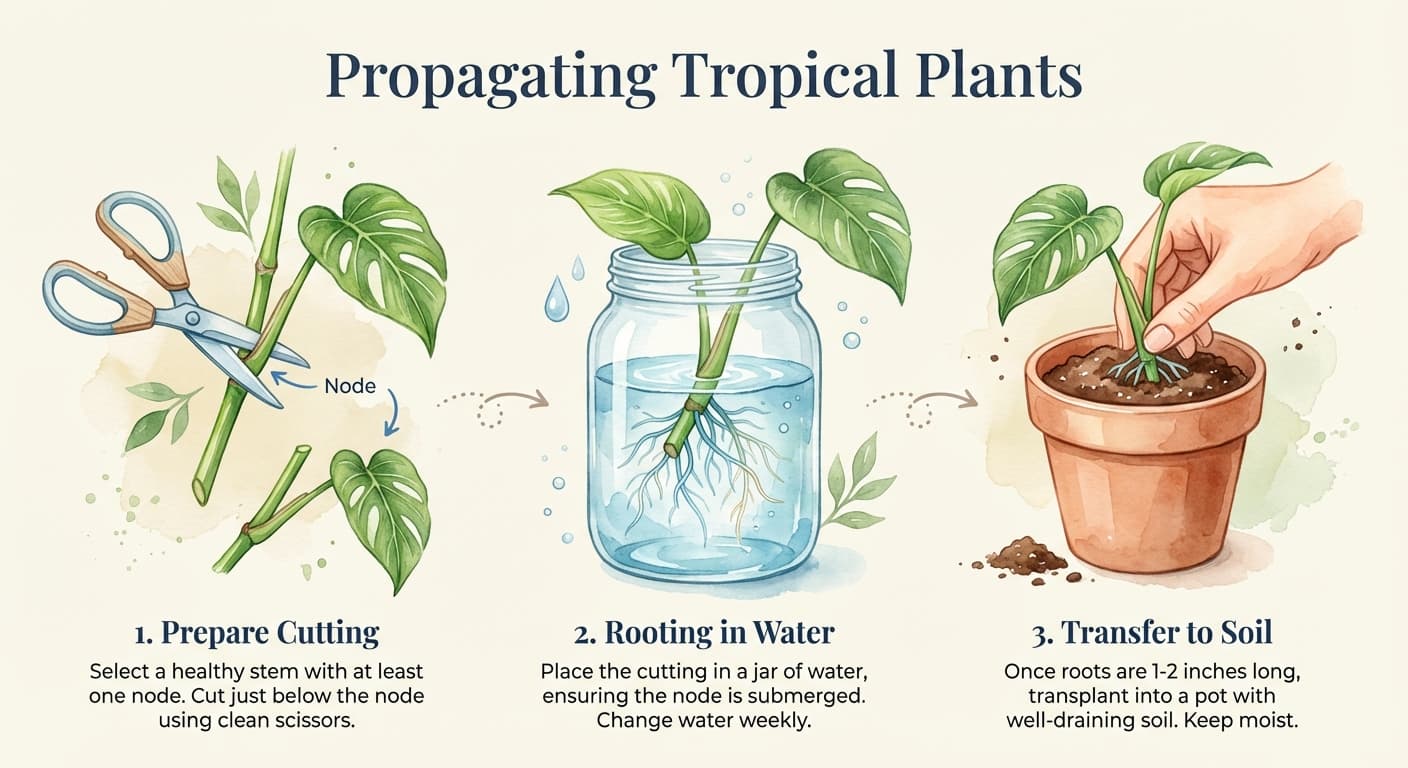
Stem Cutting in Water
The easiest method:
-
Identify a node: The bumpy ring around the stem where leaves and aerial roots emerge. Each cutting needs at least one node.
-
Make the cut: Use clean, sharp scissors or pruning shears. Cut 1-2 inches below a node.
-
Remove lower leaves: The cutting needs 1-2 leaves maximum. Remove any that would be submerged.
-
Place in water: Submerge the node (and any aerial roots) in clean water. Keep leaf above water.
-
Wait for roots: Change water weekly. Roots typically appear in 2-4 weeks.
-
Pot in soil: Once roots are 2-3 inches long, plant in appropriate soil mix.
Stem Cutting in Soil
Similar process, but plant the cutting directly in moist soil:
- Take cutting with node as described above
- Optional: Dip cut end in rooting hormone
- Plant in moist, well-draining soil with node buried
- Keep humid (cover with plastic bag or place in high-humidity area)
- Keep soil moist but not soggy
- New growth indicates successful rooting (4-8 weeks)
Air Layering
Best for large plants where you want to preserve size:
- Select a node with aerial root
- Make a small notch in the stem
- Wrap with moist sphagnum moss
- Cover with plastic wrap to retain moisture
- Wait for roots to develop in the moss (1-2 months)
- Cut below the roots and pot
For more techniques, see our tropical plant propagation guide.
Common Problems
Yellow Leaves
Lower leaves yellowing: Often natural aging. Monstera sheds old leaves as it grows. Remove cleanly at the stem.
Multiple leaves yellowing: Usually overwatering. Check soil moisture and root health. Reduce watering frequency.
Brown Leaf Tips or Edges
Causes: Low humidity, inconsistent watering, fertilizer burn, or water quality issues.
Solutions: Increase humidity, establish consistent watering, flush soil if over-fertilized, use filtered water if very hard.
Brown Spots
Crispy spots with yellow halos: Often sunburn from direct light. Move to indirect light.
Soft, brown spots: May indicate fungal or bacterial issues. Remove affected leaves, improve air circulation.
No Fenestrations
Cause: Plant is too young, or insufficient light.
Solution: Increase light, provide support, and be patient. Juvenile plants need time to mature.
Leggy Growth
Cause: Insufficient light.
Solution: Move to brighter location. Prune leggy stems and propagate cuttings.
Pests
Monstera can attract:
- Spider mites: Fine webbing, stippled leaves. Increase humidity, treat with neem oil.
- Thrips: Silver streaks on leaves. Use blue sticky traps, treat with spinosad. See our complete thrips guide.
- Scale: Brown bumps on stems. Scrape off, treat with horticultural oil.
For comprehensive pest management, see our Houseplant Pest Mastery Guide. For other problems, see our tropical plant troubleshooting guide.
Growth Timeline
Setting realistic expectations helps avoid frustration:
First Year
- Establishes in new environment (may lose a leaf or two from stress)
- Produces 3-6 new leaves
- Likely all solid or minimally split leaves if starting from small plant
- Root system develops
Years 2-3
- Growth accelerates
- Leaves begin showing splits (first often just 1-2 splits)
- Aerial roots become more prominent
- May need first repotting
- Support becomes important
Years 3-5
- Significant fenestrations develop
- Leaves reach full adult size (up to 2+ feet on deliciosa)
- Plant may reach 4-6 feet tall
- Regular repotting every 1-2 years
Mature Plants (5+ Years)
- Dramatic, highly fenestrated leaves
- Can reach 8+ feet indoors with good care
- May produce flowers (rare indoors but possible)
- May need pruning to manage size
Frequently Asked Questions
How often should I water my Monstera?
When the top 1-2 inches of soil feel dry—typically every 7-14 days, varying by conditions. Always check before watering rather than following a schedule.
Why doesn't my Monstera have splits?
Either the plant is too young (needs 2-3+ years to mature) or light is insufficient. Increase light and be patient.
Can Monstera live in low light?
It survives but doesn't thrive. Expect slow growth, small leaves, no fenestrations, and potential legginess. Monstera does best in bright indirect light.
Are Monstera toxic to pets?
Yes. Monstera contains calcium oxalate crystals that cause irritation if chewed. Keep away from curious pets or choose pet-safe alternatives.
Why are my Monstera's leaves turning yellow?
Most commonly overwatering. Yellow lower leaves can also be normal aging. Check soil moisture and root health.
Should I cut off aerial roots?
No need to remove them—they're natural and functional. If they bother you aesthetically, you can trim them, but directing them toward a moss pole is better.
How big will my Monstera get?
Indoors, Monstera deliciosa typically reaches 6-10 feet with proper care. You can manage size through pruning.
How do I make my Monstera bushier?
Prune the main stem to encourage branching. Take cuttings and plant them in the same pot for a fuller look.
Can Monstera handle direct sunlight?
Brief morning sun from east windows is usually fine. Intense afternoon sun burns leaves. Bright indirect light is ideal.
When should I repot my Monstera?
When roots circle the pot or emerge from drainage holes, typically every 1-2 years. Repot in spring for best results.
Key Takeaways
Monstera success comes down to:
- Bright indirect light: The most important factor for growth and fenestrations
- Proper watering: Let top inches dry between waterings, avoid soggy soil
- Support for climbing: Encourages larger leaves and faster maturity
- Patience: Fenestrations come with age and optimal conditions
- Consistent care: Monstera rewards regularity with vigorous growth
With these fundamentals in place, your Monstera will transform from a small starter plant into the dramatic statement piece that's made this plant an icon.
For complete tropical plant care, return to our Complete Guide to Tropical Houseplants.